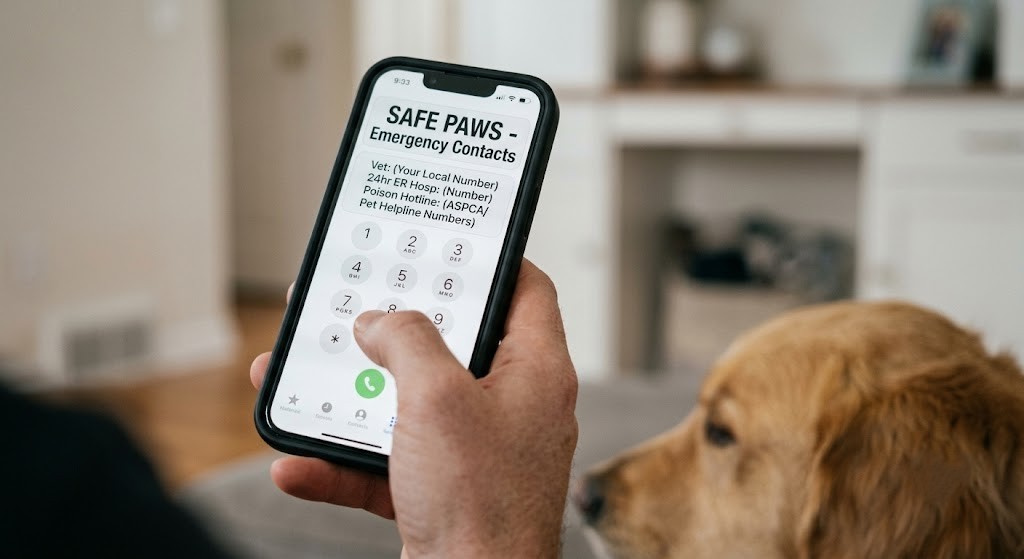
If your dog just ate something toxic, stop reading and call for help right now. Phone your veterinarian, your nearest 24-hour emergency animal hospital, or a poison hotline: the ASPCA Animal Poison Control Center at (888) 426-4435, or the Pet Poison Helpline at (855) 764-7661 (both US, 24/7, a fee may apply). Do this even if your dog looks completely fine. While the phone rings, do NOT try to make your dog vomit and do NOT give any home remedy unless a professional tells you to for that exact substance. Then gather the packaging, your dog's weight, and how much was eaten.
That paragraph is the whole answer. Everything below just walks you through it calmly, in the order it happens, so you are not making decisions from panic. Minutes matter in a poisoning, and the single most useful thing you can do is get a trained person on the phone fast.
Quick note on who is writing this. My name is Md Astafar Hossain, and I am a dog parent and a researcher, not a veterinarian. This page is general information gathered from published veterinary sources, not a diagnosis of your dog. I cannot tell you your dog is safe, and no web page can. What this guide can do is help you make a faster, better-informed call to someone who can. Please read our veterinary disclaimer too.
The 60-second version
If you have ten seconds to skim, here is the protocol:
- Take the source away from your dog and any other pets. Save it.
- Call now. Your vet, an emergency hospital, or a poison hotline. Numbers are above and repeated below.
- Do not induce vomiting unless a professional tells you to, for this substance, right now.
- Do not give milk, salt, food, or any "remedy" you read on a forum.
- Have ready: what was eaten, how much, when, and your dog's weight.
- Go in if they tell you to, and do not wait for symptoms before you call.
The rest of this page is the same six steps with the reasoning behind each one, plus the exact information a hotline will ask you for.
Minute 0 to 5: secure your dog and the evidence
Before you call, spend the first minute or two doing two physical things.
Get the source away from your dog. Move whatever was eaten, the wrapper, the plant, the pill bottle, out of reach, and check that another pet in the house is not now working on the same thing. If your dog still has some in their mouth, gently remove what you safely can. Do not put your hand into the mouth of a distressed dog if there is any risk of being bitten.
Save the evidence. This is the step panicking owners skip, and it is one of the most valuable. Keep the packet, the wrapper, the label, or the plant. Read the ingredient list before you throw anything away. A brand name and an ingredient list let a toxicologist tell the difference between "watch at home" and "come in now," and sometimes the difference between two products is the whole story. If you cannot keep the item, photograph the label and the ingredients.
Do not clean up the scene beyond keeping your dog safe. If your dog vomits on their own, that is information a vet may want to see, so do not scrub it away in a hurry.
Minute 5 to 15: who to call, and in what order
This is the step that actually changes outcomes. You have three good options, and the right one depends on the time of day and what you know.
Your own veterinarian is the best first call during opening hours. They know your dog's history and can tell you to come straight in.
Your nearest 24-hour emergency animal hospital is the call for nights, weekends, and holidays. If you do not already know that number, this is exactly the moment it costs you time you do not have, which is why the last section of this guide asks you to save it today.
A poison control hotline is staffed by veterinary toxicology specialists who do this all day, every day. They are the fastest route to a substance-specific answer.
| Service | Number | Notes |
|---|---|---|
| ASPCA Animal Poison Control Center | (888) 426-4435 | US, 24/7, a consultation fee may apply |
| Pet Poison Helpline | (855) 764-7661 | US, 24/7, a fee may apply |
Both hotlines charge for a consultation, and it is worth it. A specialist who tells you "that amount, for a dog that size, does not need a visit" has saved you a stressful night. A specialist who tells you to go in has just made sure you arrive already knowing what your dog swallowed and how much, which is time the emergency team does not have to spend guessing.
One important point: these two hotlines serve the United States. If you are reading this from another country, your own veterinarian or nearest emergency animal hospital is your fastest route to help. Our pet poison emergency page lays out the same call-order in a printable form.
What they will ask you: the information checklist
Whoever you reach will ask for the same handful of facts. Having them ready saves minutes, so read this list out loud to yourself while the phone connects, or fill it in on paper:
- What was eaten, as specifically as possible. Brand, product name, ingredient list. This is why you saved the packaging.
- How much, at the worst case. Assume the largest amount your dog could have reached, not the smallest you hope they got. It is safer to over-report than to under-report.
- How long ago it happened, as closely as you can pin it down.
- Your dog's weight. Dosage risk is calculated on body weight, so an exact number matters. If you do not know it, estimate honestly rather than guessing low.
- Your dog's age, breed, and any conditions or medications. Some breeds and some existing conditions change the picture.
- What you are seeing right now. Drooling, vomiting, wobbliness, tremors, or nothing at all. "Nothing at all" is still an answer, and you should still report it.
- A pen. Write down what they tell you, including any case number the hotline gives you. You will not remember it clearly afterward, and your vet may need it.
Minute 15 to 60: monitor at home, or go in?
You do not make this call by yourself, and you should not have to. This is exactly the decision the professional on the phone is trained to make with you, based on the substance, the amount, your dog's weight, and the time that has passed.
Here is what usually happens next. The specialist weighs the dose against your dog's body weight and tells you one of three things: this amount is not expected to cause harm and you can watch at home for specific signs, or this needs a vet visit soon, or this needs an emergency visit right now. If they want your dog seen, they may also start a case file that your vet can pull up, so the clinic is not starting from zero when you walk in.
If they advise you to travel, go without delay and bring the packaging with you. If they advise you to monitor at home, ask them exactly which signs to watch for and how long to watch, and write it down. "Keep an eye on him" is not a plan. "Watch for vomiting, unsteadiness, or lethargy over the next twelve hours and call back or come in if any appear" is a plan.
The reason this decision belongs to a professional and not to an article is simple and it is the honest center of this whole page.
The honest part: why a web page cannot do this for you
Most articles on this topic will not say this, so I will. A web page cannot replace a professional who can actually see your dog. I have never examined your pet, I do not know its exact weight or history, and I do not know precisely what was in the thing it ate. Toxicity is never a clean yes or no. The same food that a large dog shrugs off can seriously harm a small one, and with some substances the outcome turns on the exact ingredient list, not the product category.
The real danger in these moments is not that you will do the wrong thing. It is that you will lose time. You lose time searching for an open clinic at 2 a.m. You lose time reading one more article hoping it will tell you your dog is fine, when the only person who can tell you that is a professional on the phone. Being talked out of calling, by an article or by your own hope, is how people arrive at the emergency room later than they should have.
So the most useful thing this site can give you is not reassurance. It is a faster, better-prepared call to someone who can help, and the honesty to say when you have reached the limit of what reading can do. If you take one thing from this page, save three numbers in your phone today: your vet, your nearest 24-hour emergency hospital, and one of the hotlines above. That five-minute job is the best pet-safety decision on this entire site.
What NOT to do while you wait
Each of these is a common instinct, and each can make things worse.
Do not induce vomiting on your own judgment. Not with hydrogen peroxide, not with salt, not with mustard, not with anything, unless a veterinarian or a poison hotline tells you to for this specific substance, right now. The ASPCA is explicit that making a pet vomit is not always safe. If your dog swallowed something corrosive like a cleaner, a petroleum product like gasoline, a sharp object, or is already showing signs like tremors or seizures, bringing it back up can cause serious additional harm. This is a decision for a professional who knows what was eaten, not for a home remedy.
Do not give salt to make your dog vomit. Salt used this way can poison a dog on its own. It is not a safe home trick.
Do not give milk, food, or water to "dilute" it. These do not neutralize most toxins, and they can slow things down or complicate treatment. Wait for direction.
Do not follow a remedy from a forum thread. The person answering has not seen your dog and is not accountable for the outcome.
Do not wait for symptoms before you call. This is the most important one. With several common toxins, the harm begins well before a dog looks unwell, so "he seems fine" is not evidence that he is fine. A page that tells you a dose is "probably fine, just watch and see" is guessing, and guessing is the thing you called to avoid.
The most common culprits
Once your dog is safe and you have made your call, you may want to understand what your dog ate. These are among the most common things dogs get into. Each links to a fuller guide, but none of them replaces the phone call above:
- Sugar-free gum and other xylitol products. This is the one that started this whole site for me. Xylitol, a sweetener in many sugar-free gums, candies, and even some peanut butters, is dangerously toxic to dogs in small amounts. See my dog ate sugar-free gum (xylitol).
- Chocolate. Risk depends on the type of chocolate and your dog's weight. See what to do when your dog eats chocolate.
- Grapes and raisins. Even small amounts have been linked to kidney injury in some dogs. See my dog ate one grape, and, when they were baked into something, my dog ate raisins in a cookie.
- Onions and garlic. These damage red blood cells, and the effect can appear over days. See my dog ate onions.
Every guide in this cluster
Each of these is one part of the same emergency, and none of them replaces the phone call above.
The substances
- My dog ate one grape: why even one is treated as an emergency
- My dog ate raisins baked into something
- My dog ate chocolate: what to do now and what the vet will ask
- My dog ate sugar-free gum
- My dog ate onion or garlic: why the danger shows up days later
The questions that stop people calling
- He seems fine: why a normal-looking dog can still be in serious trouble
- Why you must never make a dog vomit on your own judgment
- What to take with you to the emergency vet
Prepare before it ever happens
Everything above is easier if you did five minutes of prep on a calm day. Right now, while nothing is wrong:
- Save three numbers in your phone: your vet, your nearest 24-hour emergency animal hospital, and one poison hotline from the table above.
- Write your dog's current weight in a note in your phone, and update it after each vet visit.
- Know your night route to the emergency hospital before you ever have to drive it.
The night my own dog ate that gum, we lost time we could not get back searching for a clinic that was open. Five minutes now buys those minutes back when they are worth the most.
Frequently asked questions
My dog ate something but he seems totally fine. Do I still need to call?
Yes. With several common toxins, harm starts before a dog shows any signs, so looking fine is not proof of being fine. Call your vet or a hotline and let a professional decide whether "watch at home" is safe for this specific substance and amount. This page cannot make that call for you.
Can I just make my dog throw up at home to be safe?
No, not on your own judgment. For some substances, vomiting causes serious extra harm, and the ASPCA states that inducing vomiting is not always safe. Only do it if a veterinarian or a poison hotline instructs you to, for that exact substance, right now. Call first, always.
Is it worth paying for a poison hotline instead of just waiting?
For a substance-specific answer at 2 a.m., the hotlines staffed by veterinary toxicologists are often the fastest expert help available. A consultation fee may apply, and it is generally money well spent: they can tell you whether you need an emergency visit at all, and if you do, your vet can work from the case they open.
How long do I have to act after my dog eats something toxic?
Sooner is always better, and you should not wait to see what happens. Some interventions are far more effective in the first hour or two, which is another reason to call immediately rather than monitor and hope. The professional you reach will factor in how long ago it happened.
Which number should I call first?
During opening hours, your own veterinarian, because they know your dog. Nights and weekends, your nearest 24-hour emergency animal hospital. For an immediate answer about a specific substance any time of day, a poison hotline: ASPCA Animal Poison Control Center at (888) 426-4435 or Pet Poison Helpline at (855) 764-7661 (US, 24/7, a fee may apply).
Safe Paws is written by Md Astafar Hossain, a dog parent and researcher, not a veterinarian. This is general information, not veterinary advice, and it cannot diagnose or treat your pet. Please read our full veterinary disclaimer. We cite the ASPCA, the Pet Poison Helpline, and the Merck Veterinary Manual because they are who the veterinary community points to, and we are not affiliated with any of them. If anything here conflicts with your own veterinarian, listen to your veterinarian.