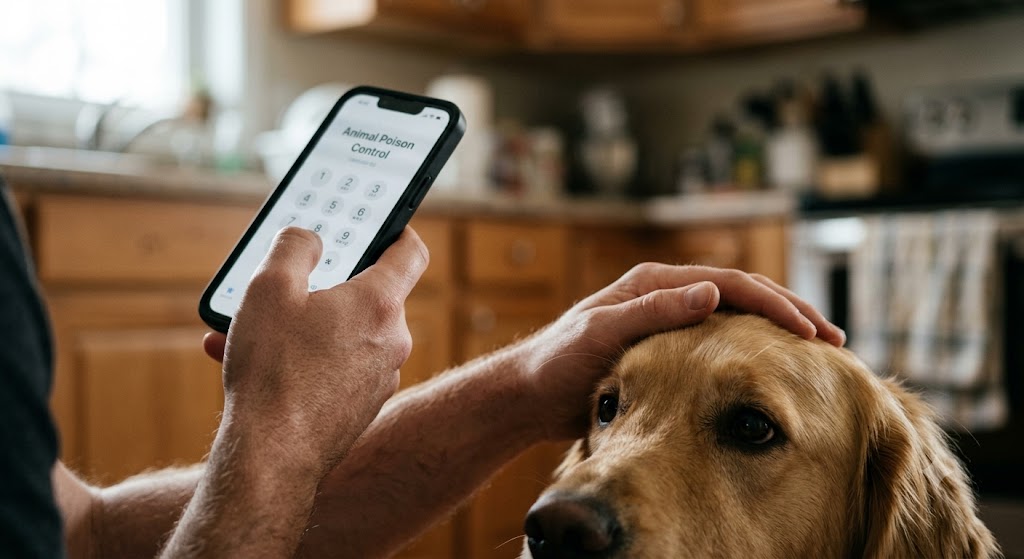
If your dog just ate a grape, even a single one, call your veterinarian or an animal poison control hotline right now: ASPCA Animal Poison Control Center at (888) 426-4435 or Pet Poison Helpline at (855) 764-7661, both open 24 hours a day. Do not wait to see whether your dog gets sick, and do not try to make your dog vomit at home unless a vet or one of these hotlines tells you to for this exact situation. There is no known safe number of grapes for a dog. The same grape that passes through one dog with no harm can trigger kidney failure in another, so the only safe move is to make the call now.
This page exists to help you talk to that professional faster and with better information. It is general information from published veterinary sources, not veterinary advice, and it cannot examine your dog. Please read our veterinary disclaimer so you know exactly what this page is and is not.
The short version: call, do not "wait and watch"
Here is the reasoning behind that first paragraph, because "just one grape" feels like it should be fine and it may not be.
Grapes, raisins, and currants can cause acute kidney injury in dogs. The dangerous part is the timing. A dog that ate a grape can look completely normal for a day or more while damage builds silently in the kidneys. By the time the dog looks unwell, treatment is harder and the outcome is worse. Waiting for symptoms is the one clearly wrong move, because the window where treatment works best is the first few hours, before the dog shows anything at all.
Calling costs you a phone call. Waiting can cost a kidney. That trade is the whole reason vets and poison hotlines say to call for any grape ingestion, not just a large one.
Why there is no "safe number of grapes"
For years no one knew what in a grape hurt dogs. That changed when the ASPCA Animal Poison Control Center identified tartaric acid as the likely toxic component. Tartaric acid is what gives grapes their tart taste, and it appears to damage the kidneys in dogs that cannot clear it well.
Two facts from that finding explain why no vet will give you a safe dose:
- The amount of tartaric acid in grapes varies enormously. The ASPCA reports the concentration ranges from about 0.35% to 2% depending on the grape variety and how ripe it is. One grape is not a fixed dose. Two grapes off different vines can carry very different amounts of the actual toxin.
- Individual dogs vary in sensitivity. Some dogs eat grapes with no apparent effect. Others develop kidney injury after a small amount. There is no reliable way to know in advance which kind of dog yours is.
Put those together and you get the honest answer the search results tend to skip: "one grape" is not a measured, safe dose. It is an unknown dose of a toxin whose strength changes grape to grape, given to a dog whose sensitivity you cannot predict. That is precisely why the guidance is to call, not to calculate.
There is no established safe dose of grapes or raisins for dogs, and serious kidney injury has been documented after small amounts. Treat any grape or raisin ingestion as a reason to call a professional. (Reported by the ASPCA and Pet Poison Helpline.)
Hour by hour: what happens after a dog eats a grape
This timeline is drawn from the Merck Veterinary Manual and poison-control guidance. Your dog will not necessarily follow it, which is the point: the early hours can look like nothing.
| Time after eating | What is happening | What matters for you |
|---|---|---|
| 0 to 2 hours | The grape is still in the stomach or early digestion. This is the decontamination window. | This is when a vet may induce vomiting or give activated charcoal to remove the grape before the body absorbs it. Getting on the phone now is what protects this window. |
| 6 to 12 hours | The earliest signs, if they appear, are usually vomiting or diarrhea. Some dogs also show lethargy, reduced appetite, or belly pain. | Many dogs show nothing here. A calm-looking dog is not proof of safety. |
| 24 to 72 hours | This is the silent, dangerous window. Kidney injury can develop now, sometimes with reduced or no urine output. Vets track this with bloodwork (kidney values like creatinine). | Even a dog that seemed fine can start failing here. This is why vets often want bloodwork at intervals, not a single "he's fine" check. |
The takeaway from the table: the moment you feel most reassured (the dog acting normal in the first day) is exactly the moment the guidance says not to trust.
"But my dog seems totally fine"
This is the most common reason people talk themselves out of calling, so it deserves a direct answer.
A dog looking and acting normal in the hours after eating a grape tells you almost nothing about the risk to the kidneys. The Merck Veterinary Manual describes kidney failure developing 24 to 72 hours after exposure, well after the dog first appeared unaffected. "Seems fine" is expected early. It is not the all-clear.
If your dog seems fine, that is genuinely good, and it may stay that way. It is simply not information you can safely act on by staying home. Make the call and let a professional decide whether your specific dog, at your specific timing, needs to be seen.
Grape vs raisin vs juice vs jam: does the form change the risk
The form changes the concentration, not the rule. In every case below, the rule is the same: call.
- Raisins are dried grapes, so the toxic component is more concentrated by weight. A small number of raisins can represent more tartaric acid than the same number of fresh grapes. Raisins are a common hidden source in trail mix, cookies, and baked goods.
- Grape juice, jam, and jelly contain grape material and should be treated as a potential exposure. Tell the hotline what the product was and roughly how much.
- A found, chewed stem or an unknown amount counts as an ingestion. If you cannot rule it out, call and say so honestly. "I am not sure how many" is a normal, useful thing to tell poison control.
A quick note on other size and type questions people ask: a large dog is not automatically safe because it is big, and "seedless" or "peeled" or "organic" grapes are not known to be safer. None of those change the core problem, which is an unpredictable dose of tartaric acid.
What the vet or hotline will actually do
Knowing what happens next removes some of the fear that keeps people from calling.
On the phone, poison control or your vet will typically ask: what was eaten (grape, raisin, product), roughly how much, how long ago, and your dog's weight and health history. Having those ready makes the call faster. Be honest about the numbers you are unsure of.
If the exposure is recent, the vet may induce vomiting in the clinic to bring the grape back up, and may give activated charcoal to reduce further absorption. Do not do either of these at home on your own judgment. Inducing vomiting the wrong way, or for the wrong substance, can cause its own harm, which is why the instruction has to come from a professional for this specific case.
If time has passed or risk is significant, the plan usually centers on IV fluids to support the kidneys and flush the system, along with bloodwork to watch kidney values over the following days. Merck describes aggressive IV fluid therapy for a minimum of about 48 hours in significant ingestions. The earlier this starts, the better it tends to work.
Yes, an emergency visit costs money, and that is often the quiet reason people hesitate. It is a fair worry to name. But the cheapest version of this whole situation is the early phone call, because the early decontamination window is also the one where a big, expensive kidney crisis is most likely to be avoided.
Symptoms that mean go now
If any of these appear at any point, do not wait for your next scheduled check, get to a vet or emergency animal hospital immediately:
- Vomiting or diarrhea
- Unusual tiredness, weakness, or hiding
- Loss of appetite or refusing food
- Belly pain, or a hunched, uncomfortable posture
- Increased thirst
- Peeing much more, much less, or not at all
The absence of these signs is not a reason to relax. Their presence is a reason to move faster.
The honest part
Most "my dog ate a grape" pages want to either scare you or soothe you. Here is the plain version.
We cannot tell you your dog will be fine, and we cannot tell you your dog is in danger. Nobody writing an article can, because the two things that decide the outcome, the exact tartaric acid load in that grape and your individual dog's sensitivity, are both unknown from where you are sitting. That uncertainty is not a reason to panic. It is a reason to route the decision to the one person who can narrow it down: a vet or a poison-control specialist who can factor in your dog's weight, the timing, and the amount.
Being cautious here costs you a phone call and maybe an inconvenient evening. Being wrong in the other direction can cost a kidney or a life. When the downside is that lopsided, you make the call. That is the entire message of this page.
Related emergency guides
- What to do in the first 60 minutes after your dog eats something toxic
- How much chocolate is toxic to dogs
- My dog ate sugar-free gum: the xylitol emergency
FAQ
My dog ate one grape and is a 70-pound dog. Is he too big to be affected?
No. Body size does not make a dog safe from grapes. Because the toxic dose is unpredictable and sensitivity varies dog to dog, veterinary sources advise calling for any ingestion regardless of the dog's weight. Call your vet or a poison hotline and let them weigh the specifics.
My dog ate a grape yesterday and seems fine. Do I still need to worry?
Contact a vet or poison hotline and tell them the timing. Kidney injury from grapes can develop 24 to 72 hours after eating, so "yesterday and seems fine" is still inside the window where a professional may want to check bloodwork. A normal-acting dog is not proof the kidneys are unharmed.
Are seedless or peeled grapes safer for dogs?
There is no evidence that seedless, peeled, or organic grapes are safe for dogs. The suspected toxin, tartaric acid, is in the grape itself, so removing seeds or skin does not remove the risk. Treat any grape the same way: call.
Should I make my dog throw up at home?
Not on your own. Only induce vomiting if a veterinarian or a poison hotline tells you to for this specific situation, right now. Doing it the wrong way, or when it is not appropriate, can cause additional harm. The safe first step is always the phone call.
What is the toxic component in grapes for dogs?
The ASPCA Animal Poison Control Center identified tartaric acid as the likely toxic component. Its concentration varies widely between grapes (roughly 0.35% to 2%), which is a key reason there is no known safe dose and why any ingestion warrants a call.
This article is general information gathered from published veterinary sources, including the ASPCA Animal Poison Control Center, Pet Poison Helpline, and the Merck Veterinary Manual. It is not veterinary advice and does not replace an examination by your own veterinarian. Written by Md Astafar Hossain, a dog parent and researcher, not a veterinarian. In an emergency, call your vet, the ASPCA Animal Poison Control Center at (888) 426-4435, or Pet Poison Helpline at (855) 764-7661.