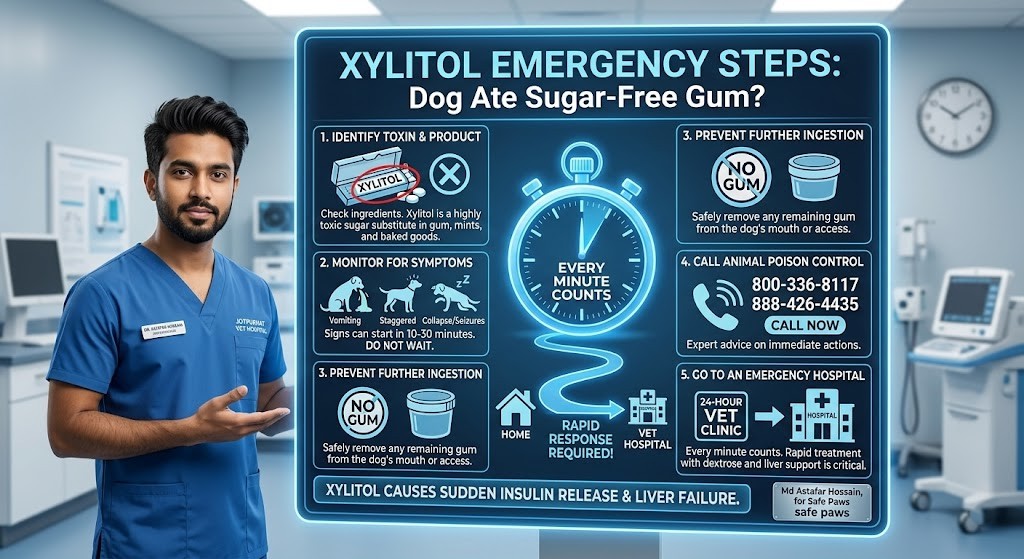
If your dog just ate sugar-free gum, treat it as an emergency and call for help right now. Call your veterinarian, the nearest 24-hour emergency animal hospital, the ASPCA Animal Poison Control Center at (888) 426-4435, or the Pet Poison Helpline at (855) 764-7661. Many sugar-free gums contain xylitol, one of the fastest-acting common poisons for dogs, and it can drop a dog's blood sugar dangerously within 10 to 60 minutes. Do not wait for symptoms. Do not induce vomiting unless a vet or poison control tells you to. Check the gum's ingredient label now while you call.
This is a call-now situation, not a wait-and-watch one. Xylitol acts fast, it is dangerous at very small amounts, and a dog can look completely normal in the minutes before its blood sugar crashes. The most useful thing you can do while the phone rings is read the ingredient panel on the pack, because whether the gum contains xylitol changes everything the vet does next. For the full first-hour playbook that applies to any suspected poisoning, see our guide on what to do in the first 60 minutes after your dog eats something toxic.
First, check the label: is there xylitol in it?
Pick up the gum wrapper or pack and read the ingredients. You are looking for xylitol, but it hides under other names. On a label it may be written as:
- Birch sugar or birch bark extract
- Wood sugar
- Sugar alcohol (a general category that can include xylitol)
- E967 (a European additive code)
If you see any of those, tell the vet or the hotline. If the ingredient list is worn off or you threw the pack away, do not spend long hunting for it. Assume xylitol is present, call anyway, and bring or photograph whatever packaging you can find. The people on the phone would rather act on a "maybe" than lose time.
Two very different situations sit behind the same phrase "my dog ate gum," so it helps to know which one you are in:
- Sugar-free gum almost always means a possible xylitol poisoning. This is the urgent, time-sensitive emergency this guide is about.
- Regular, sugared gum is mainly a swallowed-object question (a choking or blockage risk, especially with a whole pack or foil), not a xylitol one. We cover that further down.
When in doubt, treat it as the xylitol scenario and call.
A note from Safe Paws, honestly
Safe Paws exists because of this exact emergency. In 2022, my own dog, Robin, got into sugar-free gum. That day, and the four years of reading veterinary sources that followed, are the reason this site is here. I am a dog parent and a researcher, not a veterinarian, so nothing below is a diagnosis or a substitute for the call you are making right now. You can read more about that day and why every claim here is sourced on our About page, and our full veterinary disclaimer explains the limits of any web page in a poisoning. The point of this article is to help you make a faster, better-informed call to a professional, not to replace it.
What xylitol actually does to a dog
Xylitol is a sugar substitute. In people it is harmless. In dogs, the body mistakes it for real sugar and releases a large surge of insulin, which pulls blood sugar down hard. There are two separate dangers, and they happen on different clocks.
1. Hypoglycemia (a rapid, dangerous drop in blood sugar). This is the first and most common effect. According to the Merck Veterinary Manual and Pet Poison Helpline, signs can appear within about 15 to 30 minutes, and generally within the first hour. A dog with crashing blood sugar may become weak, wobbly, or lethargic, may vomit, and in severe cases can have tremors, seizures, collapse, or slip into a coma.
2. Liver injury (a slower, sometimes delayed danger). At higher doses, xylitol can cause severe liver damage. The Merck Veterinary Manual notes this can show up roughly 24 to 48 hours after ingestion, sometimes without an obvious blood-sugar crash first. This is one reason a dog that "seemed fine" still needs to be seen: some harm begins before the dog looks sick, and some appears a day or two later.
There is no home antidote for either problem. That is exactly why this is a phone-a-professional emergency rather than something to manage at the kitchen counter.
How much is dangerous for your dog
Here is the honest, uncomfortable truth: it takes very little. Veterinary sources place the threshold for hypoglycemia at roughly 100 mg of xylitol per kilogram of body weight (about 45 mg per pound), and the threshold associated with liver injury much higher, at roughly 500 mg/kg (about 227 mg per pound), per the Merck Veterinary Manual and Pet Poison Helpline.
The problem is the amount per piece of gum. Pet Poison Helpline and VCA Animal Hospitals report that a single piece of gum or a mint can contain anywhere from about 0.22 to 1.0 gram of xylitol, and some gums that are sweetened almost entirely with xylitol run higher still. That range is enormous, which is why you cannot eyeball this at home.
To make it concrete, here are worked examples using the 100 mg/kg hypoglycemia threshold. Treat these as illustrations of how little it takes, not as a "safe amount," because the amount per piece varies by product and formulations change:
| Dog's weight | Rough hypoglycemia threshold (~100 mg/kg) | What that can mean in gum |
|---|---|---|
| 5 kg (about 11 lb) | ~500 mg (0.5 g) xylitol | A single piece of high-xylitol gum can be enough |
| 10 kg (about 22 lb) | ~1,000 mg (1 g) xylitol | Roughly one to a few pieces |
| 25 kg (about 55 lb) | ~2,500 mg (2.5 g) xylitol | A few pieces can reach it |
Notice what this means: even a large dog can hit the danger threshold from a handful of pieces, and a small dog from just one. There is no dose this article can call "fine," and no home math you should rely on. Report the dog's weight, the product name, and your best guess of how many pieces are missing, and let the vet do the calculation.
Which gum brands contain xylitol
There is no way to give a list you can trust forever, because manufacturers change formulas and the same brand name can cover products with and without xylitol. Use the names below as a "check your specific pack" prompt, not as a final answer, and always read the label.
Gums commonly reported to use xylitol include lines from Trident, Orbit, Ice Breakers Ice Cubes, and PÜR (marketed as sweetened with xylitol). Some products under these same names use other sweeteners instead, such as sorbitol, maltitol, or aspartame. That inconsistency is the whole point: the brand on the front tells you far less than the ingredient list on the back.
Brand and per-piece information verified against manufacturer labels, Pet Poison Helpline, and VCA on 2026-07-20. Formulations change without notice, so read your own pack.
Xylitol hides in more than gum
If your dog got into gum, it is worth knowing where else this ingredient turns up, because Pet Poison Helpline reports poisonings from non-gum sources are rising. Xylitol (or "birch sugar") commonly appears in:
- Sugar-free mints, candies, and chocolate
- Some peanut butters and nut butters (brands that have used it include Go Nuts, Co., Nuts 'N More, No Cow, Krush Nutrition, and P28, so check any jar before you share it)
- Baked goods and "keto" or "diet" snacks
- Chewable vitamins and some medications
- Toothpaste and mouthwash
- Some nasal sprays and flavored syrups
The peanut butter one catches many owners off guard, because peanut butter is the classic "hide the pill" treat. Read that jar the same way you just read the gum pack.
Signs to watch for and report
While you are getting help, note anything you see so you can describe it accurately. Report to the vet or hotline if your dog shows:
- Weakness, wobbliness, or trouble standing
- Sudden lethargy or acting "off"
- Vomiting
- Tremors or shaking
- Seizures or collapse
Important: the absence of symptoms does not mean your dog is safe. With xylitol, the crash can come suddenly, and liver signs can lag by a day or more. "He seems normal" is a reason to call, not a reason to skip the call.
What the vet will do
There is no antidote for xylitol, so treatment is about catching and controlling the effects early. Based on VCA Animal Hospitals and the Merck Veterinary Manual, care typically involves:
- Blood-sugar monitoring and intravenous dextrose (sugar) to correct or prevent hypoglycemia
- Liver-value monitoring with blood tests, often over 24 to 72 hours, since liver injury can be delayed
- Supportive care, such as IV fluids and, in some cases, liver-protective medication
Inducing vomiting is sometimes done, but only by professionals who decide it is appropriate for the timing and the dog. This is another reason not to try it at home. For the same reason we walk through in our guides on how much chocolate is toxic to dogs and what to do if your dog ate a grape, the safe move is to let the vet choose the intervention.
If your dog ate regular, sugared gum instead
If you checked the label and there is no xylitol (and no other sugar substitute you cannot identify), the worry shifts. Ordinary gum is not metabolically toxic, but a large wad, a whole pack, or swallowed foil and wrappers can pose a choking or intestinal blockage risk, especially in small dogs. Watch for repeated vomiting, straining, a painful belly, or loss of appetite over the next day or two, and call your vet if any of those appear. When you are not sure whether the gum was sugar-free, treat it as the xylitol scenario and call.
How dogs actually get into gum (and how to prevent the next scare)
Almost every gum emergency traces back to the same few spots. Dogs find gum in handbags and backpacks left on the floor, coat and pants pockets, car cup holders and door pockets, and nightstands or coffee tables. Prevention is mostly about height and closure: keep gum, mints, and sugar-free candy zipped away and up off the ground, and be especially careful with guests and kids who may not know the risk. Check the peanut butter jar too, before it becomes a treat.
FAQ
My dog ate one piece of gum hours ago and seems totally fine. Do I still need to call?
Yes, call anyway. A dog can appear normal before its blood sugar drops, and xylitol-related liver injury can show up 24 to 48 hours later. "Seems fine" is not the same as "is fine," and the hotline can tell you whether monitoring at home or a vet visit is right for your dog's size and the amount involved.
How do I know if the gum even had xylitol?
Read the ingredient list on the pack. Look for xylitol, birch sugar, birch bark extract, wood sugar, sugar alcohol, or the code E967. If you cannot find the packaging, assume it may contain xylitol and call for guidance rather than guessing.
Is xylitol in peanut butter really a risk for dogs?
It can be. Most peanut butter is fine, but a growing number of "sugar-free" or protein-focused brands use xylitol, and peanut butter is often used to hide pills or fill toys. Always read the jar before sharing it with your dog.
Should I make my dog throw up at home?
No, not on your own. Do not induce vomiting with hydrogen peroxide, salt, or anything else unless a veterinarian or poison-control expert tells you to for this exact situation. For some ingestions, vomiting causes more harm, and timing matters.
Is xylitol dangerous to cats too?
Current veterinary sources report xylitol toxicity is well documented in dogs and far less understood in cats. If a cat has eaten a xylitol product, do not assume it is safe. Call your veterinarian or a poison hotline for advice.
This article is general information from a dog parent and researcher, sourced from the FDA, the Merck Veterinary Manual, Pet Poison Helpline, and VCA Animal Hospitals. It is not veterinary advice. In an emergency, always call your veterinarian, the ASPCA Animal Poison Control Center at (888) 426-4435, or the Pet Poison Helpline at (855) 764-7661. See our full veterinary disclaimer. Sources verified 2026-07-20.