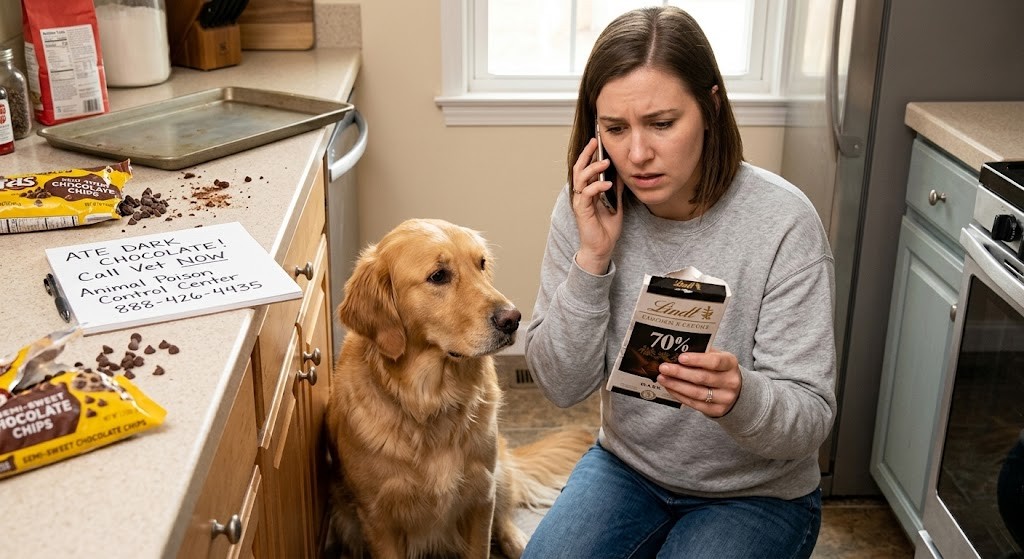
Call for help now, before you finish reading. Phone your own veterinarian, your nearest 24-hour emergency animal hospital, the ASPCA Animal Poison Control Center at (888) 426-4435, or the Pet Poison Helpline at (855) 764-7661. Both hotlines are US-based, staffed around the clock, and a consultation fee may apply. Do not make your dog vomit and do not give any home remedy unless a veterinarian or a poison-control specialist tells you to, for this exact product, right now. Our pet poison emergency page has the same call order in one place.
While the phone rings, do one thing: find the packaging and keep it. It is the single object most likely to change what happens next.
This page is general information gathered from published veterinary sources. It is not veterinary advice, it cannot examine your dog, and it cannot tell you whether your dog is safe. Please read our veterinary disclaimer.
The number this page does not give you
Most of the results for this search answer a different question than the one you asked. They answer "how much chocolate is toxic to a dog," and they answer it with a threshold, a chart, or a calculator you type your dog's weight into.
This site publishes no dose, no threshold and no weight-based calculation for any substance, and that is deliberate rather than an oversight. There is no number on this page you can measure your dog against, because the arithmetic those pages invite is arithmetic you cannot do correctly from where you are standing, and the version of it that goes wrong is the version where a frightened owner talks themselves out of a phone call.
What this page gives you instead is the thing that actually moves your evening forward: what a veterinarian or a poison-control specialist is about to ask you, and why each answer matters. Have those ready and the call takes two minutes rather than ten.
What the vet or the hotline will ask you
Expect these, roughly in this order. Answer honestly, including the parts you are unsure of. "I do not know" is a useful answer and they hear it constantly.
- What was it, exactly? Not "chocolate." The product. Read the front of the wrapper to them, and the ingredient list if you still have it. Cocoa powder, baking chocolate, a filled candy bar and a chocolate-flavored cereal are four different conversations.
- How much, at worst case? Round up, not down. The amount missing from the wrapper is not always the amount eaten, and a dog that got into a box may have eaten more than the empty spaces suggest.
- How long ago? A best estimate is fine. If you found the mess rather than watching it happen, say so and give the window: "sometime between six and nine this morning."
- How much does your dog weigh? Their real weight, not last year's. If you do not know, say approximately, and say the breed.
- How old is your dog, and is there anything else going on? Existing conditions, and every medication or supplement they are on.
- What are you seeing right now? Including nothing. "He is behaving completely normally" is information, not an admission that you are wasting their time.
- Was anything else in it? This is the question people forget. Chocolate-covered raisins, macadamia nuts, espresso beans and sugar-free chocolate each add a separate problem on top of the chocolate, and the second problem is sometimes the more urgent one.
Write down what you are told, including any case number the hotline gives you. If you end up at a clinic, that number lets the veterinary team talk to the same specialist about the same case.
Why you cannot score this yourself
The charts exist. They are real tools, and veterinary teams and poison-control specialists genuinely use them. The reason they work in a clinic and fail in a kitchen is that a professional feeds them three verified values, and you would be feeding them three guesses.
You rarely know the product. "Dark chocolate" covers an enormous range, a homemade brownie could have been made with cocoa powder or with milk chocolate chips, and the plain paper bag of baking cocoa in the back of the cupboard is not the item most people would point to as the dangerous one.
You rarely know the amount. Dogs eat fast and they eat the wrapper. What is left on the floor is evidence of what was not eaten, which is not the same thing.
Dogs differ from each other. Veterinary sources are explicit that sensitivity varies between individual animals and that serious signs have been recorded in cases where the expected pattern said otherwise. A rule that holds on average does not tell you which dog is in front of you.
Three guesses in, a chart can produce a reassuring answer for a dog that ate something entirely different from what you assumed. That is not a small error at the margin. It is the whole result.
Why the type of chocolate matters more than the size of the bar
This part is worth understanding, because it is the piece most owners have backwards and it changes what you tell the hotline.
Chocolate contains theobromine and a smaller amount of caffeine, both stimulants in a family called methylxanthines. The danger tracks how concentrated the cocoa is, not how big or how expensive the item looked. In descending order of concentration, veterinary sources rank them roughly like this:
- Cocoa powder and unsweetened or baking chocolate, the most concentrated
- Dark and semisweet chocolate
- Milk chocolate, less concentrated but still a genuine exposure in quantity
- White chocolate, which contains very little theobromine
The consequence: a small amount of baking chocolate or cocoa powder can matter more than a much larger amount of milk chocolate. The frightening-looking candy bar is often the less concentrated item, and the plain bag of cocoa in the pantry is often the one worth calling about first. When you describe the product, lead with how dark and how cocoa-heavy it was.
Why "he seems completely fine" is exactly what you would expect
This is the reason people wait, and it is worth being direct about it.
Signs of chocolate toxicity are usually delayed by several hours rather than immediate, so a dog behaving normally in the first hour is behaving the way an affected dog would behave in the first hour. The absence of symptoms early tells you almost nothing about what happens tonight.
There is a second reason the timeline stretches. Dogs clear theobromine far more slowly than people do. The Merck Veterinary Manual reports a half-life in dogs of roughly 17.5 hours, against a few hours in humans, which is why an affected dog can be unwell for a day or more from a single mistake and why treatment is sometimes about supporting a dog through a long clearance rather than fixing something quickly.
So "he seems fine" is a good thing and it is not the all-clear. We wrote a whole page on this reflex, because it is the single most common reason a treatable ingestion becomes a hospital case: why a dog that seems fine can still be in trouble.
What to watch for while you are waiting for the call
Report anything you see, and report it as a description rather than a conclusion. Veterinary sources describe early signs as things like restlessness, unusual thirst and urination, and vomiting or diarrhea, with a racing or irregular heartbeat, tremors, unsteadiness and seizures appearing in more serious cases.
Two things about that list. It is a reason to call, not a checklist to decide with, and nothing on it needs to appear before you make the call. If any of it does appear, stop waiting and go in.
What the emergency team may actually do
Knowing this takes some of the fear out of the phone call.
There is no antidote for theobromine, so care is about limiting what gets absorbed and supporting the dog while the rest clears. Depending on timing and amount, that can mean decontamination in the clinic, activated charcoal, intravenous fluids, and monitoring of the heart and the nervous system, sometimes over more than one day.
Decontamination is their decision and their procedure, not yours. That is not a formality. For several common household substances, bringing material back up causes a second injury on the way, which is why we published a page that gives no method for it at all.
If you are told to come in, take these things with you, and take the packaging.
The genuinely lower-risk cases
Being honest about low risk is part of being useful, so here it is.
White chocolate contains very little theobromine, so theobromine poisoning from it is unlikely. The fat and sugar can still upset a dog's stomach, and in susceptible dogs fatty foods carry their own risk. Carob, the chocolate look-alike used in dog treats, contains no theobromine at all. Chocolate-flavored cereals and biscuits are usually very low in real cocoa.
None of that means ignore it. It means these are more likely a stomach problem than a theobromine problem, and if you are certain of the product that is a reasonable and useful thing to say on the call. Let them close the case rather than closing it yourself.
Related emergency guides
- What to do in the first 60 minutes after your dog eats something toxic
- Why a dog that seems fine can still be in trouble
- Why you must never make a dog vomit on your own judgment
- What to take with you to the emergency vet
Frequently asked questions
How much chocolate is toxic to a dog?
This site does not publish that figure, in any unit, for any substance. The honest reason is that the answer depends on the exact product, the true amount, and your individual dog, and a number read off a web page invites a calculation with three guesses in it. A veterinarian or a poison-control specialist can work it out with you on the phone in minutes, using values they have verified rather than estimated. Call them, describe the product and round the amount up.
My dog ate chocolate last night and seems fine this morning. Is he safe?
That is genuinely encouraging and it is not proof. Signs are usually delayed, and dogs clear theobromine slowly, so the timeline runs long. Call with the timing anyway and let a professional decide whether your dog is past the point of concern. "Seems fine overnight" is one of the facts they weigh, not the conclusion.
Is dark chocolate worse for dogs than milk chocolate?
Yes. The danger tracks how cocoa-heavy the product is, so baking chocolate, cocoa powder and dark chocolate carry more of the compound than milk chocolate does for the same amount of product. When you call, describe how dark it was and read the packaging out if you have it.
My dog ate a brownie. Is that a lot?
Nobody can tell you from here, and that is not a dodge. A brownie can be made with cocoa powder, with baking chocolate or with milk chocolate chips, and those are meaningfully different exposures behind an identical word. Say "a homemade brownie, I do not know what chocolate was in it" on the call. Being uncertain out loud is more useful than guessing confidently.
Should I make my dog throw up after chocolate?
Not on your own judgment, and not from anything you read online. Whether it helps or harms depends on the substance, the timing and the state your dog is in, and for several common household products it causes a second injury. Call first and follow the instruction you are given for this specific case.
My dog only licked some chocolate icing. Do I still need to call?
Call anyway. It is a short conversation, it costs you nothing but the time, and specialists tell owners that no visit is needed more often than people expect. The call is also where the second question gets asked, which is what else was in it, and that is the one that occasionally changes the answer.
Safe for Paws is written by Md Astafar Hossain, a dog parent and researcher, not a veterinarian. This is general information gathered from published veterinary sources including the ASPCA Animal Poison Control Center, the Pet Poison Helpline and the Merck Veterinary Manual. It is not veterinary advice, it is not a set of instructions, and it cannot diagnose or treat your pet. Please read our full veterinary disclaimer. If anything here conflicts with your own veterinarian, listen to your veterinarian. In an emergency, call your vet, the ASPCA Animal Poison Control Center at (888) 426-4435, or the Pet Poison Helpline at (855) 764-7661.