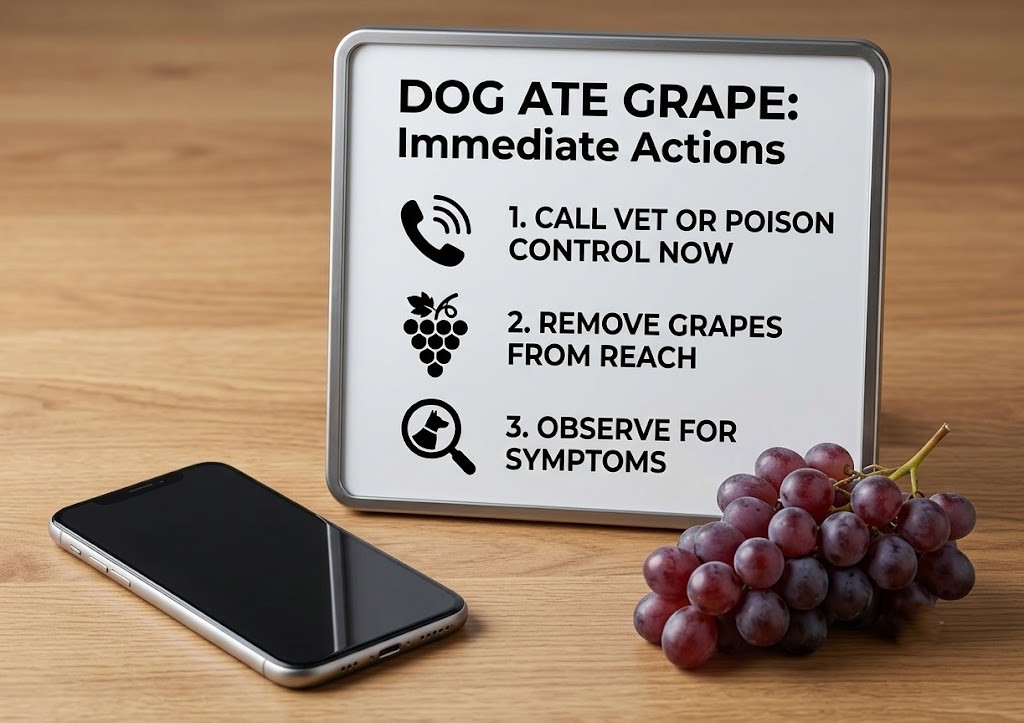
If your dog has eaten something toxic, call for help now rather than trying to bring it back up. Phone your own veterinarian, your nearest 24-hour emergency animal hospital, the ASPCA Animal Poison Control Center at (888) 426-4435, or the Pet Poison Helpline at (855) 764-7661. Both hotlines are US-based, staffed around the clock, and a consultation fee may apply. Do not attempt to make your dog vomit and do not give any home remedy unless a veterinarian or a poison-control specialist instructs you to, for this exact substance, right now. Our pet poison emergency page has the same call order in one place.
This page exists to talk you out of one specific action, so it is worth being direct about what it is and is not. It is general information gathered from published veterinary sources. It is not veterinary advice, it cannot examine your dog, and it is not a set of instructions for anything. Please read our veterinary disclaimer.
The short answer, and why this page gives you no method
The answer to the question in the title is no, not on your own judgment, and not from anything you read online, including this page.
You will have noticed that most of the results for this search do the opposite. They give a household substance and an amount worked out by body weight, usually with a warning underneath the instructions. One of the pages ranking today is titled around a dosage table.
This page publishes no substance, no method and no amount, and that is deliberate rather than an oversight. Not hydrogen peroxide, not salt, not mustard, not anything else that circulates for this. There is no quantity here, no procedure here, and nothing on this page can be followed as a recipe.
The reason is not squeamishness. It is that the decision this page would be helping you make is one you do not have the information to make, and the rest of this article is the argument for that.
Four situations where making a dog vomit causes serious harm
Bringing a swallowed substance back up is not a neutral act with an upside. It is a procedure, and there are well-documented categories where it makes the outcome substantially worse.
Guidance published by the ASPCA Animal Poison Control Center on decontamination describes emesis as contraindicated in situations including these.
1. Corrosive substances, meaning acids and alkalis. These injure tissue on the way down. Bringing them back up sends them through the esophagus a second time, and the sources describe risk of ulceration, perforation and scarring. Many household cleaners, drain products, dishwasher products and batteries sit in this category.
2. Petroleum products and hydrocarbons. Here the danger is aspiration. These substances can be drawn into the lungs during vomiting, and that is a separate and serious injury on top of the original ingestion. Fuels, solvents, lamp oils, some polishes and some lubricants belong here.
3. Sharp or solid objects. Something with an edge does its damage twice if it comes back up, and something bulky can lodge on the way. This is not a poisoning problem, it is a physical one, and vomiting is the wrong response to it.
4. A dog that is already unwell. An animal that is having tremors or seizures, is collapsed, is unusually drowsy or is not fully conscious cannot reliably protect its own airway. Sources describe emesis as inappropriate in that state. Pre-existing conditions can also make vomiting hazardous for a particular dog, which is a judgment that requires knowing the dog's history.
The Cornell University Riney Canine Health Center puts the general position plainly in its first-aid guidance for poisonous substances: making a dog vomit may not always be the right thing to do, and induction of vomiting is sometimes contraindicated. Their instruction is to call a veterinarian or emergency clinic immediately instead.
Why you cannot tell which situation you are in
This is the step the pages handing out a home method skip, and it is the load-bearing one.
Deciding whether vomiting is safe requires knowing what a substance is chemically, not what it is sold as. That distinction disappears in a normal house. A liquid your dog licked off the garage floor might be a detergent, a solvent, an antifreeze product or a fuel additive, and those four have four different answers. Two products with near-identical labels on the same shelf can fall on opposite sides of this line, because the answer sits in the ingredient list rather than the product category.
Then there is the second unknown. Even with the substance correctly identified, the decision still depends on how long ago it happened, how much was taken in, your dog's weight and age, and any condition your dog already has. That is a set of variables a veterinary toxicologist works with daily and an owner meets once.
This is the whole argument. It is not that owners are careless. It is that the question requires information the owner does not have and cannot get in the next ten minutes, and being wrong about it converts a treatable ingestion into two problems.
Even when it is appropriate, it does not end the incident
There is a second misunderstanding worth clearing up, because it causes a particular kind of delay.
Vomiting does not empty a stomach completely. Material is left behind even when the procedure works as intended, which is why a veterinary team may follow it with other steps and continue to monitor the dog afterward.
So a successful attempt at home, in the rare case it is appropriate at all, is not the end of the story. Treating it as the end is how a dog gets to a clinic later than it should have, with an owner who reasonably believed the problem had been dealt with. Nothing you do at home closes this incident. Only the follow-up plan does, and that comes from a professional.
Timing matters here too, and it is also not yours to judge. Where decontamination is useful it is useful early, and after a certain point it stops offering benefit while still carrying every one of the risks above. Working out where you are in that window is part of the assessment you are calling for.
The real reason people want to do this at home
Very few people asking this question are looking for a shortcut out of laziness. The honest reasons are usually these, and they deserve to be named rather than lectured at.
Money. An emergency visit is expensive, and it lands without warning. The thought that a cheap household item might make the whole thing unnecessary is not a stupid thought.
Distance and time. It is two in the morning, the nearest 24-hour clinic is an hour away, or there is no car. Doing something now feels better than driving through the night on a maybe.
The urge to act. Standing still while something bad might be happening to your dog is genuinely hard. Any action feels better than none.
Here is the reply to all three, and it is a practical one rather than a moral one. The phone call is free of the thing you are trying to avoid. Calling your vet or a hotline does not commit you to a drive, an admission or a bill for treatment. It is how you find out whether any of those are needed, and specialists tell owners that no visit is required more often than people expect. If the answer does turn out to be a visit, you will arrive knowing what your dog swallowed and when, which is time the emergency team does not have to spend working it out.
A home attempt, by contrast, can add an injury that needs treating in its own right. That is the version of this evening that costs the most.
What to do instead, in order
- Take the source away from your dog and from any other animal in the house.
- Keep the packaging. Read the ingredient list before anything goes in the trash. Photograph the label if you cannot keep the item. This is the single object most likely to change what happens next.
- Call. Your own veterinarian in hours, your nearest 24-hour emergency animal hospital otherwise, or a poison hotline any time for a substance-specific answer.
- Have ready what was eaten with brand and ingredients, roughly how much at worst case, how long ago, your dog's weight, your dog's age and any conditions or medications, and what you are seeing right now, including nothing.
- Write down what you are told, including any case number the hotline gives you.
- Do not give food, milk or water to dilute anything, and do not follow a remedy from a forum. Wait for direction.
- Go in if you are told to, without delay, and take the packaging with you.
If your dog vomits on its own, do not clean it up in a hurry. It may be worth showing to a veterinarian.
If you have already done it
If you have already given your dog something to make it vomit, before finding this page, do not spend time on regret. Call now and tell them exactly what you gave, how much, and when. That information changes the plan, and withholding it out of embarrassment is the only version of this that makes things worse. Specialists deal with this constantly and nobody on that call is interested in judging you.
The honest part
There is a version of this page that would rank better. It would explain the method, print the amount, and put the warnings underneath. That page would answer the query the way most of this search result does.
It is not written here because the site would then be handing a procedure to the one reader least equipped to judge whether it applies: someone who is frightened, in a hurry, and holding a product whose chemistry they cannot read off the front of the bottle. The people who can make that judgment safely are on the end of a phone, around the clock, and they will make it with you.
The instinct to act is right. The action is the phone call.
Related emergency guides
- What to do in the first 60 minutes after your dog eats something toxic
- Why a dog that seems fine can still be in trouble
- What to take with you to the emergency vet
Frequently asked questions
Everyone says to use hydrogen peroxide. Why will this page not tell me how?
Because whether it is appropriate depends on what the substance is chemically, how long ago it was swallowed, and your dog's size and condition, and none of that can be judged from a web page. For corrosives, petroleum products, sharp objects and a dog that is already unwell, veterinary sources describe bringing material back up as harmful rather than helpful. A veterinarian or a poison-control specialist can decide it in minutes on the phone. This page cannot decide it at all, so it does not pretend to.
What if I cannot reach a vet or a hotline right now?
Keep trying, and go to your nearest 24-hour emergency animal hospital. Both hotlines listed above are staffed around the clock, so an unanswered call is unusual rather than the end of the options. An inability to reach someone is not, on its own, a reason to attempt a procedure whose safety depends on information you do not have.
My dog swallowed a cleaning product. Should I get it back up quickly?
No. Cleaning products are one of the clearest categories where veterinary sources describe vomiting as harmful, because corrosive substances injure tissue again on the way back up. Call immediately, keep the bottle, and follow the instructions you are given.
Is it too late for anything if some time has already passed?
That is a question for the call, not for you to settle at home. Where decontamination helps it helps early, but the assessment also covers what else can be done and what monitoring your dog needs, and those do not close at the same time. Report the timing as accurately as you can and let a professional work from it.
Does making a dog vomit remove all of what was swallowed?
No. Material is left behind even when the procedure works as intended, which is why a veterinary team may take further steps and keep monitoring afterward. Treating vomiting as the end of the incident is a common reason dogs reach a clinic later than they should.
Safe for Paws is written by Md Astafar Hossain, a dog parent and researcher, not a veterinarian. This is general information gathered from published veterinary sources including the ASPCA Animal Poison Control Center, the Pet Poison Helpline and the Cornell University Riney Canine Health Center. It is not veterinary advice, it is not a set of instructions, and it cannot diagnose or treat your pet. Please read our full veterinary disclaimer. If anything here conflicts with your own veterinarian, listen to your veterinarian. In an emergency, call your vet, the ASPCA Animal Poison Control Center at (888) 426-4435, or the Pet Poison Helpline at (855) 764-7661.