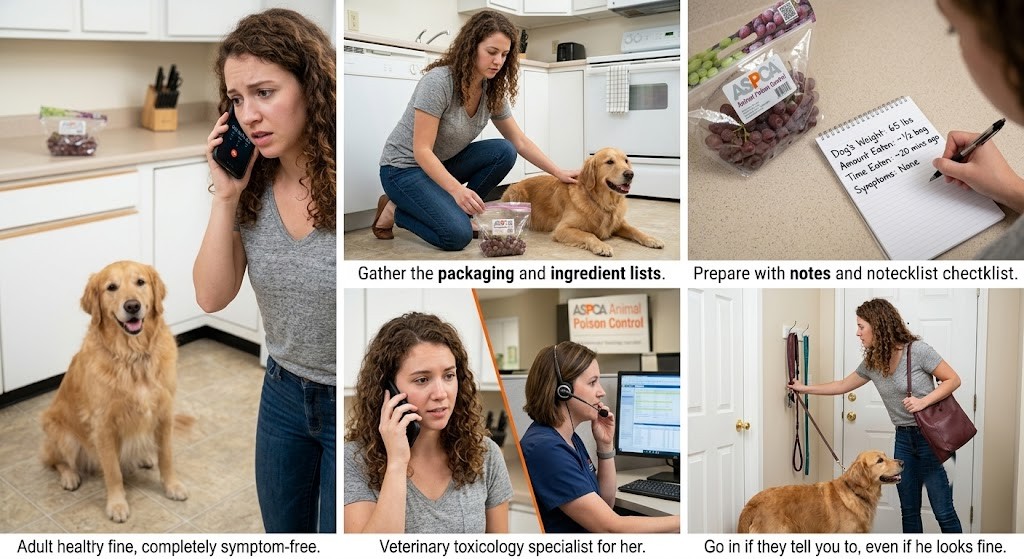
If you know or suspect your dog has eaten something toxic, call now, even though nothing is happening. Phone your own veterinarian, your nearest 24-hour emergency animal hospital, the ASPCA Animal Poison Control Center at (888) 426-4435, or the Pet Poison Helpline at (855) 764-7661. Both hotlines are US-based, staffed around the clock, and a consultation fee may apply. Do not wait to see whether your dog becomes unwell. Do not try to make your dog vomit and do not give any home remedy unless a veterinarian or a poison-control specialist tells you to for this exact situation. Our pet poison emergency page keeps the same call order in one place.
The rest of this page explains why a calm, normal-looking dog is not the reassurance it feels like. This is general information gathered from published veterinary sources. It is not veterinary advice, it cannot examine your dog, and it cannot tell you your dog is safe. Please read our veterinary disclaimer.
What "seems fine" actually tells you
Almost nothing, and that is the honest answer.
Consider what you are observing. Your dog is behaving normally. That is a statement about the last few minutes. It is not a statement about what is in the bloodstream, what the kidneys or the liver are dealing with, or what the next day will look like. You are watching the outside of a process that happens on the inside.
The mismatch matters because of when people search this. The question "he seems fine, do I still need to call" gets typed in the window where a dog is expected to look fine for many substances. So the observation that feels most reassuring arrives at exactly the moment it carries the least information.
None of that means your dog is in danger. It means the thing you are using to decide with is not capable of telling you either way.
Three reasons a normal-looking dog can still be in trouble
These are three separate mechanisms, not three ways of saying one thing. Any of them alone is enough.
1. Absorption happens before anything shows
Signs of illness are not the substance arriving. They are the body's response to a substance that has already been absorbed and has already started doing something. There is a gap between those two events, and its length depends on the substance and on the dog.
That gap is the whole reason veterinary sources tell owners not to wait for symptoms. "Nothing yet" describes where you are on the toxin's schedule. It is not evidence about the destination.
2. Some substances have a quiet phase built in
For a number of common exposures the serious outcome is organ injury that develops over a longer period, with little or nothing visible while it is happening.
The clearest documented example on this site is grapes and raisins. The Merck Veterinary Manual describes acute kidney injury developing in the range of roughly 24 to 72 hours after ingestion, well after the point at which the dog first appeared completely unaffected. A dog acting normally two hours in is not defying that pattern. It is following it.
Other substances run the other way and move quickly. The point is not to memorize which is which. The point is that the relationship between "how long has it been" and "how worried should I be" is different for every substance, and it is not something an owner can work out from the outside.
3. Waiting spends the one window you control
This is the reason that changes what you should do in the next few minutes.
Where a veterinary team can reduce how much of a substance gets absorbed, that opportunity is early and it closes on its own. Nobody can reopen it later. It is the only part of this situation that your timing genuinely affects, and "wait and see" is the single decision that gives it away.
Everything else in this situation is out of your hands. That one thing is not, and it has a clock on it.
Why this page does not give you a symptom checklist
Every other page you will find on this question hands you a list: vomiting, diarrhea, tremors, lethargy, pale gums. Those lists are accurate. They are also, for you specifically, the wrong tool, and that is why one is not printed here.
A symptom list is written for awareness. It gets used for permission. Someone whose dog has no symptoms reads a list of symptoms their dog does not have and comes away feeling cleared, when the sources those lists come from mean exactly the opposite. The list quietly turns into a home test, and it is not one. It cannot rule anything out, because it was never designed to.
So here is the rule this page offers instead of a list, and it is short enough to hold onto in a stressful moment:
Any change is a reason to call. No change is not a reason not to.
If something does appear, whatever it is, that is a reason to move faster, not a reason to start reading. And if nothing appears at all, you are exactly where this page assumes you are, and the answer has not changed.
Deciding what a sign means is diagnosis, and diagnosis needs someone who can put hands on your dog. This site does not do it and no article should.
What you are actually searching for
This is worth saying plainly, because it is true for most people who land here and nobody says it.
If you are reading this, you are probably not looking for information. You are looking for permission not to go. You are hoping to find a sentence that says a dog who is behaving normally is a dog who is fine, so that you can put the phone down and get on with your evening.
That is a completely human thing to want, and it is not carelessness. Emergency visits are expensive, they are exhausting, they happen at the worst hours, and the drive is horrible. Wanting to avoid one is reasonable.
The problem is only this: the page that gives you that permission cannot see your dog. It does not know what the substance was, how much, or how long ago, and it will not be there tomorrow. A veterinarian or a poison-control specialist can look at your specifics and tell you, quite often, that no visit is needed. That is a real outcome and it happens on these calls constantly. The difference is that when they say it, it means something.
The phone call is not the same thing as the drive. Making the call does not commit you to an emergency visit. It is how you find out whether you need one.
What to say when there is nothing to report
People hesitate here too, because it feels strange to phone a specialist and say that nothing is wrong. It is not strange. It is the normal version of this call.
Have ready what the Cornell University Riney Canine Health Center lists for any suspected poisoning: what was eaten, as specifically as you can including brand name and ingredient list, roughly how much, when it happened, and approximately what your dog weighs. Add your dog's age and any existing conditions or medications.
Then, when you are asked what you are seeing:
- Say "nothing at all." It is real information and it is used. It tells the specialist where you are in the timeline.
- Report the timing precisely if you can. With no symptoms to work from, how long ago it happened is doing most of the work in the assessment.
- Do not round the amount down to sound less alarming. Report the largest amount your dog could have reached.
- Write down what you are told, including any monitoring instructions and any case number. If you are advised to watch at home, ask exactly what to watch for and for how long, and write that down too. "Keep an eye on him" is not a plan. A named sign with a named time limit is.
If you are advised to come in, our guide to what to take with you to the emergency vet lists what to grab and in what order.
While you wait, do not try to fix it yourself
The instinct to do something is strongest exactly when there is nothing visible to respond to. Resist it.
Do not attempt to make your dog vomit on your own judgment, and do not give food, milk, water or any remedy to dilute or neutralize anything. For several categories of substance, bringing material back up causes serious additional injury, and an owner cannot tell from a label which category they are in. The reasoning is set out in full on why you must never make a dog vomit on your own judgment.
Do the useful things instead. Take the source away from your dog and any other animal in the house. Keep the packaging and read the ingredient list. If your dog vomits on its own, leave it rather than cleaning it up, because it may be worth showing to a vet.
The honest part
We cannot tell you your dog is fine and we cannot tell you your dog is in danger. Nobody writing an article can, because the two facts that decide it, the actual amount absorbed and your individual dog's sensitivity, are both invisible from where you are sitting.
What can be said with confidence is narrower and more useful: a normal-looking dog in the first hours after an exposure is not evidence of a good outcome. It is evidence that not enough time has passed. Those are very different things, and the whole risk of this moment sits in the gap between them.
Make the call. Let someone qualified tell you it is nothing. Quite often, they will.
Related emergency guides
- What to do in the first 60 minutes after your dog eats something toxic
- My dog ate one grape: why even one is treated as an emergency
- My dog ate raisins baked into something
- Why you must never make a dog vomit on your own judgment
Frequently asked questions
My dog ate something toxic hours ago and still seems completely fine. Do I still need to call?
Yes, and tell them how long it has been. With no symptoms to work from, the timing is doing most of the work in the assessment, and for some substances the serious effects are described in veterinary sources as developing over the following days rather than immediately. A professional can tell you whether your dog is past the point of concern. An article cannot.
How long should I watch my dog before I decide it is fine?
That is not a question to answer at home, because the answer is different for every substance and every dog. Ask it on the call and write down the answer, including which specific signs to watch for and for how long. A monitoring plan from someone who knows what was eaten is safe. A self-imposed waiting period is not.
Does calling a hotline mean I have to take my dog to the emergency vet?
No. The call and the visit are separate decisions, and the call is how you find out whether the visit is needed. Poison-control specialists frequently advise that no visit is necessary for a given substance, amount and dog. That answer is worth far more coming from them than from a web page.
My dog vomited once and now seems fine again. Is that the problem resolving itself?
Treat it as new information to report rather than as a resolution, and call. Vomiting once does not mean a substance has been cleared, and a return to normal behavior afterward does not settle what happens over the following days. Do not clean the vomit away, because it may be useful to a veterinarian.
Why does this page not list the symptoms of poisoning in dogs?
Because a symptom list cannot rule anything out, and it tends to get used as though it can. Your dog has no symptoms, which is why you are here, and a list of things your dog does not have would read as an all-clear it is not able to give. The rule that replaces it is simpler: any change is a reason to call, and no change is not a reason not to.
Safe for Paws is written by Md Astafar Hossain, a dog parent and researcher, not a veterinarian. This is general information gathered from published veterinary sources including the ASPCA Animal Poison Control Center, the Pet Poison Helpline, the Merck Veterinary Manual and the Cornell University Riney Canine Health Center. It is not veterinary advice and it cannot diagnose or treat your pet. Please read our full veterinary disclaimer. If anything here conflicts with your own veterinarian, listen to your veterinarian. In an emergency, call your vet, the ASPCA Animal Poison Control Center at (888) 426-4435, or the Pet Poison Helpline at (855) 764-7661.