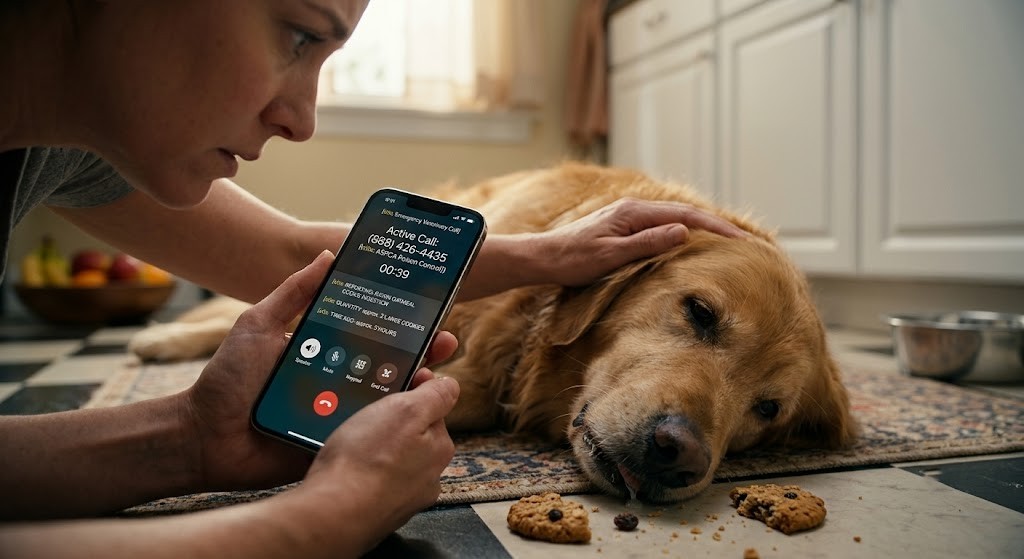
If your dog has eaten a raisin cookie, a scone, a hot cross bun, a granola bar or anything else with raisins in it, call for help now. Phone your own veterinarian, your nearest 24-hour emergency animal hospital, the ASPCA Animal Poison Control Center at (888) 426-4435, or the Pet Poison Helpline at (855) 764-7661. Both hotlines are US-based and staffed around the clock, and a consultation fee may apply. Do this even if your dog looks completely normal. While you wait to be connected, do not try to make your dog vomit and do not give any home remedy unless a veterinarian or a poison-control specialist tells you to for this exact situation. Then go and find the packaging. Our pet poison emergency page has the same call order in a form you can keep on your phone.
That is the whole answer, and everything below exists to help you make that call faster and better informed. This page is general information gathered from published veterinary sources. It is not veterinary advice, it cannot examine your dog, and it cannot tell you whether your dog is safe. Please read our veterinary disclaimer so you know exactly what this page is and is not.
Why a baked item is harder than a handful of raisins
If your dog had eaten loose raisins off the counter you would have an approximate number. You would look at what is left in the box and estimate. That estimate would not be perfect, but it would be something to say on the phone.
A raisin baked into a scone is a different problem. The raisins are distributed unevenly through the dough, they are partly rehydrated, and there is no honest way to look at a half-eaten cookie and say how many were in the missing half. Bakers do not count them. Recipes measure by volume, and volumes vary batch to batch and baker to baker.
So the difficulty here is not toxicological. It is a counting problem, and it lands on you at the exact moment you are least able to think clearly. That is worth naming, because a lot of people freeze at this point and delay the call while they try to work out an answer they were never going to be able to reach.
You do not need to solve it before you pick up the phone. "I do not know how many, it was baked in" is a complete and useful answer, and the specialists on the other end hear it constantly.
"How many did he eat?" when you genuinely do not know
Veterinary toxicology works on worst case, not best case. That is the frame to bring to this question, and it converts an unanswerable question into an answerable one.
Instead of trying to count raisins, describe the boundary of what was possible:
- What the item was. "An oatmeal raisin cookie, shop-bought, about the size of my palm." "Half a fruit scone." "A cereal bar, the whole thing including the wrapper."
- How many items. Two cookies off a plate of six is a far more useful sentence than a guess at a raisin count.
- The most he could have had. If you left a plate and came back to crumbs, assume the plate. Report the largest amount your dog could have reached, not the smallest you are hoping for. Over-reporting costs you a more cautious plan. Under-reporting costs you the plan that would have worked.
- What you are unsure about, said out loud. "I think it was two but it could have been three" is exactly the kind of sentence a specialist knows what to do with.
The Cornell University Riney Canine Health Center sets out the same information set for any suspected poisoning: the brand name, the ingredient list, roughly how much was eaten, when it happened, and approximately what your dog weighs. Notice that a raisin count is not on that list. The product and the portion are.
A raisin cookie is rarely only raisins
This is the part that most pages on this query skip, and it is the reason the packaging matters so much.
Baked goods stack ingredients. The thing your dog ate may have contained more than one substance that a veterinary toxicologist would want to know about:
- Chocolate chips or cocoa, common in the same cookies and cakes as raisins.
- Currants and sultanas, which are the same grape-family concern as raisins, sometimes in the same fruit loaf.
- Nutmeg, cinnamon and other baking spices, which come up regularly in holiday baking.
- Macadamia and other nuts, in cookies, brownies and granola.
- Alcohol, in rum-soaked dried fruit, brandy butter and Christmas cake.
- Xylitol or other sugar substitutes, in some "no added sugar", "keto" and diabetic-friendly baking. This is the reason the ingredient panel is worth more than the product name.
This is why the instruction above is "go and find the packaging" rather than "look up raisins". A brand name and an ingredient list let a specialist tell the difference between one exposure and three. If the wrapper is already in the trash, it is worth retrieving. If it is genuinely gone, photograph any remaining piece of the item itself and say so on the call.
Do not delay the call to do this. Make the call, and look while you are on hold.
Homemade or shop-bought: two different ways to find out
Shop-bought items carry a legally required ingredient list. Read it before you throw anything away, including the outer box, which sometimes carries a fuller list than the inner wrapper. If you bought it recently, the ingredient list may also be on the retailer's website or in your order history.
Homemade items have something better: a person. If a neighbor, a relative or a colleague made it, call or message them and ask what went in. People are usually happy to answer this question quickly when they hear why you are asking. A recipe link is a perfectly good substitute for a label.
If nobody is reachable and there is no packet, the honest report is "an unknown homemade fruit cookie", and the specialist will plan around that uncertainty. Uncertainty is normal in these calls. It is not a reason to skip them.
Why the concern with grapes and raisins does not scale down
Raisins are dried grapes, so the same concern applies, concentrated by the drying.
For many years nobody knew what in a grape harmed dogs. The ASPCA Animal Poison Control Center identified tartaric acid as the likely toxic component. Its concentration is not fixed. It varies with the grape variety and its ripeness, which means a raisin is not a standard unit of anything. On top of that, individual dogs differ in how they respond, and there is no way to know in advance which kind of dog yours is.
The Merck Veterinary Manual describes acute kidney injury as the serious outcome in dogs affected by grapes and raisins, and describes it developing over the days after the exposure rather than immediately.
Put those together and you get the reason no veterinarian will give you a safe number, and the reason this page does not print one either. There is no established safe amount, so there is no arithmetic that gets you out of the phone call. If a page tells you a specific quantity is fine, it is guessing on your dog's behalf.
"He seems fine"
He very likely does, and that is expected rather than reassuring. The Merck Veterinary Manual describes the serious kidney effects of grape and raisin ingestion developing roughly 24 to 72 hours afterward, well after the dog first appeared unaffected. A calm dog on the sofa an hour later is inside the window where nothing is meant to be visible yet.
This comes up so often that it has its own page here: why a dog that seems fine can still be in trouble. The short version is that a normal-looking dog is not evidence of a safe outcome, it is evidence that not enough time has passed.
What happens after the call
Knowing what comes next takes some of the fear out of making the call.
On the phone, you will be asked what was eaten, roughly how much, how long ago, your dog's weight, and whether you are seeing anything at all. "Nothing at all" is a real answer and you should still give it. Write down what you are told, including any case number the hotline gives you, because your veterinarian may want it.
If you are told to come in, the clinic may consider decontamination if the timing still allows it, and will discuss monitoring your dog's kidney values with bloodwork over the following days. What that plan looks like depends on the substance, the amount and the timing, which is precisely why it is built by someone who can ask questions rather than by an article.
Do not attempt decontamination at home. The reasons are set out in full on why you must never make a dog vomit on your own judgment, and they are not a formality. For some substances, bringing the material back up causes serious additional injury.
If you are told to travel, our guide to what to take with you to the emergency vet lists what to grab, in the order it matters, and the packaging is at the top of it.
The honest part
Nobody writing a web page can tell you whether your dog is going to be fine. The two things that decide the outcome are the actual amount of the toxin your dog took in and your individual dog's sensitivity to it, and neither is knowable from where you are standing.
That is not a reason to panic. It is the reason to hand the decision to someone who can narrow it down: a veterinarian or a poison-control specialist who can factor in the product, the portion, the timing and your dog's weight, and who is accountable for the answer they give you.
Being cautious here costs you a phone call and possibly an inconvenient evening. Being wrong in the other direction is not recoverable in the same way. When the downside is that lopsided, you make the call.
Related emergency guides
- What to do in the first 60 minutes after your dog eats something toxic
- My dog ate one grape: why even one is treated as an emergency
- Why a dog that seems fine can still be in trouble
- What to take with you to the emergency vet
Frequently asked questions
My dog ate a raisin cookie but I do not know how many raisins were in it. What do I say?
Say exactly that. Describe the item and the portion instead: what it was, how many of them, and the most your dog could possibly have reached. Veterinary toxicology works from worst case, so an honest description of the item is more useful than a guessed raisin count, and "I do not know, it was baked in" is a normal thing for a specialist to hear.
Is a raisin in a cookie less of a concern because it is cooked?
Baking is not known to remove the concern. Treat a baked raisin the same as a loose one, and tell the hotline it was baked in, because that affects how the amount is estimated rather than whether it matters.
Should I make my dog vomit to bring the cookie back up?
Not on your own judgment. Only a veterinarian or a poison-control specialist can decide whether that is appropriate for this substance, this dog and this timing, and for some substances it causes serious extra harm. Call first, always.
The cookie also had chocolate chips in it. Does that change anything?
It changes what you need to report, so say so on the call. A baked item can contain more than one substance worth knowing about, which is why the ingredient list matters more than the product name. Find the packaging and read it out.
My dog ate it yesterday and is completely normal. Is it too late to call?
Call anyway and tell them the timing. Serious effects from grapes and raisins are described in veterinary sources as developing over the days after the exposure rather than immediately, so a normal-acting dog the next day is still inside the period where a professional may want to check bloodwork.
Safe for Paws is written by Md Astafar Hossain, a dog parent and researcher, not a veterinarian. This is general information gathered from published veterinary sources including the ASPCA Animal Poison Control Center, the Pet Poison Helpline, the Merck Veterinary Manual and the Cornell University Riney Canine Health Center. It is not veterinary advice and it cannot diagnose or treat your pet. Please read our full veterinary disclaimer. If anything here conflicts with your own veterinarian, listen to your veterinarian. In an emergency, call your vet, the ASPCA Animal Poison Control Center at (888) 426-4435, or the Pet Poison Helpline at (855) 764-7661.