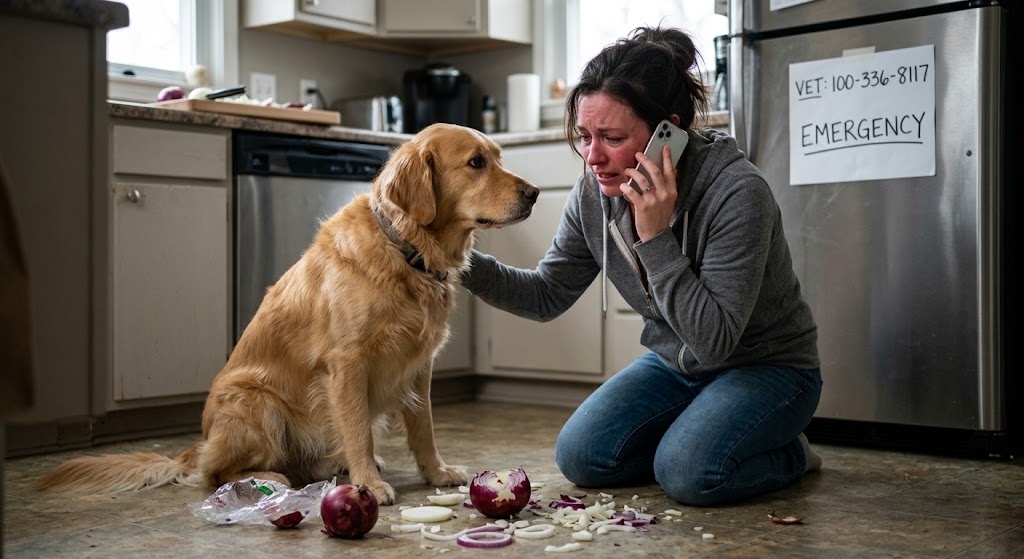
If your dog just ate onion in any form, call a professional now, before you finish reading. Call your own veterinarian, your nearest 24-hour emergency animal hospital, the ASPCA Animal Poison Control Center at (888) 426-4435, or the Pet Poison Helpline at (855) 764-7661 (both US, 24/7, a fee may apply). Onions damage a dog's red blood cells, and the danger is that it is often delayed: a dog can seem completely fine for days and then become seriously ill, so "he looks okay" does not mean he is cleared. Do not make your dog vomit unless a vet or poison line tells you to for this situation right now.
This page is general information from a dog parent who researches veterinary sources, not a vet. It exists to help you make a faster, better-informed call to a professional. It is not a substitute for that call. See our full veterinary disclaimer.
The short version, in plain language
Onions are toxic to dogs. So are garlic, leeks, chives, shallots, and every other member of the Allium plant family. This is true whether the onion was raw, cooked, fried, dehydrated, or ground into powder, and whether it was eaten on its own or hidden inside human food.
The reason to call now, rather than wait and watch, comes down to three facts:
- Onions attack red blood cells. The damage can build before your dog shows any sign of it.
- Symptoms are usually delayed. According to the Merck Veterinary Manual, signs of anemia may take several days to appear, with hemolysis (the destruction of red blood cells) typically occurring 3 to 5 days after exposure.
- A professional weighs the amount against your specific dog. How much onion matters, but so does your dog's exact weight, age, and health. That is a calculation for your vet or a poison line, not for a web page.
Why onions poison dogs: what happens to the red blood cells
Onions and the rest of the Allium family contain sulfur compounds (often referred to as N-propyl disulfide) that a dog's body cannot safely process. Inside the bloodstream, these compounds cause oxidative damage to red blood cells.
The damaged hemoglobin clumps into what veterinarians call Heinz bodies. Cells carrying Heinz bodies become fragile and rigid, and the body destroys them faster than it can make new ones. The result is hemolytic anemia: your dog runs low on the healthy red blood cells that carry oxygen. In serious cases this is life-threatening.
Here is the part that trips people up. The Merck Veterinary Manual notes that Heinz bodies and methemoglobin can start rising within 24 hours of ingestion, but the outward clinical signs of anemia may take as long as several days to appear. That gap is exactly why a dog can eat onion, act normal at dinner, and be in trouble later that week. Seeming fine on day one is not the all-clear.
Raw, cooked, powder, or broth: the form changes the risk
People often assume a bit of cooked onion in leftovers is harmless. Cooking does not remove the toxin. In fact, the more concentrated the onion, the more toxin sits in a small volume. Onion powder is the biggest hidden danger for this reason.
| Form | Why it matters |
|---|---|
| Raw onion (slice, chunk, whole) | The reference form for most toxicity figures. Easy to see and measure. |
| Cooked onion (in curry, soup, stew, stir-fry) | Cooking does not detoxify it. Often eaten in larger amounts because it is mixed into tasty food. |
| Fried onion / onion rings | Onion plus fat and salt. Still toxic, and the batter hides how much onion is inside. |
| Onion powder / dried onion | The most concentrated form. The Pet Poison Helpline notes a single teaspoon of onion powder can be as dangerous as a whole medium onion, and small dogs can be affected by even less. |
| Onion broth / stock / gravy | Onion is dissolved through the whole liquid, so the dose is spread across everything it flavors. |
The takeaway: do not judge risk by how much onion you can see. A spoon of onion powder in a seasoning blend can carry more toxin than a raw slice.
Hidden onion: the foods people forget contain it
The most common way dogs get poisoned is not a dog stealing a raw onion off the counter. It is onion hidden inside human food. When you call your vet, mention anything from this list that your dog got into:
- Baby food (many savory jars contain onion powder)
- Pizza, and sauce or gravy of almost any kind
- Soup, broth, stock cubes, and instant noodle seasoning
- Meatballs, meatloaf, burgers, and seasoned or marinated meats
- Stuffing, especially around holidays
- Chinese, Indian, and other takeout dishes built on an onion base
- Guacamole, salsa, and dips
- Garlic bread and onion bread
If your dog ate table scraps or "a little bit of what we were having," assume onion or garlic could be in it and call to check.
How much onion is dangerous? Why this is a question for your vet
You will find threshold figures online, and this page will not repeat them. That is a deliberate choice, not an oversight. A number invites arithmetic, and the arithmetic is what makes an owner decide not to call. What is worth knowing instead is the scale: for a small dog the amount that matters is small, well under a whole onion, and concentrated forms such as powder count for far more than their weight suggests.
Now the caution. Do not use any number on this page to decide your dog is safe. Real risk depends on things no article can know: your dog's exact weight, age, breed, and existing health; the true amount eaten; the form it was in; and whether this was a one-time bite or repeated exposure. Two other points matter here:
- Concentrated forms break the simple math. With onion powder, a tiny visible amount can cross the threshold.
- Small amounts can add up. Merck's clinical material notes that repeated small doses, like regular table scraps over time, can accumulate and cause the same damage as one large meal. A daily nibble of onion-seasoned food is not automatically safe just because each portion is small.
This is why we route you to a professional to assess the amount for your dog, rather than telling you a "safe" quantity. There is no amount this page can promise is safe for your animal.
Your day-by-day monitoring window (only after you have called)
Calling a professional comes first. Depending on the amount and timing, your vet may want to see your dog right away, or may advise you to monitor closely at home. If monitoring is the plan, here is what the waiting window looks like, because the risk with onions plays out over days, not minutes.
- Day 0 (the first hours): Watch for stomach upset first, vomiting, diarrhea, drooling, or belly pain. This is the body reacting to the irritation, not yet the anemia.
- Days 1 to 3: The red blood cell damage is building even if your dog seems normal. This is the deceptive stretch. Keep watching, do not relax the watch because he is eating and playing.
- Days 3 to 5: This is when anemia most often becomes visible, matching Merck's typical hemolysis window. Check gum color and urine color carefully.
- Up to day 7: Signs can still emerge this late. Your dog is not fully in the clear until this window has passed and your vet agrees.
Red flags that mean call again, or go in now
Contact your vet or emergency hospital immediately if you see any of these at any point in the window:
- Pale, white, or bluish gums (a key sign of anemia; healthy gums are pink)
- Red, brown, or dark-colored urine
- Weakness, lethargy, or reluctance to move
- Rapid breathing or a racing heart
- Fainting, collapse, or unsteadiness
- Loss of appetite that continues
- Yellowing of the gums, eyes, or skin
Any one of these, especially pale gums or dark urine, is a reason to stop watching and get professional help now.
Garlic, leeks, chives, and shallots: the rest of the family
Onion is not a special case. The entire Allium family carries the same red-cell-damaging compounds, so the same rules apply to all of it:
- Garlic is more concentrated than onion by weight, which is why concentrated garlic (powder, or supplements marketed for dogs) deserves real caution. If your dog ate garlic, treat it as seriously as onion and call.
- Leeks, chives, shallots, and scallions (green onions) are all toxic to dogs as well.
If you are here because of garlic or chives rather than onion, the guidance on this page still fits: call a professional, do not induce vomiting unless told to, and watch for the same delayed anemia signs.
What the vet will do
Knowing the likely plan can make the phone call less frightening. Based on published veterinary sources, care may include:
- Decontamination, which can mean inducing vomiting or giving activated charcoal, but only if it is soon after ingestion and only when a professional decides it is safe. This is their call, not yours to attempt at home.
- Blood tests to check for Heinz bodies and to track red blood cell levels over the following days.
- IV fluids to support the body and protect the kidneys.
- Oxygen support, and in severe anemia, a blood transfusion.
There is no antidote for onion toxicity. Treatment is about supporting your dog while their body clears the toxin and rebuilds healthy red blood cells, which is another reason getting ahead of it early helps.
Related emergency guides
- What to do in the first 60 minutes after your dog eats something toxic
- My dog ate one grape: is that dangerous?
- How much chocolate is toxic to dogs?
Frequently asked questions
My dog ate one onion ring. Is that an emergency?
Do not judge it by the single ring. It depends on your dog's weight and what else was in it. A small dog can be at risk from a surprisingly small amount, and onion powder in the batter adds to the load. Call your vet or the Pet Poison Helpline at (855) 764-7661 and describe your dog's weight and exactly what was eaten. Let them assess it.
My dog ate rice cooked with onions. Should I worry?
Yes, take it seriously. Cooking does not remove the toxin, and onion cooked through a dish spreads the dose across everything your dog ate. Call a professional with details on how much and when. Do not wait to see if symptoms appear, because with onions they are usually delayed by days.
My dog eats a little onion-seasoned food every day. Is a small amount okay?
Repeated small amounts are a known concern. Veterinary sources note that onion exposure can accumulate over time, so daily scraps can cause the same red blood cell damage as one large serving. There is no amount we can promise is safe. Stop the exposure and ask your vet about your specific dog.
My dog ate onions two days ago and seems totally fine. Is he safe?
Not necessarily. This is the most important point about onions: the serious signs, from anemia, most often appear 3 to 5 days after eating, and can come as late as day 7. Seeming fine now does not mean the danger has passed. Call your vet, and watch closely for pale gums and dark urine through the end of that window.
Is garlic safer than onion for dogs?
No. Garlic is actually more concentrated than onion by weight, so a smaller amount can cause harm. Treat garlic, including garlic powder and garlic supplements, with the same seriousness as onion, and call a professional if your dog ate any.
Sources: Merck Veterinary Manual (Garlic and Onion Allium spp Toxicosis in Animals); Pet Poison Helpline; ASPCA Animal Poison Control Center; American Kennel Club. Figures are commonly cited veterinary reference points, not safety guarantees for your individual dog. Reviewed against these sources on 2026-07-20. If anything here ever conflicts with what your own veterinarian tells you, listen to your veterinarian.