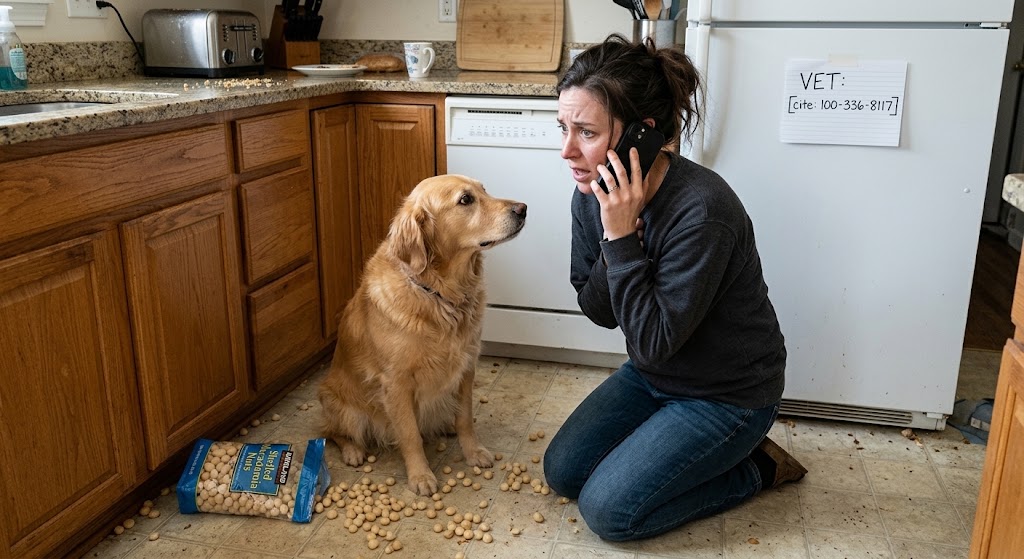
Call for help now, before you finish reading. Phone your own veterinarian, your nearest 24-hour emergency animal hospital, the ASPCA Animal Poison Control Center at (888) 426-4435, or the Pet Poison Helpline at (855) 764-7661. Both hotlines are US-based and staffed around the clock, and a consultation fee may apply. Do not make your dog vomit and do not give any home remedy unless a veterinarian or a poison-control specialist tells you to, for this exact product, right now. Our pet poison emergency page has the same call order in one place.
While the phone rings, find the packaging and keep it, and look at the ingredient list rather than the front of the pack.
This page is general information gathered from published veterinary sources. It is not veterinary advice, it cannot examine your dog, and it cannot tell you whether your dog is safe. Please read our veterinary disclaimer.
The question that matters more than the nuts
Almost nobody searching this has a bowl of plain macadamia nuts on the counter. The nuts were in trail mix, in cookies, in a chocolate-covered cluster, in banana bread, or on a cheese board with dried fruit next to them.
That matters, because the companion ingredients are often the more urgent problem, and they are the part owners forget to mention on the call. Trail mix routinely contains raisins or sultanas. Chocolate-covered anything is a chocolate exposure first. A protein or "keto" snack bar may be sweetened with something that is a separate emergency in its own right. Baked goods can contain more than one of these at once, invisibly.
So before you think about the nuts, do this: read the full ingredient list on whatever it came out of, and read it to the person who answers the phone. If the packaging is gone, say what the item was and say you are not certain what was in it. That single sentence often changes what the specialist tells you to do next, and it is the sentence most often left out.
If it was baked into something, the counting problem we wrote about for raisins in a cookie applies here too. And if there were dried grapes in the mix, that is its own separate conversation, which we cover in what happens when a dog eats a single grape.
What nobody knows about macadamia nuts, and why it matters to you
Here is the thing most pages skate past.
The Merck Veterinary Manual states plainly that the mechanism of toxicity is not known. Macadamia nuts are recognized in veterinary toxicology as causing a specific pattern of illness in dogs, and the ASPCA Animal Poison Control Center has published an alert about them, but the compound or process responsible has not been identified.
That is not a footnote. It explains something practical about every page you are about to read on this subject. When the mechanism is unknown, there is no agreed pharmacology to build a threshold on, and any confident number you encounter is standing on softer ground than its formatting suggests.
It also means the honest answer to "is this the bad kind of nut" is that macadamia is the one nut with its own entry in the veterinary toxicology literature, and that this is a reason to call rather than a reason to calculate.
The number this page does not give you
This site publishes no dose, no threshold and no weight-based calculation for any substance, and that is deliberate rather than an oversight. There is no number on this page you can measure your dog against, and there is no count of nuts that this page will describe as fine.
The reason is the same one that applies everywhere on this site, with an extra layer here. You rarely know the true amount, because what is left in the bag is evidence of what was not eaten. You rarely know the product, because "trail mix" is a category rather than a recipe. And in this case the underlying mechanism is not established, so the arithmetic has nothing solid underneath it even when the inputs are right.
What the vet or the hotline will ask you
Expect these, roughly in this order. "I do not know" is a useful answer and they hear it constantly.
- What was it, exactly? Not "nuts." The product, and the full ingredient list if you still have it.
- What else was in it? Chocolate, raisins, sultanas, sweeteners. This is the question that most often changes the answer.
- How much, at worst case? Round up, not down.
- How long ago? A best estimate is fine. If you found the mess rather than watched it happen, give the window.
- How much does your dog weigh? Their real weight, not last year's.
- How old is your dog, and is there anything else going on? Existing conditions, and every medication or supplement they are on.
- What are you seeing right now? Including nothing at all.
Write down what you are told, including any case number the hotline gives you. If you end up at a clinic, that number lets the veterinary team talk to the same specialist about the same case.
What veterinary sources say about how this usually goes
This site does not hide good news, so here it is, bounded and sourced.
Merck describes macadamia nut toxicosis in dogs as generally self-limiting, and states that most clinically affected dogs recover without any specific treatment. The signs described in the veterinary literature include weakness, particularly in the hind limbs, vomiting, unsteadiness, tremors, depression and a raised body temperature. The ASPCA describes the same picture and adds that pancreatic inflammation can develop in some cases because of the fat content, and that signs may show up over the days following, not only immediately.
Treat that list as reasons to call, not as a checklist to decide with. Nothing on it needs to appear before you make the call, and if any of it does appear, stop waiting and go in.
Three reasons that is not an all-clear
The favorable picture above is real. It is also not an answer to the question you actually have, for three reasons.
One: the exposure is almost never just macadamia. Everything in the section at the top of this page still applies. A dog who ate a chocolate-and-macadamia cookie has two exposures and the second one is not self-limiting.
Two: the fat is its own problem. Macadamias are a very high-fat food, and a sudden fatty meal is a recognized trigger for pancreatitis in susceptible dogs. That risk exists independently of whatever the unknown macadamia toxin does.
Three: nobody can tell from a kitchen which course this is. "Generally self-limiting" is a statement about a population of cases. It is not a statement about the animal in front of you, and it does not distinguish the dog who will be uncomfortable for a day from the dog who is developing something that needs support. That distinction is made by someone who can examine your dog, ideally after a conversation that included the words "there were raisins in it as well."
The ASPCA's own instruction, for what it is worth, is unambiguous: if your pet eats macadamia nuts, contact your local veterinarian or the Animal Poison Control Center right away.
What you must not do while you wait
Do not make your dog vomit. Not with hydrogen peroxide, not with salt, not with anything, and not because a search result gave you a method. Whether bringing material back up helps or harms depends on the substance, the timing and the state the dog is in. This site publishes no method for it at all, and that is the entire purpose of that page.
Do not decide to wait and watch on your own. A monitoring plan from someone who knows what was eaten is a real plan. A self-imposed waiting period is not, and the reasoning behind that distinction is set out in why a dog that seems fine can still be in trouble.
Do not go without the packaging. If you are told to come in, take these things with you, and take whatever the nuts came out of.
Related emergency guides
- What to do in the first 60 minutes after your dog eats something toxic
- When the dangerous ingredient was baked into something
- Why a dog that seems fine can still be in trouble
- Why you must never make a dog vomit on your own judgment
- What to take with you to the emergency vet
Frequently asked questions
How many macadamia nuts are toxic to a dog?
This site does not publish that figure, for this or any substance. Beyond the usual reasons, there is a specific one here: the Merck Veterinary Manual states that the mechanism of macadamia toxicity is not known, so there is no settled pharmacology for a threshold to rest on. Call a veterinarian or a poison-control specialist, tell them the product and the full ingredient list, and round the amount up.
My dog ate one macadamia nut. Is that really an emergency?
Treat it as a reason to make a phone call rather than something to resolve yourself. The ASPCA's guidance is to contact a veterinarian or Animal Poison Control right away if a dog eats macadamia nuts. The call is short, and it is also where the more important question gets asked, which is what else was in whatever the nut came from.
Are other nuts safe for dogs?
This page will not give a safety verdict on any food, and a page that does is worth being careful with. Different nuts raise different issues, from fat content to salt to the risk of an obstruction with a large or shelled nut, and a mixed product introduces whatever else is in the bag. If your dog has eaten something you are unsure about, the phone call is the fastest way to find out what applies.
It was chocolate-covered macadamias. Which one do I mention first?
Mention both, and lead with the chocolate. Say the type of chocolate and how dark it was if you know, then say there were macadamias in it, then read the rest of the ingredient list. A specialist would rather untangle two exposures with you than discover the second one later.
He seems completely fine. Can I just watch him at home?
Only if that is the plan you are given, by someone who knows what was eaten. Veterinary sources describe signs that can appear over the days following, so a normal-looking dog in the first hours has not told you very much. Call, describe what happened, and let a professional set the monitoring plan and its length.
Safe for Paws is written by Md Astafar Hossain, a dog parent and researcher, not a veterinarian. This is general information gathered from published veterinary sources including the ASPCA Animal Poison Control Center, the Merck Veterinary Manual and the Pet Poison Helpline. It is not veterinary advice, it is not a set of instructions, and it cannot diagnose or treat your pet. Please read our full veterinary disclaimer. If anything here conflicts with your own veterinarian, listen to your veterinarian. In an emergency, call your vet, the ASPCA Animal Poison Control Center at (888) 426-4435, or the Pet Poison Helpline at (855) 764-7661.