
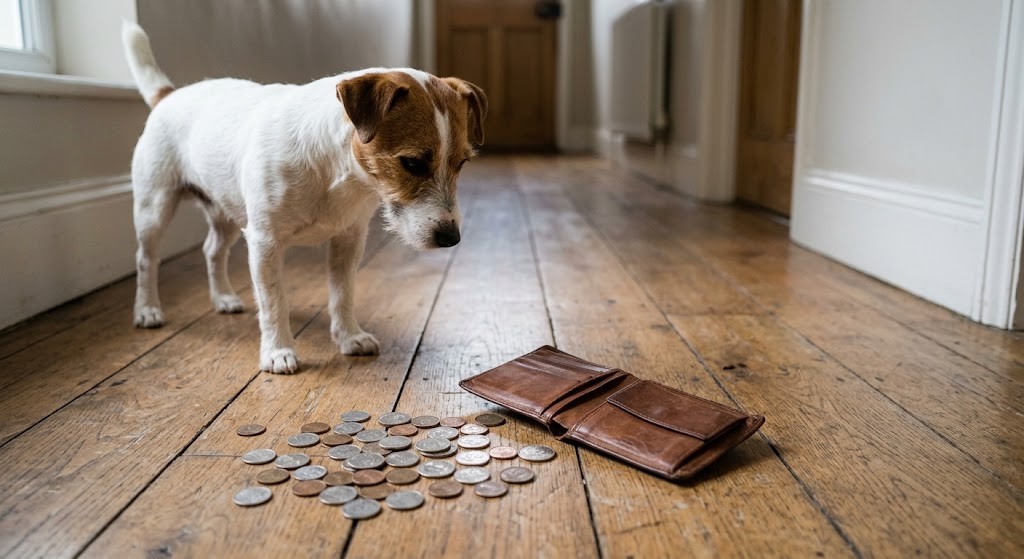
If your dog swallowed a coin, call now: your veterinarian, the nearest 24-hour emergency animal hospital, the ASPCA Animal Poison Control Center (888-426-4435) or the Pet Poison Helpline (855-764-7661). Both lines answer 24 hours a day, and a fee may apply. Do not make your dog vomit and do not give any home remedy unless a vet or poison specialist tells you to. A coin is not only a blockage risk: US pennies contain zinc, which can poison a dog. If magnets or other small metal pieces are missing too, say so. The risk depends on the object and on your dog's size and health, and only a vet can judge it.
"It's Just a Coin. Won't It Pass?"
That is the reasonable first thought. The veterinary sources give two reasons not to wait and find out.
The first is that a penny is not inert. The Pet Poison Helpline's article on zinc poisoning says: "Even one U.S. penny could be toxic for a dog!" The Merck Veterinary Manual describes US pennies as "a key source of exposure" to zinc for animals.
The second is that pennies do not always move along. The same Pet Poison Helpline article notes that "Zinc-containing items such as pennies may sit in the stomach much longer." Its page on dogs eating metal explains why that matters: "Zinc can be broken down in the stomach, leading to stomach discomfort and absorption into the bloodstream."
And a coin with no zinc in it is still a solid object in the gut. Our guide on whether a dog that ate something might have a blockage covers that side of it.
None of the pages we read gives a safe waiting period for a swallowed coin or magnet, and we will not invent one. Whether it will pass is a vet's decision, usually made with an X-ray, not a guess at home.
Dog Swallowed a Coin: Which Coin It Was Matters
You do not need to know before you call. But the type of coin, and anything swallowed with it, changes what the vet looks for.
| Coin or object | What the sources say |
|---|---|
| US penny | Merck: pennies minted since 1982 are "a key source of exposure" to zinc. Pet Poison Helpline: pennies minted after 1982 are mostly zinc, and one may be toxic to a dog |
| US dollar coin | Merck: dollar coins "also contain zinc, although at a much lower concentration" |
| Other coins | The pages we read do not classify them. Any coin is still a solid object the vet needs to locate |
| Magnets | An ASPCA case describes strong magnets that clumped together and damaged a dog's esophagus |
| Nuts, bolts, zippers, game dice, jewelry, BB pellets | Merck lists these among the sources of zinc |
Merck's wording is "since 1982" and the Pet Poison Helpline's is "after 1982." Either way, you cannot read the date on a coin that is inside your dog. Tell the vet "a penny," or "some change from my pocket," and let them work from there.
Why Zinc From a Penny Is a Poisoning, Not Just a Blockage
The Pet Poison Helpline's page on dogs that eat metal describes what absorbed zinc can do: "This can result in the destruction of red blood cells, as well as kidney and heart failure, and liver damage."
The Merck Veterinary Manual chapter on zinc toxicosis describes two phases. The first involves "vomiting, diarrhea, anorexia, and lethargy, which can progress to ulcers and melena." Anorexia here means not eating, and melena means dark, tarry stool. A second phase can follow "several hours to several days after the GI phase," with intravascular hemolysis (red blood cells breaking down inside the blood vessels), anemia, icterus (yellowing, also called jaundice) and hemoglobinuria (discolored urine), and possible organ failure.
That timing is the reason a dog who seems fine after swallowing a penny has not been cleared. The serious part of a zinc poisoning can come after the first day looks quiet.
Merck adds one more point that owners rarely hear: "Abdominal radiographs can show a radiopaque foreign body (eg, a coin); however, the lack of a visible foreign body does not exclude zinc toxicosis." Radiographs are X-rays. Put simply, an X-ray is a strong tool, but the vet also relies on your account of what went missing.
Magnets: Small, Strong and Hard to Separate
Magnets get their own section because they behave differently from a single coin.
The ASPCA's account of a dog named Theo, published April 5, 2024, describes multiple magnets found in his esophagus and gastrointestinal tract. "The magnets were sitting in a clump in his esophagus leading to erosion and dying of tissue," it says. The magnets were described as "extremely strong and hard to separate," and they had created outpouchings in his esophagus. Dr. Karla Kovach, quoted in the ASPCA's account, called it "a life-threatening situation with long-term implications."
The lesson for an owner is narrow and practical. If more than one magnet may be missing, or a magnet along with coins or other metal, tell the vet that exactly. In Theo's case the magnets held together in a clump and damaged the tissue they sat against, and the vet needs to know to look for more than one object. Strong magnets turn up in toys, fridge decorations, fidget sets and some jewelry clasps.
Other Small Metal Objects That Carry Zinc
This is the part most coin articles leave out. The small metal object your dog swallowed may matter more for what it is made of than for its shape.
The Merck Veterinary Manual lists sources of zinc beyond pennies: "automotive parts, galvanized nails/nuts/bolts, wire/hardware, polyhedral game dice, zippers, toys, aluminum galvanized cookware, galvanized metal cages (eg, coated birdcages), BB pellets, jewelry, and zinc-coated garland and tinsel decorations." The Pet Poison Helpline makes the same point in plainer words: "Metal pieces such as pennies, hardware, nuts, and bolts may contain the metal, zinc."
So a missing bolt from a flat-pack shelf, a die from a board game or a zipper pull chewed off a jacket all belong in the same phone call as a penny. Tell the poison line what the object was, even if it seems too ordinary to mention.
What the Vet Is Likely to Do
Every case is different, and only the vet who examines your dog can decide. The sources describe the general shape of it.
The Cornell Riney Canine Health Center says vets use abdominal X-rays or ultrasound, blood work and a physical exam to find an obstruction. It describes gastrointestinal obstructions as "emergencies often requiring surgical removal," and notes that "For smaller objects that are not causing a full obstruction, your veterinarian may opt for conservative treatment, such as hospitalization with fluids and monitoring. If the object does not pass, surgery will be required."
For a zinc object, Merck describes the aim as reducing zinc absorption "until the zinc foreign body can be surgically or endoscopically removed." An endoscope is a camera on a flexible tube passed into the stomach. Merck also states that "With early diagnosis and treatment, the outcome is usually favorable for animals with zinc toxicosis." The word that matters there is early. Our guide to what the vet does for dog poisoning explains what a clinic visit usually involves.
Signs to Report to the Vet
These are the signs the sources name. They are listed so you can describe what you see, not so you can decide at home whether your dog is poisoned.
| What you might see | Where the sources mention it |
|---|---|
| Vomiting, diarrhea, not eating, lethargy | Merck, zinc toxicosis, first phase |
| Weakness, pale gums, faster breathing, faster heart rate, discolored urine, collapse | Pet Poison Helpline, dogs that ate metal |
| Abdominal pain, blood in the urine, yellowing of the skin | Pet Poison Helpline, zinc poisoning |
| Vomiting, loss of appetite, abdominal pain, diarrhea, dehydration, lethargy | Cornell Riney Canine Health Center, obstruction |
No signs at all does not mean no problem. Report the coin, not just the symptoms.
What to Tell the Vet or Poison Line
- Which coins may be missing, and how many
- Whether any magnets, batteries, hardware or other metal were in the same place
- Roughly when it happened, or when your dog was last seen without access to it
- Your dog's approximate weight, age and health conditions
- Every sign you have seen so far
Do not try to make your dog bring the coin back up. Our guide on whether you should make your dog throw up explains why that decision belongs to the vet. If you are sent to a clinic, bring any matching coins or the toy or device the magnet came from. Our checklist of what to take to the emergency vet covers the rest.
Keeping Coins and Magnets Out of Reach
Most coin and magnet incidents start somewhere ordinary: a change jar on a low shelf, coins left in a coat pocket on the floor, a child's magnetic building set, a fridge magnet that fell behind the bin. A lidded container for loose change, pockets emptied before coats go on a chair, and magnetic toys packed away after play remove most of the chance. Hardware from a project belongs in a closed box, since Merck lists galvanized nuts and bolts among zinc sources.
Sources Checked
On October 2, 2026 we read the Merck Veterinary Manual chapter Zinc Toxicosis in Animals, the Pet Poison Helpline article Zinc Poisoning, the Pet Poison Helpline page on what to do if your dog ate metal, the ASPCA's account of a dog named Theo (April 5, 2024), and the Cornell Riney Canine Health Center page on gastrointestinal foreign body obstruction in dogs (updated December 2024). This article publishes no dose, threshold or safe amount.
Frequently Asked Questions
Will a coin my dog swallowed pass on its own?
That is the vet's call, not one to make at home. The Pet Poison Helpline says pennies may sit in the stomach much longer than other zinc sources, and the Cornell Riney Canine Health Center says that if an object does not pass, surgery will be required.
Is one penny really dangerous for a dog?
The Pet Poison Helpline says: "Even one U.S. penny could be toxic for a dog!" The Merck Veterinary Manual calls US pennies minted since 1982 a key source of zinc exposure for animals.
My dog swallowed a penny but seems fine. What now?
Call anyway. Merck describes a second phase of zinc toxicosis appearing several hours to several days after the first stomach signs, so seeming fine early does not rule it out.
What if my dog swallowed a magnet?
Call a vet now, and say how many magnets, or other metal objects, may be missing. The ASPCA describes a dog whose swallowed magnets clumped together in his esophagus and caused erosion and tissue death.
This article is general information and does not replace veterinary care. If your dog has swallowed a coin, a magnet or any small metal object, contact your veterinarian, the ASPCA Animal Poison Control Center at 888-426-4435, or the Pet Poison Helpline at 855-764-7661 now. Toxicity varies with your dog's size and health, and only a veterinarian can assess your individual dog.