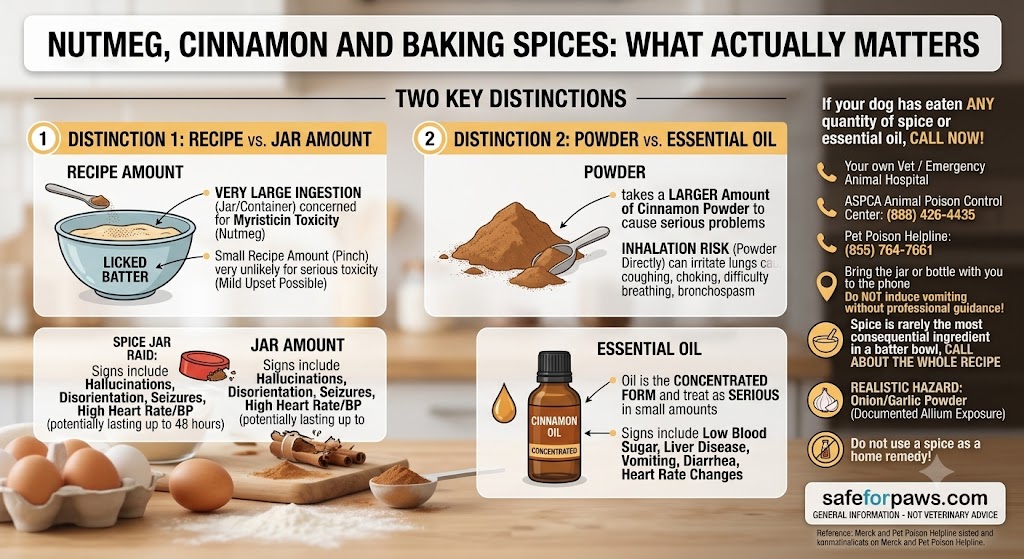
If your dog has eaten a quantity of any spice, or any essential oil, call now. Call your own veterinarian, your nearest 24-hour emergency animal hospital, the ASPCA Animal Poison Control Center at (888) 426-4435, or the Pet Poison Helpline at (855) 764-7661 (both US, 24/7, a fee may apply). Take the jar or bottle with you to the phone. Do not make your dog vomit unless a veterinarian or a poison line tells you to, for this dog, right now.
This page is general information from a dog parent who reads veterinary sources, not a veterinarian. It exists so your call to a professional is faster and better informed. It is not a substitute for that call.
Two splits, and they answer almost every version of this question
The Pet Poison Helpline's guidance on nutmeg and cinnamon toxicity, retrieved 2026-08-28, makes two distinctions that the search results collapse into one.
Split one: the recipe amount versus the jar amount.
On nutmeg, Pet Poison Helpline's position is that the small amount used in recipes is very unlikely to cause serious toxicity, though mild stomach upset could occur from a small ingestion. It is the very large amount, the jar or the container rather than the pinch, where myristicin toxicity becomes the concern, and the signs it names for that case are hallucinations, disorientation, increased heart rate, high blood pressure, dry mouth, abdominal pain and possibly seizures, potentially lasting up to forty-eight hours.
Split two: the powder versus the essential oil.
On cinnamon, the same source separates them explicitly: it takes a larger amount of the powder to cause problems than it does of the essential oil. The oil is the concentrated form and it is the one to treat as serious in small amounts.
Those two splits are the article. A licked batter bowl and a chewed-open spice jar are different events. A dusting of cinnamon and a spill of cinnamon oil are different events. The SERP calls all four "spices".
Why the batter bowl question usually resolves calmly, and why you still call
Most people arriving here have a dog who licked something out of a bowl. That is the low end of both splits: a recipe quantity, in powder form, mixed into other things.
Two reasons to call anyway, neither of which is alarmism.
You do not know what else was in the batter. Chocolate, raisins, a sugar-free sweetener, nuts. The spice is rarely the most consequential ingredient in a baking bowl, and the poison line will ask about the whole recipe rather than the spice you were worried about.
A poison line can close this in two minutes. Being told a lick from a batter bowl is not a concern is the outcome you want, and it is a better outcome than deciding it yourself from a webpage that cannot see the recipe.
The one that is easy to miss: inhaled powder
Pet Poison Helpline notes something specific and physical about cinnamon powder that has nothing to do with toxicity: dogs ingesting the powdered spice directly can inhale it, and it is very irritating to the lungs, causing coughing, choking, difficulty breathing and bronchospasm.
A dog who buries their nose in a spilled jar is at risk from breathing it as much as from eating it, and coughing or laboured breathing after a spice spill is a reason to go rather than a reason to watch.
The essential oil case, stated separately because it is different
Concentrated essential oils are not food ingredients and they behave differently from the spice they come from. Pet Poison Helpline names, for large overdoses of cinnamon powder or exposure to the essential oil, low blood sugar, liver disease, vomiting, diarrhea and changes in heart rate.
Treat any essential oil exposure as its own event, including skin contact and a dog who licks a spill, and take the bottle to the phone because the concentration is on the label.
What we will not publish
No safe amounts. Pet Poison Helpline's guidance includes a comparative figure for cinnamon powder. We report that they publish a comparative amount and we are not reproducing it as a line, because a figure like that used at home becomes "my dog had less than that, so I will not call", which is the exact decision this site exists to prevent.
No pinch-by-pinch reassurance for other spices. The realistic hazard in a spice rack is not the individually named baking spices, it is onion powder and garlic powder, which are a genuinely documented Allium exposure in concentrated form, and they have their own page on this site.
If you do not know what the spice was
Sometimes the jar is chewed and unreadable. That is common and it is workable. Bring the container anyway, even destroyed, and the approach for an unidentified substance is in my dog ate something and I do not know what it was.
What not to do
Do not make your dog vomit. Especially not after an oil exposure or where breathing is affected. The reasoning is in why you must never make a dog vomit on your own judgment.
Do not give milk, bread or water to dilute it. None of that is a treatment and it can complicate what happens next.
Do not use a spice as a home remedy for anything. Cinnamon in particular circulates as a supplement suggestion for dogs. That is a dosing decision and it belongs to a veterinarian, not to a blog and not to this one.
Do not assume a "pumpkin spice" product is only spice. Flavored drinks and baked goods contain sweeteners, chocolate and other ingredients, and the label matters more than the name.
FAQ
Is nutmeg toxic to dogs?
Pet Poison Helpline names myristicin as the toxin in nutmeg and describes very large ingestions as the concern, with signs including hallucinations, disorientation, increased heart rate, high blood pressure, dry mouth, abdominal pain and possibly seizures, lasting up to forty-eight hours. It describes the small amount used in recipes as very unlikely to cause serious toxicity, with mild stomach upset possible.
Is cinnamon safe for dogs?
The same source separates the powder from the essential oil, with the oil being the concentrated form that causes problems in far smaller amounts. It also notes that inhaled cinnamon powder is very irritating to the lungs.
My dog licked cake batter with nutmeg in it. What now?
Call and describe the whole recipe rather than just the spice. What else was in the bowl is usually the more consequential question.
Are baking spices dangerous for dogs in general?
The individually named baking spices are mostly a quantity-and-form question. The spice-rack items with a documented delayed toxicity are onion powder and garlic powder, which are concentrated Allium.
My dog is coughing after getting into a spice jar. Is that toxicity?
It may be irritation from inhaling the powder, which Pet Poison Helpline names specifically for cinnamon, and which it describes as capable of causing coughing, choking, difficulty breathing and bronchospasm. Breathing difficulty is a reason to go now rather than to wait.
Sources read at the source on 2026-08-28 and named above: Pet Poison Helpline, pet safety tips, "Nutmeg And Cinnamon Toxicity", for myristicin as the toxin in nutmeg, for the distinction between recipe amounts and very large ingestions, for the named signs of myristicin toxicity and their up-to-forty-eight-hour duration, for the distinction between cinnamon powder and cinnamon essential oil, for the named effects of large powder overdoses and oil exposure, and for the respiratory irritation caused by inhaled cinnamon powder.
Pet Poison Helpline publishes a comparative amount for cinnamon powder. It is deliberately not reproduced here as a figure. It is a comparison between forms, not a safe amount, and a number used at home to avoid a phone call is the failure mode this site is built to prevent.
This page is general information, not veterinary advice, and it does not diagnose or treat. If your dog has eaten something, the call comes first.