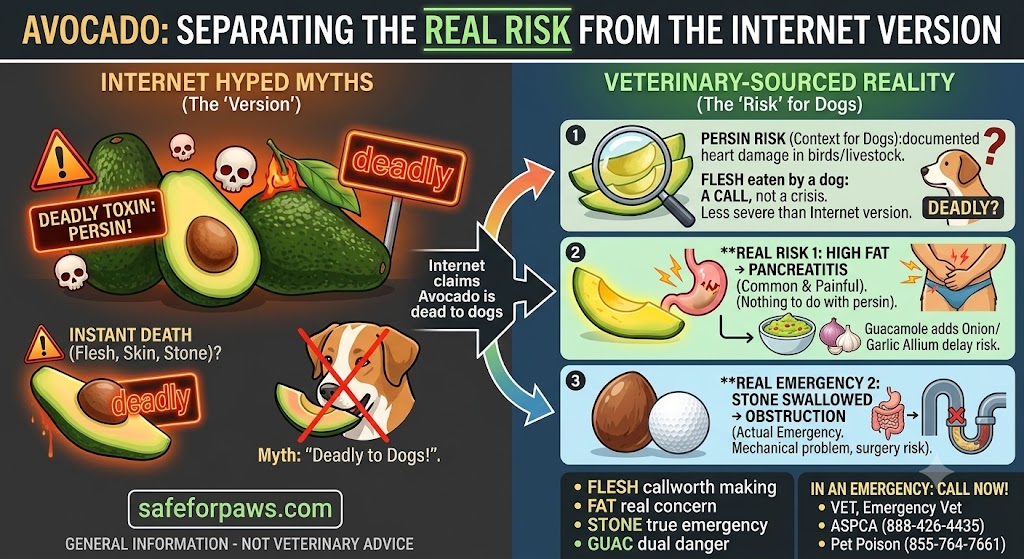
If your dog has eaten avocado, and particularly if they may have swallowed the stone, call now. Call your own veterinarian, your nearest 24-hour emergency animal hospital, the ASPCA Animal Poison Control Center at (888) 426-4435, or the Pet Poison Helpline at (855) 764-7661 (both US, 24/7, a fee may apply). Do not make your dog vomit unless a veterinarian or a poison line tells you to, for this dog, right now.
This page is general information from a dog parent who reads veterinary sources, not a veterinarian. It exists so your call to a professional is faster and better informed. It is not a substitute for that call.
If it has just happened, the page you want is my dog ate an avocado.
Why the answers you found contradict each other
Search this and you will find pages calling avocado deadly and pages calling it a harmless superfood, sometimes on the same site. Neither camp is quoting a veterinary source, and the source explains the disagreement.
The Merck Veterinary Manual's food hazards article, retrieved 2026-08-28 (reviewed October 2020, last updated May 2026), states:
"All parts of the avocado, the fruit, leaves, stems, and seeds, can cause poisoning in animals."
and describes heart muscle damage occurring within 24 to 48 hours in mammals and birds.
The word doing the work in that whole entry is "animals". Merck's toxicology is written across species, and avocado's documented harm is not evenly distributed across them. The severe, well-documented cardiac injury sits with birds and with certain livestock. The "deadly" pages are quoting the species where it is deadly. The "superfood" pages are quoting the species where it mostly is not. Both are describing something real about a different animal from the one in front of you.
That is the honest state of this subject and it is why we are not going to give you a clean verdict. What we can do is tell you which risks are documented, which are extrapolated, and which one actually sends most dogs to a vet.
The three separate questions inside "is avocado bad for dogs"
1. Persin, the compound everyone names
Persin is the substance the toxicity is attributed to, and it is present throughout the plant, which is what Merck's "all parts" statement reflects.
What is well documented is the cardiac damage in birds and in some livestock species. For dogs specifically, the picture in the reference literature is less severe than the internet version, and we are not going to fill that gap with confidence we do not have. Merck's page is written for animals generally and states the risk generally.
Practically: flesh eaten by a dog is a call rather than a crisis, and the call is worth making because it is the professional's assessment rather than a website's.
2. The fat, which nobody mentions and which sends dogs to vets
Avocado is a high-fat food. A dog who eats a large amount of a high-fat food is a dog with a plausible reason to develop pancreatitis, and that is a real, common and painful condition that has nothing to do with persin.
This is the part of the avocado question with the most everyday relevance and it is missing from almost every page, because it is not exotic.
Guacamole compounds it, and for a completely different reason: guacamole usually contains onion and garlic. A dog who ate guacamole may have an Allium exposure as well as an avocado one, and the Allium half is the one with a documented delayed presentation.
3. The stone, which is the actual emergency
A dog who swallows an avocado stone has swallowed a hard, smooth, roughly golf-ball-sized object.
That is an obstruction question, not a poisoning question, and obstruction is the mechanism most likely to require surgery here. It does not depend on any chemistry at all.
It also does not depend on whether you think the fruit was safe. A large object in a digestive tract is a mechanical problem, and a stone can move on and then lodge, so a dog who seemed fine yesterday is not cleared.
If the stone is unaccounted for, say so on the phone in those words. It changes what the vet does.
What that means when you call
Say which parts. Flesh only, flesh and skin, or stone unaccounted for. These are three different conversations.
Say what else was in it. Guacamole, salad, a dip. The onion and garlic question travels with the avocado question.
Say roughly how much and when. "A slice off a plate" and "half a bowl of dip" are different, and "twenty minutes ago" and "yesterday evening" are different.
What happens next from the owner's side is described in what the emergency vet actually does for a poisoning case.
What not to do
Do not make your dog vomit, and in this case there is a specific extra reason: bringing a large stone back up is not necessarily better than letting it go down, and that judgement is not one to make at home.
Do not conclude it is fine because a pet food contains avocado. Commercial products use processed fractions in controlled amounts. That tells you nothing about a whole fruit off a kitchen counter.
Do not conclude it is deadly because a bird died of it. Merck's statement is about animals generally, and the species differences here are large.
Do not skip the call because a website was reassuring. Including this one.
FAQ
Is avocado bad for dogs?
Merck states that all parts of the avocado can cause poisoning in animals, and documents heart muscle damage in mammals and birds within twenty-four to forty-eight hours. How severely that applies to dogs specifically is less well documented than the internet suggests in either direction, which is why this page describes the three separate risks rather than issuing a verdict.
Is guacamole worse than plain avocado for a dog?
It raises a second question, because guacamole usually contains onion and garlic. Mention it on the phone.
What if my dog swallowed the avocado stone?
That is the most urgent version of this, and it is an obstruction question rather than a toxicity one. Call and say the stone is unaccounted for.
Why do some sites say avocado is safe for dogs?
Because the severe documented harm sits with other species, particularly birds, and pages quoting the dog-specific literature reach a milder conclusion. Both are describing real findings about different animals.
My dog ate a small piece and seems fine. Do I still call?
Call and describe it. That is a short conversation and it accounts for your dog, the amount, what else was in it and whether the stone is accounted for, none of which a page can do.
Sources read at the source on 2026-08-28 and named above: the Merck Veterinary Manual, Special Pet Topics, Poisoning, "Food Hazards" (reviewed October 2020, last updated May 2026), for the quoted statement that all parts of the avocado can cause poisoning in animals and for the twenty-four to forty-eight hour window for heart muscle damage in mammals and birds.
Where this page describes the dog-specific picture as less clear than the internet version, that is a statement about what the reference source does and does not say for dogs, made deliberately rather than by omission. The pancreatitis and obstruction points are mechanisms of general veterinary knowledge stated as such, and neither is a diagnosis of your dog.
This page is general information, not veterinary advice, and it does not diagnose or treat. If your dog has eaten something, the call comes first.