
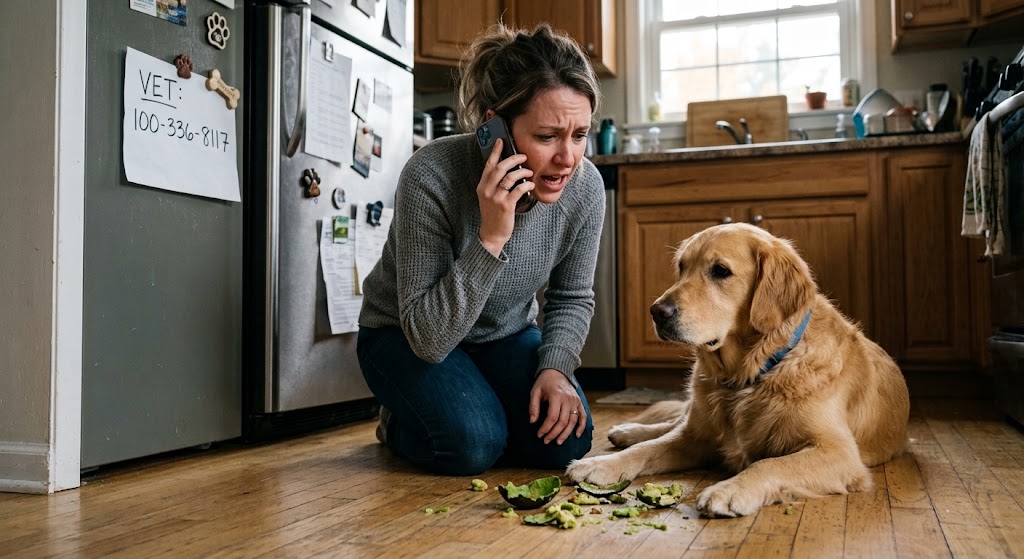
Call now, before you read further. Phone your own veterinarian, your nearest 24-hour emergency animal hospital, the ASPCA Animal Poison Control Center at (888) 426-4435, or the Pet Poison Helpline at (855) 764-7661. Both hotlines are US-based and staffed around the clock, and a consultation fee may apply. If the pit went down, say that in your first sentence, because a swallowed pit is a mechanical emergency and it is treated differently from a food question. Do not make your dog vomit and do not give any home remedy unless a veterinarian or a poison-control specialist tells you to, for this exact situation, right now. Our pet poison emergency page has the same call order in one place.
While the phone rings, find the pit. Actually find it, do not assume. Check the counter, the bin, the floor and the garden.
This page is general information gathered from published veterinary sources. It is not veterinary advice, it cannot examine your dog, and it cannot tell you whether your dog is safe. Please read our veterinary disclaimer.
The two different questions hiding inside "my dog ate avocado"
Owners arrive here with one query and two entirely different problems, and the internet mostly answers the wrong one.
Question one is chemical. Is avocado poisonous to dogs? That is the question every "can dogs eat avocado" article is built to answer, and it belongs to a calm pre-check reader who is deciding whether to share a slice.
Question two is mechanical. Is there a hard object the size of a golf ball inside my dog? That is a foreign-body question, it is the one that sends dogs to surgery, and it runs on a completely different clock.
If the pit is missing, you are in question two. Lead with that on the phone.
What the sources actually say about persin
Here is the part that explains why your search results feel like they contradict each other.
The ASPCA's toxic-plant entry for avocado lists it as toxic to horses. It names persin as the toxic principle and lists respiratory distress, edema and heart failure as the clinical signs. Those are alarming words, and they are the words that get quoted, screenshot and reposted across pet forums.
They are also, in that entry, describing a horse.
The American Kennel Club describes persin as a natural fungicidal toxin found in the leaves, skin and pit of the avocado, and states that dogs are more tolerant of it than other animals, with the flesh generally causing mild stomach upset at most in small amounts. That is a meaningfully different picture from the one a horse-focused warning paints.
So the scary version of avocado toxicity is largely borrowed from species that are not your dog. That is not permission to relax. It is context, and it is the thing to hold in your head while a professional asks you the real questions, because the actual dog risks lie somewhere the persin discussion does not point.
The information gain: the pit is the emergency, and it is on a different clock
Almost every page ranking for this query mentions the pit in a sentence and then returns to persin. That is backwards for the reader who is already in trouble.
The AKC states that avocado pits "are a serious choking hazard and can cause intestinal obstruction, especially in smaller dogs," and that this "can become a medical emergency requiring surgery."
Three things follow from that, and they are the practical core of this page.
One: the timeline is not a poisoning timeline. A stimulant or a toxin declares itself in hours. An object that is moving through an intestine may declare itself over days, or may lodge quietly and then stop everything at once. A dog who is bright and playing four hours after swallowing a pit has told you almost nothing about whether the pit is going to pass.
Two: the signs to describe are different ones. The AKC lists signs of obstruction as vomiting, straining, abdominal swelling, refusing food and lethargy. Repeated vomiting, especially with nothing coming up, is the one people wait too long on. That is a call-again-immediately list, not a wait-and-see list.
Three: size is relative, and the phone call handles it. A pit that would pass uneventfully through one dog is a plug in another. Nobody can judge that from a photograph, and this page will not try. It is why the first sentence of your call should be the pit and the weight of your dog.
If it turns out the missing object was a bone rather than a pit, the same mechanical logic applies and we set it out in what to do when a dog eats a cooked bone.
It was probably not a plain avocado
The other thing the pre-check articles miss: dogs rarely raid a bowl of plain sliced avocado.
- Guacamole typically contains onion and garlic, and those are a separate exposure with a delayed pattern of their own. If guacamole is what disappeared, mention the onion and garlic before you mention the avocado, and see why the danger from onion and garlic shows up days later.
- Salt, lime, chili and sour cream are all in that bowl too.
- Avocado toast, sushi rolls and dips bring their own extra ingredients.
- The skin and leaves, which are where the AKC places persin along with the pit, are more likely to be eaten from garden waste or a compost heap than from a plate.
- Fat. Avocado is a high-fat food, and a sudden fatty meal is a recognized trigger for pancreatitis in susceptible dogs. The AKC notes that too much avocado can cause weight gain or stomach upset from its fat content. That risk is independent of persin entirely.
Read the whole list of what was in the dish to the person on the phone. It routinely changes what they tell you.
What the vet or the hotline will ask you
Roughly these, roughly in this order. "I do not know" is a useful answer.
- Is the pit accounted for? Found, or missing. This is the first question for a reason.
- What form was it in? Plain flesh, guacamole, skin, garden trimmings, a whole fruit.
- What else was in it? Onion, garlic, salt, anything else.
- How much, worst case? Round up.
- How long ago, and did you see it happen or find the aftermath?
- How much does your dog weigh? Their weight now.
- Age, existing conditions, medications. A history of pancreatitis is worth volunteering.
- What are you seeing right now? Including nothing at all.
Write down the answer and any case number you are given. If you are told to come in, take these things with you, and take the pit if you found it, or a photo of an identical one if you did not.
The number this page does not give you
You will see a per-weight feeding amount for avocado quoted in nutrition articles. This site publishes no dose, no threshold and no weight-based calculation for any substance, including that one, and that is deliberate rather than an oversight.
A serving suggestion for a healthy dog eating a planned snack is a different kind of statement from a safety threshold for a dog who just ate an unknown amount off the floor, and the two get confused constantly in this niche. In an incident you rarely know the amount, you often do not know the form, and a number that persuades an owner not to call is doing harm. The specialist on the phone can do that arithmetic properly, with your actual dog and your actual bowl.
What not to do while you wait
Do not make your dog vomit. Not with hydrogen peroxide, not with salt, not on the strength of a search result. It is a decision that depends on the substance, the timing and the animal, and with a swallowed pit specifically it can turn a moving object into a stuck one in the wrong place. This site publishes no method for it at all, on purpose.
Do not feed bread, oil or anything to "help it slide through." That is folk advice, it can complicate an anesthetic if surgery is needed, and it is not yours to decide.
Do not wait for the pit to appear in the garden as your only plan. Many pass. The ones that do not are the reason this page exists, and the checking should happen alongside professional advice, not instead of it.
Do not treat a normal-looking dog as proof of anything yet. The reasoning is in why a dog that seems fine can still be in trouble.
Frequently asked questions
Is avocado poisonous to dogs?
Less than the internet suggests, and not in the way the internet suggests. The ASPCA's toxic-plant entry for avocado lists it as toxic to horses, naming persin as the toxic principle. The American Kennel Club describes persin as present in the leaves, skin and pit, and describes dogs as more tolerant of it than other animals, with the flesh generally causing mild stomach upset at most in small amounts. The bigger dog-specific risks are the pit as an obstruction and the fat content.
My dog swallowed a whole avocado pit. What happens now?
That is the scenario to call about immediately and to describe first. The AKC states that avocado pits are a serious choking hazard and can cause intestinal obstruction, particularly in smaller dogs, and that this can become a medical emergency requiring surgery. Some pits pass. Whether to watch, image or intervene is a decision for someone who knows your dog's size and can examine them.
How long does it take for an avocado pit to pass through a dog?
There is no reliable figure this page can give you, because it depends on the dog, the pit and where it is. That uncertainty is the point: an obstruction can announce itself days after the swallow, so a normal first evening is not an all-clear. Ask the veterinarian how long to watch, what to watch for, and when to stop watching and come in.
My dog ate guacamole. Is that worse than plain avocado?
It is a different conversation, and usually a more urgent one. Guacamole typically contains onion and garlic, which are a separate exposure with a delayed pattern, plus salt and other ingredients. Say the word guacamole rather than avocado when you call, and read the recipe or the label if you have it.
He ate some avocado flesh and seems completely fine. Do I still need to call?
Calling costs you a few minutes and settles it. Published sources describe the flesh as the lowest-risk part for dogs in small amounts, but this page cannot see your dog, cannot know the amount, and does not know whether the skin or the pit went with it. If the pit is unaccounted for, do not wait at all.
Safe for Paws is written by Md Astafar Hossain, a dog parent and researcher, not a veterinarian. This is general information gathered from published veterinary sources including the ASPCA Animal Poison Control Center, the American Kennel Club and the Merck Veterinary Manual. It is not veterinary advice, it is not a set of instructions, and it cannot diagnose or treat your pet. Please read our full veterinary disclaimer. If anything here conflicts with your own veterinarian, listen to your veterinarian. In an emergency, call your vet, the ASPCA Animal Poison Control Center at (888) 426-4435, or the Pet Poison Helpline at (855) 764-7661.