
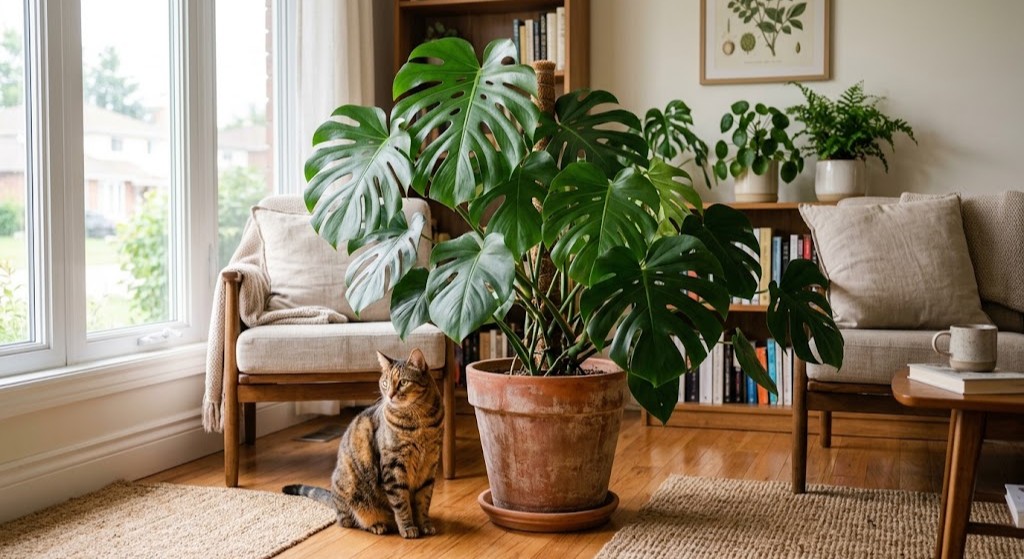
Yes, monstera is toxic to cats. The ASPCA lists Monstera deliciosa (Swiss cheese plant, split-leaf philodendron) as toxic to both cats and dogs because it contains insoluble calcium oxalate crystals. When a cat bites a leaf, those crystals cause intense burning and irritation of the mouth, tongue and lips, heavy drooling, vomiting and difficulty swallowing. If your cat has just chewed a monstera, call your veterinarian or a 24/7 poison line now: the ASPCA Animal Poison Control Center at 888-426-4435 or the Pet Poison Helpline at 855-764-7661.
If Your Cat Chewed a Monstera: What to Do Right Now
This section comes first because you may be reading it with a drooling cat beside you.
- Call for expert advice now. Phone your own veterinarian, the nearest 24-hour emergency animal hospital, the ASPCA Animal Poison Control Center at 888-426-4435, or the Pet Poison Helpline at 855-764-7661. Both poison lines answer 24 hours a day, and both charge a consultation fee.
- Do not induce vomiting and do not try any home treatment unless a veterinarian or a poison-control specialist tells you to, for this plant, at that moment. That includes remedies you may see suggested online. The right next step depends on your cat and on what was actually eaten, and that is the specialist's call, not ours.
- Go straight to an emergency vet if your cat is struggling to breathe, has a visibly swollen face, tongue or throat, or cannot swallow. Do not wait on hold for those signs.
- Have the facts ready. The plant's name (keep the plant tag or take a photo), which part was chewed, roughly how much, what time it happened, and your cat's age, weight and any health conditions.
Toxicity varies with the size, age and health of the individual animal, and how much plant was involved. Only a veterinarian can judge what it means for your cat. This article is general information, not a diagnosis and not a substitute for that call.
Why Monstera Hurts: The Needle Crystals Explained
Monstera belongs to the Araceae family, the same family as philodendron, pothos, dieffenbachia and peace lily. Plants in this family store insoluble calcium oxalate as microscopic, needle-shaped crystals. The Merck Veterinary Manual describes these crystals, called raphides, as "found bundled in cells called idioblasts that are scattered throughout the plant." When a cat bites down, those cells break open and the crystals end up in the soft tissue of the lips, tongue and mouth.
That is why the reaction is usually immediate. The Merck Veterinary Manual (page reviewed by Renee D. Schmid, DVM, of Pet Poison Helpline, last updated September 2024) lists the clinical signs of insoluble oxalate plants as immediate pain, irritation, redness, hypersalivation, pawing at the mouth, swelling, lethargy and loss of appetite. The ASPCA's own entry for monstera names oral irritation, intense burning of the mouth, tongue and lips, excessive drooling, vomiting and difficulty swallowing.
So the drooling you are seeing is a sign the Merck Veterinary Manual and the ASPCA both associate with this plant. It is still a sign to report, not a sign to interpret on your own.
Mouth Injury Versus Organ Damage: The Distinction Most Pages Miss
Most pages that answer "is monstera toxic to cats" stop at the word "toxic". That word covers very different outcomes, and the difference is the most useful thing to understand about this plant.
- Insoluble oxalate plants such as monstera cause local injury where the crystals touch: the mouth, throat and gut lining. The Merck Veterinary Manual states that, unlike plants containing soluble oxalates, insoluble oxalates "do not pose a concern for renal injury."
- True lilies (Lilium and Hemerocallis) are a completely different category in cats. According to the FDA, every part of a true lily, including pollen and vase water, can cause fatal kidney failure in a cat. Our guide to which lilies are toxic to cats and which are not explains that split in detail.
This matters for one reason: the words "toxic plant" on a label or a list cannot tell you which category you are in, and neither can you from the living room. Houseplants get mislabeled, bought without tags, or confused with look-alikes. That is exactly why the call to a vet or poison line comes before the reading, even for a plant like monstera that is usually described as a mouth irritant.
Which Signs Mean You Should Not Wait
The Pet Poison Helpline's page on insoluble oxalate plants lists drooling, gagging and vomiting as the common signs, and adds that "in rare instances severe throat swelling resulting in breathing difficulty can occur." That rare event is the one that turns a painful mouth into an emergency.
Signs worth reporting to the vet or poison line include:
- Drooling, foaming or pawing at the mouth
- Head shaking or visible discomfort when swallowing
- Vomiting or gagging
- Loss of appetite or hiding
- Swelling of the lips, tongue or face
Labored or noisy breathing, and swelling that affects swallowing, are reasons to go to an emergency vet straight away. The Merck Veterinary Manual notes that veterinarians watch specifically for swelling around the larynx that could cause respiratory distress. A cat with any breathing difficulty needs to be seen, not watched.
If your cat seems quiet rather than drooling, the sign list for general feline poisoning is broader, and our overview of cat poisoning and why cats are different covers what the vet will want to know when you call.
Is Any Part of Monstera Safe for Cats?
No part of the plant should be treated as safe for a cat. The ASPCA lists the plant as toxic without separating leaf from stem, and the Merck Veterinary Manual lists the genus Monstera as a whole among insoluble oxalate plants rather than a single species. That means the smaller trailing monsteras belong in the same conversation as the large split-leaf plant, although the plant tag is still the best way to confirm what you own.
Two practical points follow from that:
- Cut leaves count. A leaf in a vase, a trimming left on the floor, or a stem being rooted in a jar of water is still plant material a cat can chew.
- Sap on fur or paws is worth mentioning when you call. The crystals are the problem, so tell the specialist if your cat has broken stems or leaves and could lick residue off its coat. Ask them what, if anything, you should do about it rather than improvising.
Why We Do Not List Home Remedies
Search results for this question often suggest rinsing a cat's mouth, offering milk, or waiting it out. The Merck Veterinary Manual does describe rinsing or wiping out the mouth, and sometimes calcium-containing dairy, as part of veterinary care for oxalate exposure, but that description is written for veterinarians handling a patient in front of them. It is not a home protocol.
We do not give home treatment steps on this site for three reasons:
- A distressed cat with a painful mouth can bite, inhale water or panic when handled.
- You cannot confirm from home that the plant was only monstera, or that the swelling is not progressing.
- The poison line can tell you, for your cat, whether anything should be done at home at all. That is advice with your cat's details behind it.
If the specialist does give you a home instruction, follow it exactly as given for this incident only.
How Serious Is It Usually?
The Merck Veterinary Manual describes the prognosis for most exposures to insoluble oxalate plants as good to excellent. That is a statement about most cases across many animals, not a promise about yours. It sits alongside the Pet Poison Helpline's warning about rare severe throat swelling, and both are true at once.
There is no amount of monstera that anyone can responsibly call "safe" for a cat, and this site never publishes one. How a cat reacts depends on how much was chewed, whether it was swallowed, and the cat's size, age and health. A kitten, a senior cat or a cat with existing health problems may not respond like a healthy adult. Only a veterinarian can weigh those factors.
Keeping a Monstera in a Home With a Cat
Plenty of households keep a cat and houseplants. The question is whether the cat can reach the plant, and whether you would know if it did.
- Assess reach honestly. Cats climb and jump. A high shelf is only out of reach if nothing near it works as a launch point, and large monstera leaves often spread well beyond the pot.
- Check for chewing regularly. Torn leaf edges or bite marks are a sign your cat is already sampling the plant.
- Keep the plant tag. If an incident happens, the correct name saves time on the phone.
- Consider moving the plant to a room the cat cannot enter, or rehoming it, if your cat is a determined chewer.
If your cat has already been into another plant as well, our guide to what to do when your cat chewed a houseplant walks through identification and the first steps for other species.
Sources Checked
We read the ASPCA Animal Poison Control Center's plant entry for Monstera deliciosa on September 27, 2026, and the Merck Veterinary Manual's chapter on houseplants and ornamentals toxic to animals on the same date. The Pet Poison Helpline's page on insoluble oxalate plants and the FDA's guidance on lilies and cats were also read on September 27, 2026.
Frequently Asked Questions
Is monstera toxic to cats even if they only took one bite?
The ASPCA lists monstera as toxic to cats without a minimum amount, and the crystals act on contact, so even a single bite can cause pain and drooling. Call your vet or a poison line and let them decide whether your cat needs to be seen.
Can monstera cause kidney failure in cats like lilies do?
The Merck Veterinary Manual states that insoluble oxalates, the compounds in monstera, do not pose a concern for kidney injury. True lilies are different and can cause kidney failure in cats. If you are not certain which plant your cat touched, tell the poison line.
My cat is drooling after chewing a monstera leaf. Is that an emergency?
Drooling is one of the signs the ASPCA lists for monstera. Call your vet or a poison line now. Go to an emergency vet immediately if there is any breathing difficulty or swelling of the face, tongue or throat.
Should I rinse my cat's mouth or give milk?
Do not try any home treatment unless your vet or a poison-control specialist tells you to for this incident. Handling a cat with a painful mouth carries its own risks, and the specialist can judge whether anything should be done at home.
Is monstera toxic to dogs too?
Yes. The ASPCA lists monstera as toxic to both dogs and cats, with the same insoluble calcium oxalate crystals and similar signs.
This article is general information and does not replace veterinary care. If you think your cat has chewed any plant, contact your veterinarian, the ASPCA Animal Poison Control Center at 888-426-4435, or the Pet Poison Helpline at 855-764-7661. Only a veterinarian can assess your individual cat.