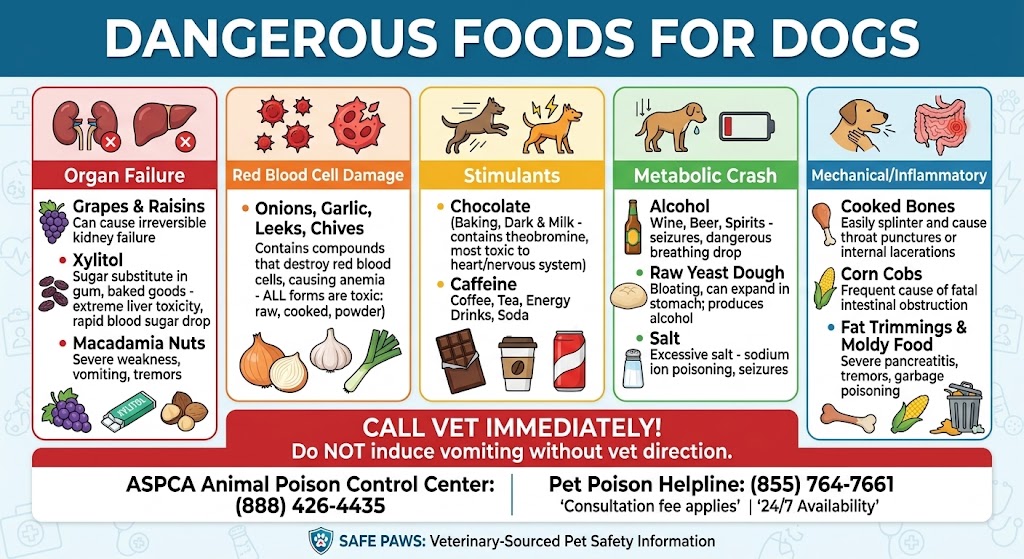
If your dog has already eaten one of these, call now.
- Your own vet, or the nearest emergency veterinary hospital out of hours.
- ASPCA Animal Poison Control Center: (888) 426-4435, 24 hours. A consultation fee applies.
- Pet Poison Helpline: (855) 764-7661, 24 hours. A consultation fee applies.
Do not make your dog vomit unless a veterinary professional tells you to. Keep the packaging.
Pet poison emergency page, numbers only, nothing to scroll past.
The short answer: the foods dogs cannot eat are chocolate and caffeine, grapes and raisins, onions, garlic, leeks and chives, xylitol, macadamia nuts, alcohol, raw yeast dough, large amounts of salt, moldy food, and cooked bones and fatty trimmings. What almost no list tells you is that these are five different kinds of danger, not one. Some attack the kidneys or the liver. Some destroy red blood cells over days. Some act as stimulants within hours. Some cause a metabolic crash in minutes. Some do purely mechanical damage. The group a food belongs to is what decides how quickly it shows, what a vet will do, and how worried to be.
This page is the reference version, for the reader standing in a kitchen deciding whether to share something. If it has already been eaten, stop reading and make the call above.
The five kinds of danger, not one list
Organ failure
Grapes and raisins are the clearest example. The ASPCA Animal Poison Control Center identified tartaric acid as the toxic principle, published in the Journal of the American Veterinary Medical Association in 2021 by a team from the APCC and two veterinary hospitals. Grapes, raisins, sultanas and currants can cause acute kidney injury, and the Merck Veterinary Manual describes that injury developing over roughly 24 to 72 hours rather than immediately. There is no established safe quantity, and the reaction is not predictable between dogs. We have separate guides on a dog who ate a single grape and on raisins baked into something.
Xylitol also belongs partly in this group. Alongside its rapid effect on blood sugar, VCA Hospitals and the FDA both describe liver injury as a documented consequence of xylitol ingestion in dogs.
Macadamia nuts sit on their own. They produce a distinctive and alarming picture, including weakness in the back legs, tremors and an inability to walk normally, but veterinary sources describe the mechanism as still not fully explained and the outcome as generally better than the picture suggests. It is a call, not a catastrophe, and it is genuinely different from every other nut.
Red blood cell damage
Onion, garlic, leek, chive and shallot, the allium family, damage a dog's red blood cells. The result is hemolytic anemia: pale gums, weakness, rapid breathing, and in some cases discolored urine. The distinctive thing about this group is timing. The damage accumulates and the anemia becomes visible days after the meal, so a dog who ate onion gravy on Sunday and is bouncing around on Monday has not escaped anything yet. Cooking does not remove the risk. Powdered and dehydrated forms are the ones most often missed.
Stimulants
Chocolate and caffeine belong together because they contain the same class of compound, the methylxanthines. In chocolate the relevant one is theobromine, and dogs clear it far more slowly than people do. Signs described by veterinary sources include restlessness, panting, vomiting, a racing or irregular heart rate, tremors and seizures. Caffeine from coffee grounds, used pods, tea bags, energy drinks and caffeine tablets does the same job, often in a more concentrated form than an owner expects.
Metabolic crash
Xylitol is the fastest-moving item on this page. In dogs it triggers a powerful insulin release, and the resulting drop in blood sugar can produce weakness, stumbling, collapse and seizures. The FDA's consumer guidance names it as a serious canine hazard, and it is now common in far more than chewing gum.
Alcohol and raw yeast dough belong here too. Dough is the one people underestimate: the yeast keeps fermenting in the warm stomach, so it both expands and produces ethanol. The Merck Veterinary Manual, describing bread dough toxicosis, notes that death is usually due to the metabolic effects of the ethanol rather than to the distension owners actually fear.
Salt, in the quantities found in homemade play dough, salt-dough ornaments, or a large volume of seawater, can cause sodium ion poisoning with neurological effects.
Mechanical and inflammatory injury
Cooked bones splinter, and the fragments can perforate or lodge. Corn cobs are a classic obstruction, because they do not break down. Fat trimmings and rich leftovers are a recognized trigger for pancreatitis. Moldy food from a bin or a compost heap can contain tremorgenic mycotoxins, which cause muscle tremors and can be severe.
Nothing in this group is a poison in the classic sense. All of it is a reason to call a vet.
Concentration is the hidden variable
This is the part the numbered lists leave out, and it is the single most useful idea on this page.
The same food is not the same hazard in every form. What changes is how much of the active compound is packed into a mouthful:
| The familiar form | The concentrated form that catches people out |
|---|---|
| A grape | A raisin, sultana or currant, which is the same fruit with the water removed and is easy to eat by the handful in a cookie or a cereal bar |
| Milk chocolate | Cocoa powder, baking chocolate and cocoa mulch, where far more theobromine sits in far less material |
| A slice of raw onion | Onion and garlic powder in gravy, stock cubes, seasoning blends, dips, baby food and takeout sauces |
| Coffee, brewed | Used grounds, unbrewed grounds, espresso pods and caffeine tablets |
| Peanut butter, which is not itself toxic | Specific jars sweetened with xylitol, which is not visible in the product and only appears on the label |
| A beer left on a table | Fermenting dough, and undiluted spirits or flavored liqueurs |
Two conclusions follow. First, the food name alone is not enough to judge risk, which is why a phone call to a professional who can ask about form and quantity beats reading a list. Second, the hazards that reach dogs most often are the ones hidden inside something else: the raisin in the scone, the onion powder in the gravy, the xylitol in the jar. Whole, obvious portions of dangerous food are the easy case. Ingredients are the hard one.
Read the ingredient panel on anything you are about to share. It is a two-second habit that catches the exposures a list of food names never will.
Fast dangers and slow dangers
Group the same substances by speed and a second pattern appears.
Fast, in minutes to hours: xylitol's effect on blood sugar, alcohol, caffeine, the stimulant phase of chocolate, tremorgenic mycotoxins from moldy food.
Slow, over a day or several: kidney injury after grapes and raisins, described by Merck over roughly 24 to 72 hours; hemolytic anemia from the allium family; liver injury from xylitol; pancreatitis after a fatty meal.
The practical consequence is the reason we say the same thing on every page of this site. A normal-looking dog is not evidence that nothing happened. For the slow group, a normal-looking dog is exactly what you would expect to see in the early window. Waiting for a symptom before calling means waiting until the option of early intervention has passed.
The question this page will not answer: how much
There is no "how much is too much" figure anywhere on this site, and this pillar is not an exception.
The reason is not caution for its own sake. A number in an owner's hands stops being information and becomes permission. A published threshold turns into "he only had half of that, so we're fine," and the arithmetic gets done by a frightened person at midnight using a guessed body weight and a guessed portion. For grapes there is no reliable dose-response threshold to publish at all, because tartaric acid content varies with variety, growing conditions and ripeness, which is precisely why two similar dogs can eat the same amount with different outcomes.
The people who can do this calculation properly are veterinary toxicologists, they do it against a real weight and a real product, and they are on the end of both numbers at the top of this page around the clock. That is the correct place for the number, and it is not here.
If your dog has already eaten one of these
- Call. Your vet, an emergency hospital, or one of the two hotlines above.
- Keep the evidence. The wrapper, the jar, the packet, the plant, the vomit. Ingredient lists matter.
- Know your dog's weight, or your best estimate.
- Do not induce vomiting. The ASPCA's position is that this belongs under veterinary direction only. Hydrogen peroxide, the method that circulates most widely online, is an irritant that veterinary sources link to inflammation and ulceration of the stomach and esophagus, and vomiting carries an aspiration risk. It is dangerous for corrosive substances and for any dog who is already unsteady. Full reasoning: why you must never make a dog vomit on your own judgment.
- Do not give milk, oil, salt or activated charcoal on your own initiative.
- Follow the plan you are given, including the boring version where you are told to monitor at home.
The first hour matters more than any other. Our step-by-step guide is what to do in the first 60 minutes.
A note on what is not here
Some foods appear on every "dangerous" list with far weaker evidence behind them than the items above, and a few appear because of a misunderstanding that spread. That is worth a page of its own rather than a paragraph here, and it is the one page on this site whose job is to reduce alarm rather than raise it. It is coming.
Until then, the honest position: this page names foods that are dangerous. It does not name any food, or any amount of any food, as safe to feed. That is a conversation for your own vet, who knows your dog.
Frequently asked questions
What is the most dangerous food for a dog?
There is no single answer, because the foods differ in mechanism rather than in rank. Xylitol acts fastest. Grapes and raisins carry a risk of kidney failure with no predictable threshold. Cocoa powder and baking chocolate carry far more theobromine than milk chocolate. Any of them is a reason to call a vet or a poison control hotline.
How much of a toxic food does it take to hurt a dog?
This site publishes no quantity, threshold or body-weight calculation for any substance, and for grapes no reliable dose-response threshold exists in the veterinary literature. Risk is assessed by a veterinary toxicologist against your dog's actual weight and the actual product. Both hotlines above do that assessment around the clock.
My dog eats these foods regularly and has been fine. Does that mean he is not affected?
No. Several of the substances on this page cause damage that accumulates or becomes visible only after a day or more, particularly the onion and garlic family. An absence of visible signs after a previous meal is not evidence of safety, and it is not a prediction about the next one.
Is peanut butter bad for dogs?
Peanut butter itself is not on the toxic list. The problem is that some brands are sweetened with xylitol, which is dangerous to dogs, and it is not visible in the product. Read the ingredient panel on the specific jar, every time, because formulations change without notice.
Is cooked onion or garlic safer than raw?
No. Cooking does not remove the compounds that damage a dog's red blood cells. Powdered and dehydrated forms are more concentrated than the fresh vegetable and are the versions most often eaten by accident, in gravies, stocks, sauces and seasoning blends.
Safe Paws publishes veterinary-sourced pet safety information. We are not veterinarians and this page is not veterinary advice, a diagnosis, or a substitute for examining your dog. See our veterinary disclaimer. Sources named on this page: ASPCA Animal Poison Control Center, Merck Veterinary Manual, VCA Hospitals, the US Food and Drug Administration, Pet Poison Helpline.