
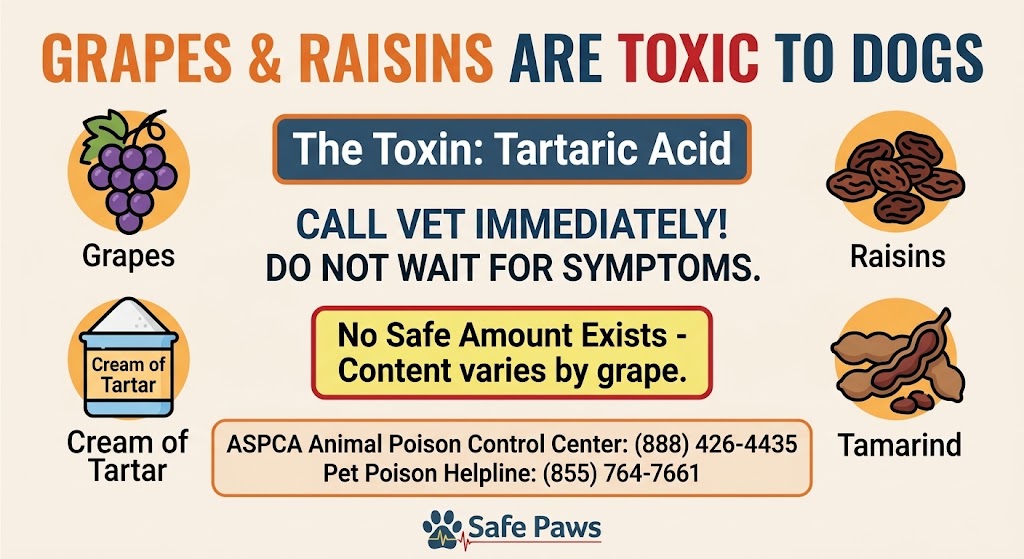
If your dog has already eaten grapes or raisins, call now. Do not wait for symptoms.
- Your own vet, or the nearest emergency veterinary hospital out of hours.
- ASPCA Animal Poison Control Center: (888) 426-4435, 24 hours. A consultation fee applies.
- Pet Poison Helpline: (855) 764-7661, 24 hours. A consultation fee applies.
Do not make your dog vomit unless a veterinary professional tells you to.
Pet poison emergency page, numbers only.
The short answer: grapes are toxic to dogs because of tartaric acid, and the potassium bitartrate that comes with it. Veterinary toxicologists at the ASPCA Animal Poison Control Center, working with two veterinary hospitals, published the identification as a letter in the Journal of the American Veterinary Medical Association in April 2021. Dogs are unusually sensitive to tartaric acid, and grapes carry it in high concentration. The toxin can cause acute kidney injury. Critically, identifying the cause did not produce a safe amount: tartaric acid content varies with grape variety, growing conditions and ripeness, so no reliable threshold exists and every ingestion is still treated as an emergency.
What the research actually found
The team behind the 2021 letter noticed something while investigating an unrelated case: a dog that had become seriously ill after eating homemade play dough, the kind made with flour, salt and cream of tartar. The kidney injury looked like grape toxicity, and the dog had not eaten grapes.
Cream of tartar is potassium bitartrate, a byproduct of winemaking. That is the link. As the ASPCA's own summary published through ASPCApro explains, tartaric acid and potassium bitartrate are present in grapes at unusually high concentrations, and dogs are a species already shown to be sensitive to tartaric acid. Cream of tartar produces clinical signs and pathology in dogs that closely resemble what grape ingestion produces.
The answer had been sitting in a baking ingredient the whole time.
Why it took so long
Grape and raisin toxicity was recognized in the veterinary literature for decades before the cause was known. That is unusual, and the reason is worth understanding because it also explains the part that has not been fixed.
Investigators had looked for a contaminant, on the reasonable assumption that a common fruit does not poison one species for no reason. Pesticide residue was examined. Heavy metals were examined. Mycotoxins from mold on the fruit were examined. None of them held up: the poisonings occurred across different regions, different growers, different products, organic and conventional, fresh fruit and dried.
The other obstacle was the erratic pattern. Reports described dogs that ate a large quantity and were unaffected, and dogs that ate very little and went into kidney failure. A toxin that behaves that inconsistently does not look like a single compound present in every grape, which is exactly the direction the search needed to go.
What the discovery changed
Three real things.
It gave the problem a name. Veterinarians can now describe the mechanism to owners instead of saying "we don't know why."
It explained the inconsistency. Tartaric acid concentration is not fixed. It varies with the grape variety, with how and where the fruit was grown, and with ripeness at harvest. Two dogs of similar size can eat the same volume of fruit and receive very different exposures, which is precisely what the case reports had been describing for years.
It widened the warning. Once tartaric acid is the culprit, other tartaric acid sources become relevant, which is covered further down this page.
What the discovery did not change
This is the part that matters most to the person reading, and it is the part most coverage skips.
It did not produce a safe amount. This is the single most common misreading of the news. Knowing the toxic principle would only give you a threshold if the amount of it in a given grape were predictable, and it is not. That variability is now explained; it has not been removed. There is still no reliable dose-response threshold in the veterinary literature that an owner could apply to a grape sitting on their kitchen floor, and this site publishes no number for it.
It did not produce an antidote. There is no drug that neutralizes tartaric acid in a dog. Treatment remains supportive and time-sensitive: decontamination where a veterinarian judges it appropriate, intravenous fluids, and monitoring of kidney values.
It did not change what you should do. The advice before 2021 and the advice today are the same. Any ingestion of grapes, raisins, sultanas or currants is a reason to contact a veterinarian or a poison control service immediately.
It did not make any variety safe. Not seedless. Not peeled. Not organic. Not a single grape. Not the raisins in a cookie. There is no evidence supporting any of those exemptions, and a page that offered one would be inventing it.
The useful way to hold this: the research answered a scientific question, not a practical one. It told us why. It did not tell us how much, and it was never going to.
The other places tartaric acid turns up
The practical consequence of the discovery, and the reason it belongs in a kitchen conversation rather than a journal:
| Source | Why it matters |
|---|---|
| Cream of tartar | Potassium bitartrate. The ingredient that led to the discovery, and a standard component of homemade play dough and salt dough ornaments, both of which dogs eat. |
| Tamarind | Named by the ASPCA as another notable tartaric acid source. It appears in sauces, chutneys, candies and drinks. |
| Grape juice, must and pomace | Same fruit, and pomace is the pressed residue left after winemaking. |
| Raisins, sultanas, currants | The same fruit with the water removed, so it is easy for a dog to eat a large number quickly, especially baked into something. |
| Foods with grape-derived ingredients | Grape juice concentrate is used as a sweetener in some snack bars, trail mixes and drinks. Read the panel. |
If your dog got into homemade play dough, say so on the phone. It is not an obvious poisoning and it is a documented one.
What happens in a dog's body, and over what period
The target organ is the kidney. Veterinary sources describe vomiting as often the first thing an owner sees, sometimes within hours, frequently with recognizable pieces of fruit in it, followed by lethargy, loss of appetite and abdominal discomfort. What follows, if kidney injury develops, is a change in urination: initially producing more, then producing less, and eventually little or none. That last stage is a serious sign.
On timing, the Merck Veterinary Manual describes acute kidney injury after grape or raisin ingestion developing over roughly 24 to 72 hours. That is a description of when injury appears, and it is not a window in which it is safe to wait and see. It is the reason waiting is dangerous: by the time the visible signs arrive, the damage they signal has already been done, and the interventions that work best are the early ones.
This is the same trap covered in our guide to the dog who "seems fine" after eating something toxic.
Why this page publishes no number
You will find grape counts and per-kilogram figures elsewhere, some of them drawn from real case series. We do not republish them, and the reason is specific rather than squeamish.
A number on a page like this stops being information the moment a frightened owner reads it. It becomes permission. "He only had three, and the site said four" is an arithmetic problem being solved at midnight, with a guessed body weight, a guessed count, and a grape variety nobody knows the tartaric acid content of. Every one of those inputs is wrong, and the output is a decision not to call.
The people who can do this properly are veterinary toxicologists working from your dog's actual weight and the actual product, and they are available around the clock on both numbers at the top of this page. The number belongs in that conversation, not on this page.
If your dog has already eaten grapes or raisins
- Call, immediately. Your vet, an emergency hospital, or one of the two hotlines.
- Say what it was and roughly how much was available, not how much you think was eaten. Bring the box or bag.
- Give your dog's weight, or your best estimate.
- Do not induce vomiting on your own judgment. The ASPCA's position is that induction belongs under veterinary direction. Hydrogen peroxide, the method that circulates most widely, is an irritant that veterinary sources associate with inflammation and ulceration of the stomach and esophagus, and vomiting carries an aspiration risk.
- Go in if you are told to. Treatment for this exposure is most effective early.
Our step-by-step guides: the first 60 minutes after any toxic ingestion, a dog who ate one grape, and raisins baked into something.
Frequently asked questions
What in grapes is toxic to dogs?
Tartaric acid, and the potassium bitartrate that accompanies it. Veterinary toxicologists at the ASPCA Animal Poison Control Center published the identification in the Journal of the American Veterinary Medical Association in April 2021, after noticing that a dog poisoned by homemade play dough containing cream of tartar showed the same kidney injury as grape ingestion.
Now that the toxin is known, is there a safe number of grapes?
No. Tartaric acid content varies with grape variety, growing conditions and ripeness, so the same weight of fruit is not the same exposure. No reliable dose-response threshold exists, and this site publishes no quantity for any substance. Every ingestion is treated as a reason to call.
Are raisins more dangerous than grapes?
They are the same fruit with the water removed, which means the toxic compound is more concentrated by weight and a dog can eat many more of them in a mouthful, often hidden inside baked goods. Both are treated as emergencies.
Are seedless, peeled or organic grapes safe for dogs?
There is no evidence that any variety or preparation of grape is safe for dogs. The seeds, the skin and the growing method are not the issue. The compound is in the fruit itself.
How long after eating grapes would a dog get sick?
Vomiting can appear within hours. The Merck Veterinary Manual describes acute kidney injury developing over roughly 24 to 72 hours. That range is a reason to call immediately rather than a window in which waiting is safe, because early treatment is what protects the kidneys.
Safe Paws publishes veterinary-sourced pet safety information. We are not veterinarians and this page is not veterinary advice, a diagnosis, or a substitute for examining your dog. See our veterinary disclaimer. Sources named on this page: ASPCA Animal Poison Control Center and ASPCApro, the Journal of the American Veterinary Medical Association (April 2021), Merck Veterinary Manual, Pet Poison Helpline.