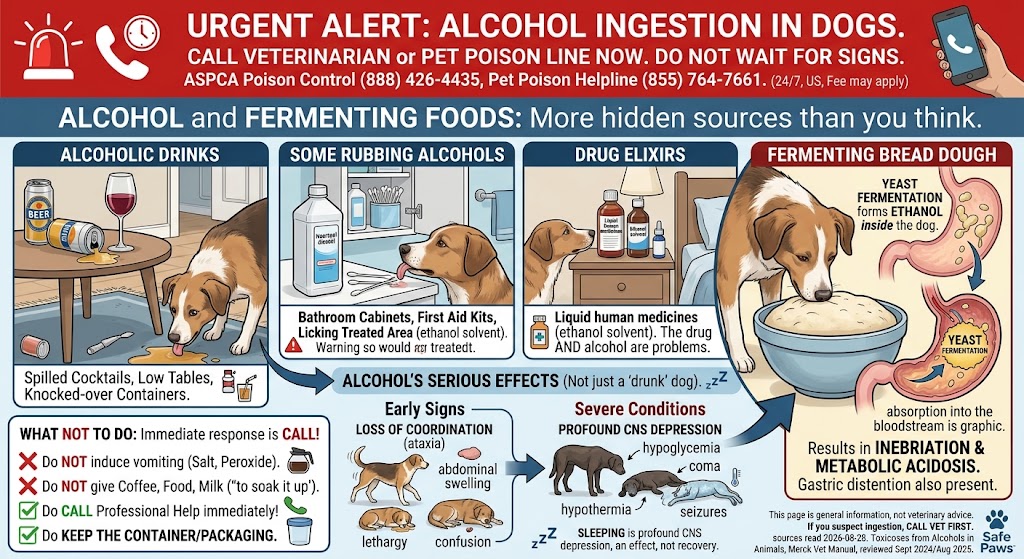
If your dog has swallowed anything containing alcohol, call now. Call your own veterinarian, your nearest 24-hour emergency animal hospital, the ASPCA Animal Poison Control Center at (888) 426-4435, or the Pet Poison Helpline at (855) 764-7661 (both US, 24/7, a fee may apply). Take the bottle, packet or container with you to the phone. Do not make your dog vomit unless a veterinarian or a poison line tells you to, for this dog, right now.
This page is general information from a dog parent who reads veterinary sources, not a veterinarian. It exists so your call to a professional is faster and better informed. It is not a substitute for that call.
If a drink was just spilled and your dog got to it, the page you want is my dog drank alcohol.
Where alcohol actually comes from in a house
The Merck Veterinary Manual, in its material on toxicoses from alcohols in animals, retrieved 2026-08-28, gives a list of ethanol sources that is wider than most people's mental picture:
"Ethanol is present in a variety of alcoholic beverages, some rubbing alcohols, drug elixirs, and fermenting bread dough."
Four sources, and only the first one gets watched.
Alcoholic drinks. The one everyone thinks of. Worth saying that a spilled cocktail, a glass left on a low table and a can knocked over are the realistic routes rather than a dog deliberately drinking.
Some rubbing alcohols. These are in bathroom cabinets and first aid kits, and they are also used topically. A dog who licks a treated area or gets into the bottle is in the same category as a dog who drank a beer, and nobody thinks of it that way.
Drug elixirs. Liquid medicines, human ones especially, frequently use alcohol as a solvent. A dog who gets into a bottle of liquid medicine has two problems at once, the drug and the alcohol, and the second one rarely gets mentioned on the phone.
Fermenting bread dough. This is the one that surprises people most and it is a large enough subject to have its own page. Merck's bread dough toxicosis page (reviewed September 2024, updated August 2025) explains the connection directly: ethanol, produced from yeast fermentation, is absorbed into the bloodstream, resulting in inebriation and metabolic acidosis. The dough does not have to have been alcoholic when it was eaten. It becomes so inside the dog. That is covered in why raw dough is two separate dangers in one food.
What alcohol does, per the source
Merck's bread dough page describes the ethanol pathway, and the picture it gives is the reason this is not treated as a comic situation:
Early on, the signs it names include unsuccessful attempts at vomiting, abdominal swelling and lethargy, then loss of coordination and confusion. It states that this can progress to "profound CNS depression, weakness, recumbency, hypoglycemia, coma, hypothermia, or seizures."
Read the last four of those. Low blood sugar, coma, low body temperature, seizures. That is not a drunk dog, that is a dog in trouble, and the progression from the first list to the second is what the phone call exists to get ahead of.
Merck also makes a statement about bread dough deaths that generalizes usefully: "Death is usually due to metabolic effects of ethanol rather than to gastric distention." In other words, in the case where a dog has both a physically distended stomach and absorbed alcohol, the alcohol is the part that kills.
Why small dogs and small amounts are not the reassurance they sound like
A given volume of alcohol is a different proportion of a small dog than of a large one. That is arithmetic and it is not controversial.
What is worth saying carefully is that this does not make a large dog safe, and it is not the basis for a calculation you should be doing at home. We publish no threshold and no per-weight figure on this site, because the number an owner would use it for is "do I need to call", and the answer to that is yes.
The things that make this worse, and nobody lists them
A dog who is also cold. Hypothermia is on Merck's list of what ethanol can cause. A small dog outdoors after getting into a spill is compounding two problems.
A dog who has not eaten. Hypoglycemia is on the same list, and a dog with nothing in their stomach has less to buffer it.
A puppy. Smaller, less reserve, and more likely to have got into something in the first place.
A dog who seems to sleep it off. Sleeping is on Merck's list of signs, not on its list of recoveries. Profound CNS depression looks like a dog who has settled down.
What not to do
Do not make your dog vomit. Merck's own salt toxicosis page notes, in passing, that salt was once used as an emetic and is no longer recommended, which is a small but exact illustration of why home emetic methods are not something to reach for. A dog with reduced consciousness is at risk of inhaling what comes up. The full reasoning is in why you must never make a dog vomit on your own judgment.
Do not give coffee, food, milk or anything else "to soak it up". None of that is a treatment, and putting more into a dog who may vomit is a separate risk.
Do not wait for it to wear off. The list above is the reason.
Do not assume it was only a lick. If a container was open and a dog was near it, you do not know the amount, and a poison line is comfortable working with "I do not know", which is a large part of what they are for.
FAQ
Is alcohol toxic to dogs?
Yes. Merck names alcoholic beverages, some rubbing alcohols, drug elixirs and fermenting bread dough as ethanol sources, and describes progression to profound CNS depression, weakness, recumbency, hypoglycemia, coma, hypothermia or seizures.
How much alcohol is dangerous for a dog?
We do not publish a figure. The amount that matters depends on the dog, the concentration, what else they ate and how long ago, which is exactly the assessment a veterinarian or a poison line makes.
Can a dog get drunk from bread dough?
Yes, and that is the documented mechanism rather than a figure of speech. Merck states that ethanol produced from yeast fermentation is absorbed into the bloodstream, resulting in inebriation and metabolic acidosis.
My dog seems drowsy after licking a spilled drink. Is that normal?
Drowsiness is on Merck's list of signs, and profound CNS depression is where that list continues. Treat it as a reason to call rather than a reason to let them sleep.
What about alcohol-free beer or a splash in cooking?
Alcohol-free is not always alcohol-zero, and cooked food may retain some. More importantly, the question you are trying to answer is whether to call, and the answer does not change with a small amount you cannot measure.
Sources read at the source on 2026-08-28 and named above: the Merck Veterinary Manual, Toxicology, "Toxicoses From Alcohols in Animals", for the quoted list of ethanol sources; the Merck Veterinary Manual, Toxicology, Food Hazards, "Bread Dough Toxicosis in Animals" (full review September 2024, updated August 2025), for the ethanol fermentation mechanism, the quoted progression of clinical signs, and the quoted statement that death is usually due to metabolic effects of ethanol rather than to gastric distention; the Merck Veterinary Manual, Toxicology, "Salt Toxicosis in Animals" (last updated September 2024), for the note that salt as an emetic is no longer recommended.
No toxic threshold, per-weight figure or dose appears on this page. That is a standing rule on this site, and the reason is that such a number's only use at home is to decide not to call.
This page is general information, not veterinary advice, and it does not diagnose or treat. If your dog has eaten or drunk something, the call comes first.