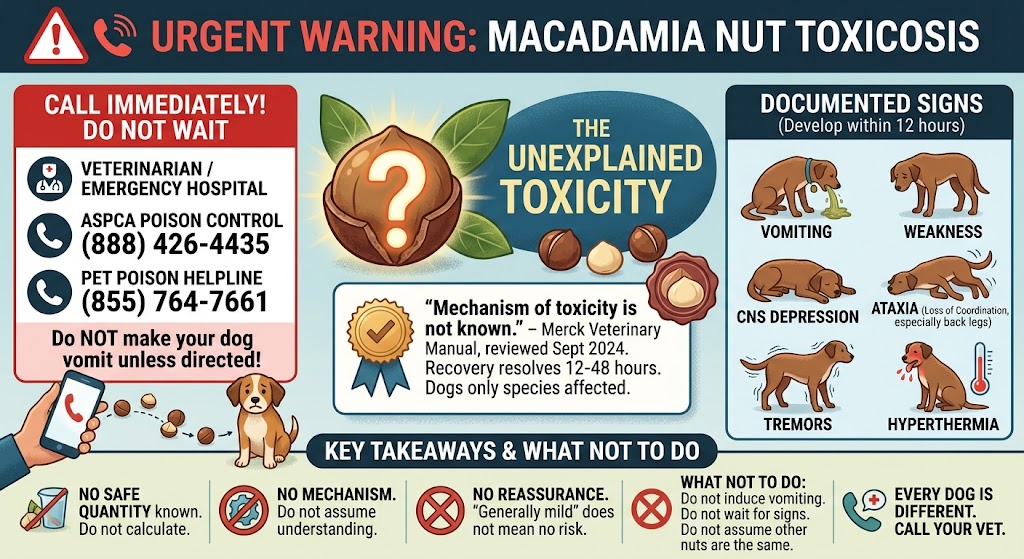
If your dog has eaten macadamia nuts, call now. Call your own veterinarian, your nearest 24-hour emergency animal hospital, the ASPCA Animal Poison Control Center at (888) 426-4435, or the Pet Poison Helpline at (855) 764-7661 (both US, 24/7, a fee may apply). Take the packet with you to the phone. Do not make your dog vomit unless a veterinarian or a poison line tells you to, for this dog, right now.
This page is general information from a dog parent who reads veterinary sources, not a veterinarian. It exists so your call to a professional is faster and better informed. It is not a substitute for that call.
If it has just happened rather than being a question you are researching in advance, the page you want is my dog ate macadamia nuts.
The sentence the whole internet leaves out
The Merck Veterinary Manual's page on macadamia nut toxicosis in dogs, retrieved 2026-08-28 and carrying a September 2024 review date, states it directly:
"The mechanism of toxicity is not known."
Nobody knows why this happens. Not the toxin, not the pathway, not why it stops. Every page you have read that explains the mechanism has told you something that is not established, because the reference veterinary text says it is not established.
That is worth knowing for a practical reason rather than as trivia: when nobody knows the mechanism, nobody can tell you what a safe amount is either. Explanations and safe amounts come from the same place, and in this case that place is empty.
What is documented
Three things, all from the same Merck page.
Dogs are the species. Merck's page is titled for dogs specifically, and the general food hazards article states that dogs are the only species affected. That is unusual and it is one of the reasons macadamias sit apart from other nuts.
The signs and their timing. Merck describes the syndrome as characterized by vomiting, weakness, hyperthermia and CNS depression, and states:
"Within 12 hours after ingestion, dogs with macadamia nut toxicosis typically develop weakness, CNS depression, vomiting, ataxia, tremors, or hyperthermia."
Ataxia means loss of coordination. In practice owners describe a dog who cannot use their back legs properly, who wobbles, or who lies down and will not get up. It looks alarming and it is not, in itself, the emergency people fear.
The prognosis. Merck states that clinical signs are generally mild and self-limiting, with resolution typically within 12 to 48 hours, and that most clinically affected dogs recover without any specific treatment.
Why this page still says call, given that prognosis
Because "generally mild" is a statement about a population and you have one dog in front of you.
Three reasons the phone call is still the right first move:
You do not know it was only macadamias. A dog who ate from a trail mix may also have eaten raisins or chocolate, and those are different problems with different urgency. The nut is often not the only thing in the bowl.
Signs that look like macadamia toxicosis look like other things. Weakness, tremors and an unsteady dog are the presentation of several conditions, some of them urgent. A page cannot tell you which you are looking at and I am not going to try.
A veterinarian or a poison line can decide whether you need to come in. That is the decision you are actually trying to make, and it is theirs.
What not to do
Do not make your dog vomit. Merck's treatment section names agents a veterinarian may use in a clinical setting. Those are professional decisions made after an assessment, and reproducing them here would be handing you a procedure without the assessment that makes it safe. The full reasoning is in why you must never make a dog vomit on your own judgment.
Do not wait to see whether the signs appear. Merck's window is up to twelve hours, which means a normal-looking dog an hour after eating tells you nothing yet. That is a general pattern on this site rather than a macadamia-specific one, and it is covered in why a normal-looking dog can still be in serious trouble.
Do not conclude other nuts are equally dangerous, and do not conclude they are safe either. Macadamias produce a documented syndrome that other nuts do not. Other nuts carry different concerns, including fat content, salt, mold and simply being an object of a size that can obstruct. Those are different reasons, not the same reason at a lower level.
What we will not publish, and why
No quantity. Merck's treatment guidance includes a per-kilogram figure that clinicians use to decide on decontamination. That figure is a clinical decision threshold, not a safety line for owners, and publishing it would invite exactly the arithmetic this site refuses to enable: weighing a dog, guessing at a portion, and deciding not to call. A chart cannot clear your dog.
No mechanism. Merck says it is not known and we are not going to improve on that.
No reassurance. "Generally mild and self-limiting" is Merck's characterization of the syndrome and it is quoted here as theirs. It is not a prediction about your dog and it is not a reason to skip the call.
FAQ
Are macadamia nuts toxic to dogs?
Yes, in the sense that Merck documents a named syndrome, macadamia nut toxicosis, occurring in dogs after ingestion, with vomiting, weakness, hyperthermia and CNS depression, typically appearing within twelve hours.
Why are macadamia nuts bad for dogs?
Nobody knows. Merck's page states that the mechanism of toxicity is not known. Any page that explains it has gone beyond the reference source.
How long do the effects last?
Merck describes signs developing within twelve hours of ingestion and resolving within twelve to forty-eight hours, and says most clinically affected dogs recover without any specific treatment.
How many macadamia nuts are dangerous for a dog?
We do not publish a number and no number would answer your question, because the mechanism is unknown, dogs differ, and the nuts are usually eaten alongside other things. Call your vet or a poison line.
Are other nuts toxic to dogs?
Macadamias are the ones with a documented named syndrome. Other nuts raise different issues, including fat, salt, mold and the risk of an object causing an obstruction, and those are separate questions rather than milder versions of this one.
Sources read at the source on 2026-08-28 and named above: the Merck Veterinary Manual, Toxicology, Food Hazards, "Macadamia Nut Toxicosis in Dogs" (reviewed September 2024), for the quoted statement that the mechanism of toxicity is not known, for the quoted clinical findings and twelve-hour onset, and for the characterization of signs as generally mild and self-limiting with resolution in twelve to forty-eight hours; the Merck Veterinary Manual, Special Pet Topics, Poisoning, "Food Hazards" (reviewed October 2020, last updated May 2026), for the statement that dogs are the only species affected and for the twelve to forty-eight hour resolution window.
Merck's treatment section contains a per-kilogram ingestion figure and names specific emetic agents. Both are deliberately omitted here. They are clinical decision tools for a veterinarian who has assessed the animal, not information an owner should act on at home.
This page is general information, not veterinary advice, and it does not diagnose or treat. If your dog has eaten something, the call comes first.