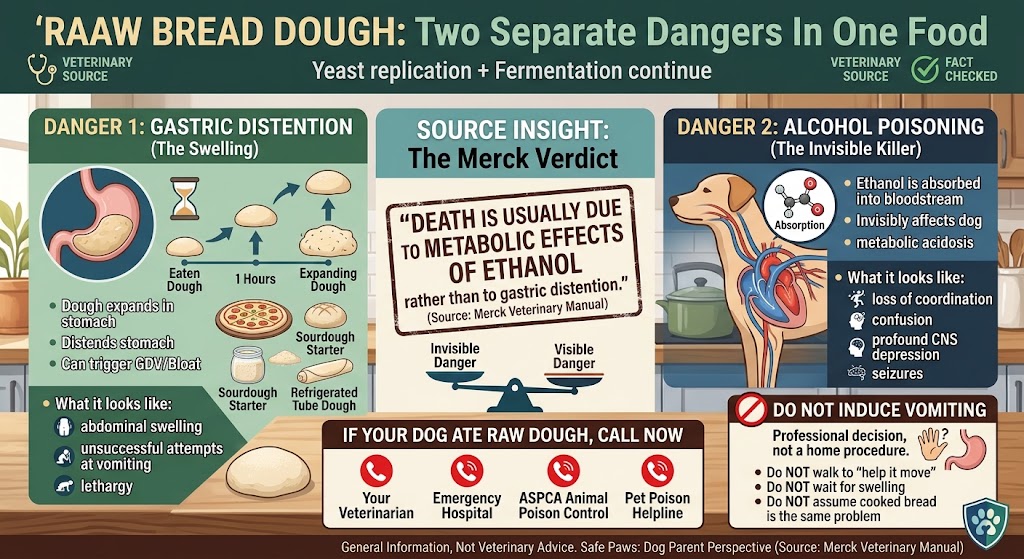
If your dog has eaten raw dough, call now. Call your own veterinarian, your nearest 24-hour emergency animal hospital, the ASPCA Animal Poison Control Center at (888) 426-4435, or the Pet Poison Helpline at (855) 764-7661 (both US, 24/7, a fee may apply). Do not make your dog vomit unless a veterinarian or a poison line tells you to, for this dog, right now.
This page is general information from a dog parent who reads veterinary sources, not a veterinarian. It exists so your call to a professional is faster and better informed. It is not a substitute for that call.
If it has just happened, the page you want is my dog ate raw bread dough.
The two dangers, and which one Merck says usually kills
The Merck Veterinary Manual's page on bread dough toxicosis in animals, retrieved 2026-08-28, carrying a full review of September 2024 and an update of August 2025, sets out both.
Danger one, the expansion. In the warm, moist environment of a stomach, yeast keeps working. Merck states that "Yeast replication promotes dough expansion in the stomach", producing gastric distention, and it notes the potential for triggering gastric dilation and volvulus in susceptible breeds.
Danger two, the alcohol. Merck states that "Ethanol, produced from yeast fermentation, is absorbed into the bloodstream, resulting in inebriation and metabolic acidosis."
And then the sentence that reorders the whole subject:
"Death is usually due to metabolic effects of ethanol rather than to gastric distention."
Read that against what you have already been told. Almost every page on this topic leads with the image of dough rising inside a stomach, because it is vivid. Merck's own text says the vivid half is not usually the fatal half.
That matters for one practical reason. A dog whose belly is not visibly swollen is not therefore fine, because the alcohol is absorbed and invisible, and the swelling is the part you can see.
What each half looks like
Merck's description of the progression covers both.
Early: unsuccessful attempts at vomiting, abdominal swelling, lethargy. A dog retching without producing anything is a sign in its own right, and on a deep-chested dog it belongs to the group of signs that get people to an emergency vet immediately rather than after a wait.
Then: loss of coordination and confusion, which is the alcohol arriving.
Then, in Merck's words: "profound CNS depression, weakness, recumbency, hypoglycemia, coma, hypothermia, or seizures."
None of that is a stage you should be waiting to observe. The list is here so you can recognize how far along you already are when you make the call, not so you can watch for the next item.
Why "it was only a bit of dough" is not the right question
Three reasons, and none of them requires a number.
Dough grows. The amount that went in is not the volume that will be in there in an hour. That is the entire mechanism.
Ethanol production continues. The alcohol dose is not fixed at the moment of eating either.
Deep-chested breeds are a separate consideration. Merck names the risk of triggering gastric dilation and volvulus in susceptible breeds. A page cannot tell you whether your dog is in that group in a way you should rely on, and a veterinarian can.
So the honest answer to "how much matters" is that the amount is not stable and neither is the risk, which is why this site publishes no threshold for it.
What not to do
Do not make your dog vomit. Merck's treatment section describes what a veterinarian may attempt in a clinical setting, including in an animal who is still clinically normal. That is a decision made after assessment by someone who can act if it goes wrong. A dog with reduced consciousness, or one whose stomach is distended, is a dog where inducing vomiting at home can make everything worse. The reasoning is set out in why you must never make a dog vomit on your own judgment.
Do not give anything to make the dough "go down". There is a documented clinical step involving cold water to slow fermentation, and it is performed alongside monitoring, not instead of it. We are not publishing it as a home instruction, because a step taken out of a treatment plan is not a treatment plan.
Do not go for a walk to "help it move". Exercise after a large stomach load is on every veterinary bloat-prevention list as the thing to avoid.
Do not wait for swelling. See the Merck sentence above.
Do not assume cooked bread is the same problem. It is not: the yeast in baked bread is dead and no longer producing gas or ethanol. Cooked bread raises other questions, including what was in it, and those are different questions.
What happens at the vet, roughly
Merck's own account of management covers monitoring and support for hypoglycemia, acid-base imbalance, cardiac effects and body temperature, and it notes that surgical removal is needed in rare cases.
In plain terms: they are treating the alcohol and watching the stomach. What that looks like from the owner's side is covered in what the emergency vet actually does for a poisoning case.
FAQ
Why is raw dough dangerous for dogs?
Two reasons at once. The yeast keeps working in the stomach, so the dough expands and distends it, and the fermentation produces ethanol that is absorbed into the bloodstream.
Which is worse, the swelling or the alcohol?
Merck states that death is usually due to the metabolic effects of ethanol rather than to gastric distention. The swelling is the visible half and not usually the fatal one.
My dog's stomach is not swollen. Is that good news?
It is not evidence that they are fine, because the alcohol half of the problem is invisible. Call regardless of what the abdomen looks like.
How much dough is dangerous?
We do not publish a figure, and in this case the question is not answerable on its own terms, because the dough continues to expand and to produce ethanol after it is eaten.
What about pizza dough, sourdough starter or refrigerated dough in a tube?
All of them contain live yeast, so the same mechanism applies. Take the packaging to the phone.
Sources read at the source on 2026-08-28 and named above: the Merck Veterinary Manual, Toxicology, Food Hazards, "Bread Dough Toxicosis in Animals" (full review September 2024, updated August 2025), for the quoted statements on yeast replication and dough expansion, on ethanol absorption causing inebriation and metabolic acidosis, on the progression of clinical signs, and on death usually being due to the metabolic effects of ethanol rather than to gastric distention, and for its notes on the risk of gastric dilation and volvulus in susceptible breeds and on management; the Merck Veterinary Manual, Toxicology, "Toxicoses From Alcohols in Animals", for fermenting bread dough as a named ethanol source.
Merck's treatment section describes clinical steps including induced emesis and cold water. These are deliberately not reproduced here as home instructions. They belong with the assessment and monitoring that accompany them.
This page is general information, not veterinary advice, and it does not diagnose or treat. If your dog has eaten something, the call comes first.