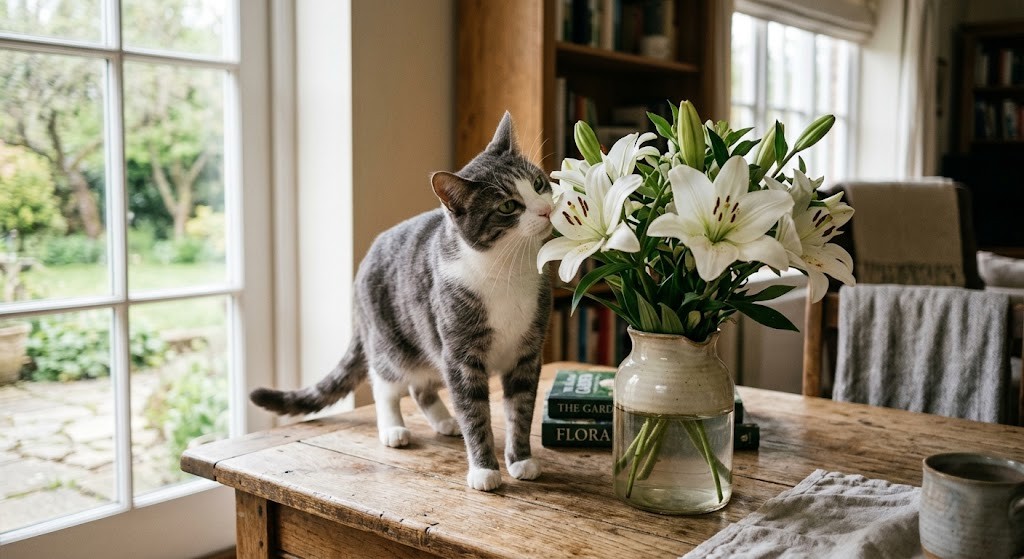
If your cat ate any part of a true lily or a daylily, even one bite of a leaf, treat it as an emergency and call now. Call your veterinarian, the nearest 24-hour emergency animal hospital, the ASPCA Animal Poison Control Center at (888) 426-4435 or the Pet Poison Helpline at (855) 764-7661 (both US, 24/7, and both charge a fee). Do not make your cat vomit and do not try any home treatment. Take the plant, or a clear photo of it, with you.
This page is general information built from named veterinary sources. It is not written by a veterinarian and it is not a substitute for that call.
Why "only one leaf" is still an emergency
This is the question almost everyone asks, and the sources answer it the same way.
- The ASPCA, in Which Lilies Are Toxic to Pets? (April 6, 2022, read 2026-09-11), says of Lilium species: all parts of the plant are toxic and small amounts can cause severe injury to the kidneys.
- The Pet Poison Helpline's lily page (read 2026-09-11) lists any amount of leaf, stem, flower, pollen, vase water, or rhizome as a concern.
- ASPCApro, the ASPCA's resource for veterinary professionals, in How to Spot Which Lilies Are Dangerous to Cats (read 2026-09-11), says it only takes a small exposure to potentially cause acute kidney injury.
So the size of the bite is not what decides this. There is no amount this site, or any source we read, will call safe. Do not look for one. Call.
My cat ate a lily: the 18-hour reason not to wait
The FDA Center for Veterinary Medicine, in Lovely Lilies and Curious Cats: A Dangerous Combination (updated September 16, 2021, read 2026-09-11), states: if treatment is delayed by 18 hours or more after ingestion, the cat will generally have irreversible kidney failure. The ASPCA says the same thing in different words: kidney failure can be prevented by aggressive treatment at a veterinary hospital, but it is often fatal if treatment is delayed longer than 18 hours after ingestion.
Read that as a reason to go now, not as a deadline you have in hand. Two things make it tighter than it sounds:
- You may not know when she ate it. If you found the leaf chewed when you got home, the clock started at some point you did not see. Count from the earliest time it could have happened.
- The worst damage can come before the worst signs. The FDA describes early signs within 0 to 12 hours, signs of kidney damage at about 12 to 24 hours, and kidney failure within 24 to 72 hours. By the time the signs look serious, the window the sources describe may already be closing.
Our dog-focused page on what to do when a toxic exposure happened hours ago explains why "it has been a while" is a reason to call, not a reason to give up. The same logic holds for a cat and a lily, with the sourced window above.
Is it the dangerous kind of lily?
The dangerous lilies for cats are the true lilies (Lilium) and daylilies (Hemerocallis). The FDA names Asiatic, Easter, Oriental, Stargazer, Tiger and Wood lilies, plus daylilies. The Merck Veterinary Manual, in Houseplants and Ornamentals Toxic to Animals (updated September 2024, read 2026-09-11), states that only lilies within the Lilium and Hemerocallis families are considered true lilies and are toxic in this kidney-damaging way.
Some plants called "lily" are not true lilies. Peace lilies and calla lilies cause mouth irritation. Lily of the valley affects the heart. Those are separate problems with separate risks.
But this is not a decision to make before calling. If you are not certain what the plant is, say so and describe it or send the photo. Bouquets often mix several flowers, and florists' labels are not always botanical names. A poison specialist can identify it with you. Guessing "probably a peace lily" to talk yourself out of the call is the mistake to avoid.
Evidence she ate it, when nobody saw
Most lily exposures are not witnessed. These are the things worth checking quickly, and worth mentioning on the phone. None of them rules an exposure out.
- Chewed or torn leaves or petals, or pieces on the floor.
- Pollen on her face, whiskers, chin or paws. Lily pollen is often orange or yellow and stains.
- A lower level in the vase, or wet paws or chin near a vase. The FDA lists vase water as toxic.
- Fallen pollen on a table or counter she walks on.
- Vomit, especially with plant material in it.
If any of these is true, it counts. If none is true but the lily was reachable and you cannot account for her time, say exactly that on the phone and let the specialist weigh it.
What to do while you get ready to go
- Move the cat away from the flowers and close her in a carrier or a small room.
- Take the plant with you, or photograph the flower, the leaves and the label. Bring the florist's card if there is one.
- Note the time, or the window in which it could have happened.
- Leave the pollen on her for the vet to see unless the poison line or your vet tells you how to remove it. Washing a cat is sometimes part of the plan, but it is their instruction to give.
- Get rid of the lilies once the cat is on her way, or put them somewhere she can never reach. Bag the fallen pollen and petals too.
For a full list of what to bring, our page on what to take to the emergency vet after a poisoning is written for dog owners and applies to a cat carrier item for item.
What not to do
Do not make your cat vomit. Whether that happens, and how, is a veterinarian's decision.
Do not give water, milk, food or anything else by mouth unless told to.
Do not wait to see whether signs appear. The FDA and ASPCA both tie the outcome to how soon treatment starts, not to how she looks tonight. Our page on a pet that ate something toxic but seems fine covers why a normal-looking animal has not been cleared.
Do not rely on a symptom list to decide. The signs below are for the phone call, not for deciding whether to make it.
Signs the sources describe
The FDA lists early signs such as decreased activity, drooling, vomiting and loss of appetite, and later signs of kidney damage such as increased urination and dehydration. The Merck Veterinary Manual describes clinical signs beginning within 1 to 3 hours after ingestion, including salivation, loss of appetite, lethargy and vomiting, with increased urination and dehydration developing afterward.
Some cats show little at first. The absence of vomiting does not mean the absence of exposure.
What the vet may do
Treatment is the veterinarian's call and depends on the cat and the timing. The Merck Veterinary Manual states that when treatment is started early after ingestion and only mild effects develop, prognosis is excellent, and that it becomes more guarded to poor if treatment is not begun until after more severe signs develop. That single sentence is the case for going now. For a general picture of how a poisoning visit runs, our walk-through of what the vet does for a poisoning describes the steps for a dog; the order of the visit is similar for a cat.
The honest limit of this page
We cannot tell you whether your cat's exposure was enough to harm her. The sources we read do not offer a safe amount, and neither will we. What they do offer is a time-sensitive treatment window and a clear statement that small exposures matter. The only way to use that window is to call.
FAQ
My cat only chewed one lily leaf. Is that really an emergency?
Yes, for a true lily or daylily. The ASPCA says small amounts can cause severe kidney injury, and the Pet Poison Helpline lists any amount of leaf, stem, flower, pollen or vase water as a concern. Call now.
How long do I have after my cat ate a lily?
Do not treat it as time in hand. The FDA states that if treatment is delayed by 18 hours or more, the cat will generally have irreversible kidney failure. If you do not know when she ate it, count from the earliest possible time.
Should I make my cat throw up after eating a lily?
No, not on your own. A veterinarian decides whether and how that is done.
What if it was a peace lily, not a true lily?
Peace lilies are not true lilies and cause mouth irritation rather than kidney failure, according to Merck and the ASPCA. If you are not sure which plant it was, call anyway and let a specialist identify it.
Sources read at the source on 2026-09-11 and named above: FDA Center for Veterinary Medicine, "Lovely Lilies and Curious Cats: A Dangerous Combination" (updated September 16, 2021); ASPCA, "Which Lilies Are Toxic to Pets?" (April 6, 2022); ASPCApro, "How to Spot Which Lilies Are Dangerous to Cats and Plan Treatment" (undated); Pet Poison Helpline, "Lilies" poison page; Merck Veterinary Manual, "Houseplants and Ornamentals Toxic to Animals" (full review November 2023, last updated September 2024); ASPCA Animal Poison Control Center toxic and non-toxic plants list, lily entry.
No amount, threshold or dose appears on this page. This page is general information, not veterinary advice, and it does not diagnose or treat. If your cat may have eaten a lily, the call comes first.