
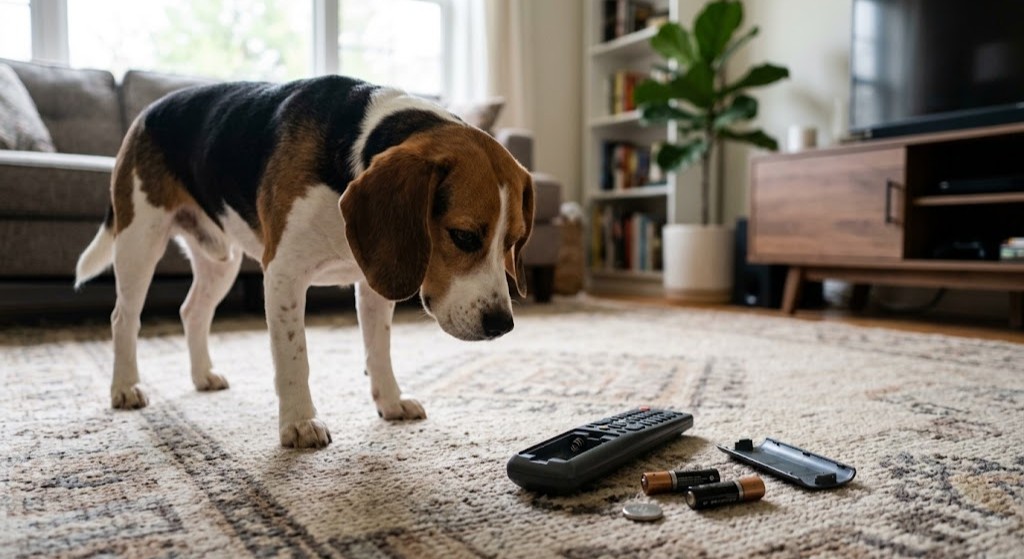
If your dog ate a battery, chewed one open or might have swallowed a button battery, this is an emergency. Do not try to make your dog vomit. Call now: your veterinarian, the nearest 24-hour emergency animal hospital, the ASPCA Animal Poison Control Center (888-426-4435) or the Pet Poison Helpline (855-764-7661). Both lines answer 24 hours a day, and a fee may apply. Find the device the battery came from and keep it. Button batteries are the most urgent kind. How serious it is depends on the battery and your dog's size and health, and only a vet can judge that.
Why You Should Not Make Your Dog Vomit
Batteries can contain corrosive material, and a corrosive can injure the throat on the way down and again on the way back up.
The Pet Poison Helpline's page on batteries says: "Dogs that ingest batteries should not be made to vomit, as the corrosive contents of the battery can cause further damage to the esophagus. Immediate veterinary attention is required."
The Merck Veterinary Manual chapter on toxicoses from corrosive agents in animals (by Sharon M. Gwaltney-Brant, DVM, PhD, last updated March 2025) says: "Emesis should not be induced if there is any possibility that the battery casing has been punctured." Emesis means vomiting. When a remote is in pieces, you usually cannot know whether the casing was punctured, which is why this decision belongs to the vet, with the battery type and an X-ray in front of them.
So do not use salt, hydrogen peroxide, fingers or anything else to make your dog throw up, and do not give food or any remedy, unless a veterinarian or poison-control specialist tells you to at that moment. Our guide on whether you should make your dog throw up explains the wider rule.
Dog Ate a Battery: The First Five Minutes
- Move your dog away from the device and any battery pieces, and keep other pets out of the room.
- Gather every piece you can find: the device, the battery cover, any whole or chewed batteries. Count what is missing.
- Call your vet, an emergency animal hospital, the ASPCA Animal Poison Control Center at 888-426-4435 or the Pet Poison Helpline at 855-764-7661.
- Go straight to an emergency vet if a button or coin battery may be missing, or if your dog is drooling, pawing at the mouth, vomiting, struggling to swallow or breathe, or in pain.
- Ask before rinsing. If your dog chewed a battery, ask the poison line whether and how to rinse your dog's mouth, and do it only as they direct.
Do not wait for signs. The Pet Poison Helpline notes that "Ulcers in the mouth may not be seen for hours after battery puncture or ingestion." A mouth that looks normal now has not been cleared.
"The Remote Is in Pieces and a Battery Is Missing"
This is the situation the sources describe least well, and it is the most common one: you find the evidence, not the moment. Three questions shape what happens next, and the poison line will ask them.
What kind of battery was it? Look at the device or the packet of spares. A remote, a toy or a torch usually takes cylinder batteries (AA, AAA, C, D) or a 9-volt. A car key fob, a watch, a kitchen scale, a hearing aid or a small light usually takes a flat, coin-shaped button battery. If you cannot tell, take the device with you.
Was it chewed or swallowed whole? Look for bite marks, a split casing or black powder. The Pet Poison Helpline says black powdered material may be seen in the mouth when dry cell batteries are punctured.
How many are missing? Count the battery slots against what you found.
You do not need to answer all three before you call. Call first, and look while you talk.
Button Batteries Are the Most Urgent
If there is any chance your dog swallowed a flat, coin-shaped battery, go to a vet now.
The Pet Poison Helpline's battery poisoning page says: "Lithium button type batteries are the most dangerous, as one 3 volt battery can result in severe necrosis to the esophagus or GIT within 15-30 minutes." Necrosis means tissue death, and the GIT is the gastrointestinal tract. That time window is why a button battery cannot wait until morning.
Merck explains why: "Disk batteries (also known as button cell, coin, or watch batteries) can lodge in the esophagus and generate a current against the esophageal walls, resulting in circular ulcers that have the potential to perforate." The Pet Poison Helpline's batteries page adds that disc-shaped or lithium batteries "can cause tissue injury by transmitting a current and causing a thermal burn when sitting in the esophagus or intestines."
In other words, a button battery does not need to be chewed to cause harm. A whole one sitting in the wrong place can do it.
Chewed AA, AAA and 9-Volt Batteries
Cylinder batteries cause harm in a different way. The danger is the material inside, and it comes out when the casing is chewed or punctured.
The Pet Poison Helpline says alkaline dry cells "contain potassium hydroxide or sodium hydroxide. When the compounds come in contact with tissue, liquefaction necrosis occurs, causing deeply penetrating ulcers." Merck says "The alkaline gel in batteries produces liquefactive necrosis of tissues on contact, resulting in burns that can penetrate deeply into tissue," and that "Mucosal burns can occur within the oral cavity, esophagus, and, less commonly, stomach."
A whole cylinder battery that was swallowed is also an object in the gut. Merck lists vomiting, anorexia (not eating), abdominal discomfort and tenesmus (straining) as signs of foreign body obstruction from batteries. Our guide on whether a dog that ate something might have a blockage covers that side of it.
Why "It Will Just Pass" Is Not Yours to Decide
Many owners hope a swallowed battery will come out the other end. The sources do not support waiting to find out at home.
Merck says: "Batteries that do not pass through the pylorus within 48 hours of ingestion are unlikely to pass on their own." The pylorus is the exit from the stomach. The Pet Poison Helpline's battery poisoning page says that certain batteries contain heavy metals such as mercury, zinc, cobalt, lead, nickel or cadmium, and that heavy metal toxicity, "albeit rare," can occur if a battery stays in the gut for more than 2 to 3 days.
There is one more reason the vet needs the details from you. Merck notes that "some disk batteries do not show up well on radiographs." Radiographs are X-rays. Telling the vet that a button battery is missing, and bringing the device, helps them know what they are looking for. Our guide to what the vet does for dog poisoning explains what usually happens at the clinic.
Signs to Report to the Vet
These are the signs the sources name. They are listed so you can describe what you see, not so you can decide at home whether your dog is hurt.
| What you might see | Where the sources mention it |
|---|---|
| Drooling, oral pain, pawing at the mouth | Pet Poison Helpline, batteries page |
| Black powder in the mouth | Pet Poison Helpline, punctured dry cells |
| Mouth ulcers, possibly hours later | Pet Poison Helpline |
| Vomiting, not eating, belly discomfort, straining | Merck, foreign body obstruction |
| Burns in the mouth or throat | Merck, alkaline batteries |
No signs at all does not mean no injury. Report the exposure, not just the symptoms.
What to Tell the Vet or Poison Line
- The device the battery came from, and the battery type printed on it or on the packet
- Whether it was a button battery or a cylinder battery
- How many batteries are missing, and whether any were chewed
- Roughly when it happened, or when your dog was last seen without the device
- Your dog's approximate weight, age and health conditions
- Every sign you have seen
If you are sent to a clinic, bring the device, the battery packet and any pieces you found. Our checklist of what to take to the emergency vet covers the rest.
Where Dogs Find Batteries
Merck lists remote controls, hearing aids, toys, watches, computers and calculators among household products that contain alkaline batteries, and notes that dogs are the animals most commonly involved. Spare batteries in a drawer, a remote left on the sofa and a hearing aid on a bedside table are all within reach of a curious dog. Keeping spares in a closed container, checking that battery covers are secure, and putting small devices out of reach are simple changes.
Sources Checked
On October 2, 2026 we read the Merck Veterinary Manual chapter on toxicoses from corrosive agents in animals (last updated March 2025), the Pet Poison Helpline page Battery Poisoning in Dogs, and the Pet Poison Helpline's batteries toxin page. This article publishes no dose, threshold or safe amount.
Frequently Asked Questions
My dog ate a battery but seems fine. Do I still need to call?
Yes. The Pet Poison Helpline says mouth ulcers may not be seen for hours after a battery is punctured or swallowed, and that immediate veterinary attention is required.
Should I make my dog throw up after eating a battery?
No. The Pet Poison Helpline says dogs that ingest batteries should not be made to vomit, because the corrosive contents can further damage the esophagus. Merck says vomiting should not be induced if the casing may have been punctured.
Is a button battery worse than an AA battery?
The Pet Poison Helpline calls lithium button batteries the most dangerous type and says one can cause severe tissue damage to the esophagus or gut within 15 to 30 minutes. Merck explains they can lodge in the esophagus and cause ulcers through electric current.
Will a swallowed battery pass on its own?
That is the vet's call, not one to make at home. Merck says batteries that have not left the stomach within 48 hours are unlikely to pass on their own, and some button batteries do not show up well on X-rays.
What does black powder around my dog's mouth mean?
The Pet Poison Helpline says black powdered material may be seen in the mouth when dry cell batteries are punctured. Tell the poison line or vet straight away.
This article is general information and does not replace veterinary care. If your dog has chewed or swallowed any battery, contact your veterinarian, the ASPCA Animal Poison Control Center at 888-426-4435, or the Pet Poison Helpline at 855-764-7661 now. Toxicity varies with your dog's size and health, and only a veterinarian can assess your individual dog.