
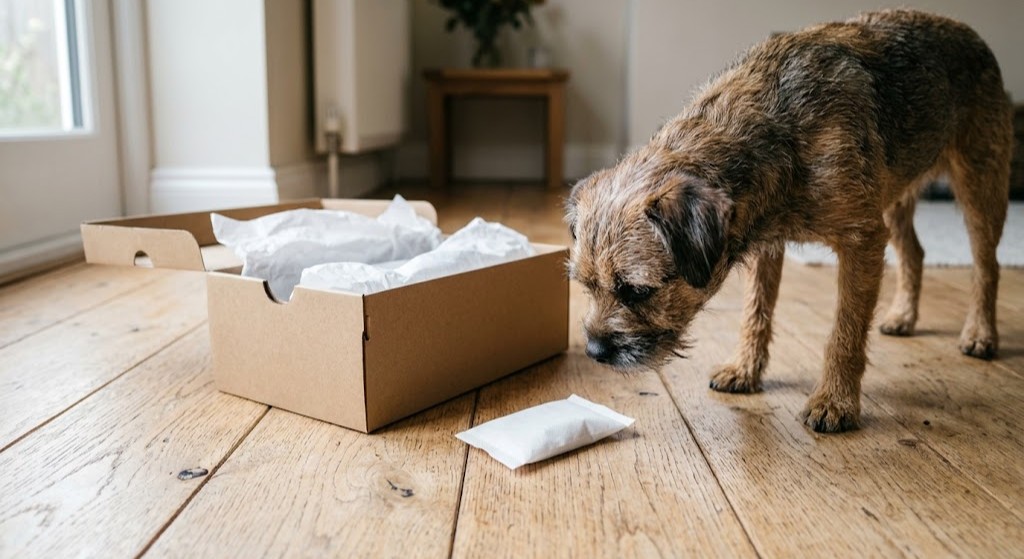
Dog ate silica gel packet, a freshness packet from a food bag, or glue from the toolbox? Call before you read further: your veterinarian, the nearest 24-hour emergency animal hospital, the ASPCA Animal Poison Control Center (888-426-4435) or the Pet Poison Helpline (855-764-7661). Both lines answer 24 hours a day, and a fee may apply. Do not make your dog vomit, and do not give food, water or any remedy unless a vet or poison specialist tells you to. Keep the packet, any torn pieces and the product it came in. The risk depends on what was inside, and on your dog's size and health, and only a vet can judge that.
Why "Do Not Eat" Does Not Tell You Enough
The packet said DO NOT EAT, and now it is gone. That printed warning appears on more than one kind of packet, and the kinds are not equal.
The Pet Poison Helpline's article on packaging freshness packets, written by staff veterinarian Dr. Catherine Angle, separates them into packets that hold silica gel and packets that hold elemental iron, known as oxygen absorbers. From across the room they can look alike. Inside, the difference can be the difference between an upset stomach and a poisoning.
There are two more questions the packet itself cannot answer. What was it packed with? And did your dog chew anything else at the same time? A packet from a pill bottle or a bag of jerky treats tells the poison line far more than the packet alone. That is why the first step is to call, and the second is to look around while you are on the phone.
Dog Ate Silica Gel Packet: Work Out Which Packet It Was
You do not need to identify the packet before you call. These are the details the sources use to tell the two main types apart, and the poison line may ask about them.
| Packet type | What the Pet Poison Helpline says it looks like | What the sources say about the risk |
|---|---|---|
| Silica gel | Usually about 1 by 2 inches, holding many small white, clear or opaque beads | Pet Poison Helpline: "No true toxicity risk exists." The ASPCA notes possible stomach upset and, with larger packets, possible obstruction |
| Oxygen absorber (iron) | Often about 1 by 1 inch; if broken open, the contents are dark brown to rust colored | Pet Poison Helpline: iron "can cause severe poisoning, even in the small amounts contained in one oxygen absorber packet" |
The Pet Poison Helpline also notes that the iron material in oxygen absorbers is magnetic, which is one way specialists tell the packet types apart. If you find torn pieces or loose powder, keep them for the vet rather than cleaning them away, and tell the poison line what color the contents were.
If the packet was swallowed whole and you never saw inside it, say so. "I don't know which kind it was" is a useful answer, and a common one.
Silica Gel Itself: What the Sources Say
The Pet Poison Helpline states that "No true toxicity risk exists from exposure to silica gel packets." The same article adds that the beads do not enlarge in the stomach and that the outer packaging is usually soft.
The ASPCA is more cautious. Its article on silica gel, dated February 4, 2016, says that if eaten, silica gel can cause gastrointestinal upset, including vomiting and diarrhea, depending on how much was eaten. It also warns: "Some silica gel packets may be fairly large, and if ingested, could potentially cause obstruction in the intestinal tract." And it tells owners plainly: "If your pet has ingested silica gel, please contact your veterinarian or APCC for more information."
So even when you are sure it was silica, both organizations end in the same place: a phone call. A small dog, several packets, or a large packet from a box of shoes or electronics all change the picture. Our guide on whether a dog that ate something might have a blockage explains what an obstruction can look like.
Why the Iron Packet Is the One That Matters
Oxygen absorbers are the packets the Pet Poison Helpline worries about. Its article says they "are often found in packages of beef jerky, pepperoni, dried fruits, dog jerky treats, etc." That list matters, because a bag that smells of meat is exactly the bag a dog tears open.
The helpline states: "Elemental iron can cause severe poisoning, even in the small amounts contained in one oxygen absorber packet." It describes vomiting, with or without blood, as one of the first signs. It says that when a poisoning does occur, "severe metabolic acidosis, shock and hepatic toxicity can develop 1 -5 days after the exposure." Hepatic means liver. It also notes that the most severe cases it has seen from oxygen absorbers were in small dogs.
Two things follow. First, a dog that looks normal tonight has not been cleared, because the serious effects the helpline describes can arrive days later. Second, your dog's size matters, but it is the vet who weighs that, not a chart. This site does not publish an amount of iron that is safe, and a figure found elsewhere is not a substitute for the call.
What Was the Packet Packed With?
This is the question most pages skip, and it is often the most useful one.
The ASPCA lists where silica gel turns up: the packaging for "shoes, bags, coats, electronics, medications, vitamins, food and cat litter." Look at where your dog found it.
- A pill bottle or vitamin jar. The packet may be the least of it. Count what is left. Human medication and supplements are a separate emergency, and the poison line needs the product name.
- A bag of jerky, pepperoni, dried fruit or dog treats. This is where the Pet Poison Helpline says oxygen absorbers are found. Treat it as a possible iron packet until someone qualified tells you otherwise.
- A shoe box, handbag or electronics box. These are classic silica gel sources, and some of those packets are large.
- You found an empty packet but not where it came from. Our guide to a dog that ate an unknown substance covers how to describe what you found.
Keep the bag, bottle or box. The label on the product is often more useful to a vet than the label on the packet.
Glue and Expanding Adhesives: A Different Emergency
Glue gets its own section because one type behaves unlike anything else in this article.
Some construction and wood glues contain isocyanates. The Pet Poison Helpline lists this group's other names as "Polyisocyanate/ Diisocyanate Glue, Foaming Glue, Expanding Glue." Its Gorilla Glue page says these formulations "will expand and adhere after exposure to surface moisture. When ingested by pets these glues will expand and adhere to the stomach creating severe irritation and blockage."
A Pet Poison Helpline article by Sharon Billings, CVT, explains why a small amount is not reassuring: "Even a very small amount of ingested adhesive can expand until the stomach is completely filled, and then the product hardens into an immovable mass." It names a painful belly, vomiting and an obstructed GI tract among the results, and says that once this happens, "surgery is required to remove the foreign body from the stomach."
The ASPCA's account of a dog who needed emergency surgery after swallowing construction glue, dated February 20, 2017, quotes Dr. Tina Wismer, medical director of the ASPCA Animal Poison Control Center: "Any glue/adhesive that contains isocyanates can expand in the stomach." This is not about one brand.
Do not make your dog vomit and do not give water. In the case the Pet Poison Helpline describes, the owner did not induce vomiting because "the adhesive expands very rapidly, so inducing vomiting should be done only if advised to do so by your veterinarian or us," and gave no fluids, because "introducing water or other fluids could have caused faster and greater expansion." Go to an emergency vet and take the glue container. Our guide on whether you should make your dog throw up explains why that decision always belongs to the vet.
Super glue and craft glue
Not every glue expands. The Pet Poison Helpline says super glues (cyanoacrylates) "are not expanding glues and do not cause any toxicity risk though can be very damaging the surface of the eye." If super glue gets in your pet's eye, the helpline says "an immediate veterinary exam is necessary." It also warns never to apply an adhesive remover to a pet's skin. If you cannot tell which kind of glue it was, assume it was the expanding kind and call.
Why "He Seems Fine" Does Not Settle It
Each of the three hazards in this article can look like nothing at first.
- An iron packet. The Pet Poison Helpline describes serious effects developing days after the exposure.
- Expanding glue. It grows after it is swallowed, so the dog you see in the first minutes is not the dog you may have later.
- A large packet of any kind. An obstruction can take time to show.
No signs is not the same as no problem. Report the exposure, not just the symptoms.
Signs to Report to the Vet
These are the signs named in the sources we read. They are here so you can describe what you see, not so you can decide at home whether your dog is hurt.
| What you might see | Where the sources mention it |
|---|---|
| Vomiting, diarrhea | ASPCA, silica gel |
| Vomiting, with or without blood | Pet Poison Helpline, iron oxygen absorbers |
| Painful belly, vomiting | Pet Poison Helpline, expanding glue |
| Vomiting, loss of appetite, abdominal pain, diarrhea, dehydration, lethargy | Cornell Riney Canine Health Center, gastrointestinal obstruction |
| Glue in or near the eye | Pet Poison Helpline, super glue |
The Cornell Riney Canine Health Center describes gastrointestinal obstructions as "emergencies often requiring surgical removal," and says "prompt veterinary intervention is critical."
What to Tell the Vet or Poison Line
- What the packet said, and its color and rough size if you saw it
- What the packet came in: the product, bag, bottle or box
- Whether it was torn, and what the contents looked like
- For glue: the brand and type from the container
- How many packets, or how much glue, may be missing, and roughly when
- Your dog's approximate weight, age and health conditions
- Every sign you have seen so far
If you are sent to a clinic, bring the packaging and the product. Our checklist of what to take to the emergency vet covers the rest.
Keeping Packets and Glue Out of Reach
The ASPCA's list is a reminder that packets arrive with almost everything: new shoes, bags, electronics, medication, vitamins and food. Opening deliveries away from the dog and putting the packet straight into a lidded bin removes most of the chance. Jerky and treat bags deserve extra care, since that is where the Pet Poison Helpline says iron packets are found. Expanding glue belongs in a closed cupboard, not on a workbench a dog can reach.
Sources Checked
On October 2, 2026 we read the Pet Poison Helpline article Are those packaging freshness packets really toxic to dogs?, the Pet Poison Helpline article Gorilla Glue: hidden danger, the Pet Poison Helpline pages on Gorilla Glue and super glue, the ASPCA articles on silica gel (February 4, 2016) and on a dog's surgery after swallowing construction glue (February 20, 2017), and the Cornell Riney Canine Health Center page on gastrointestinal foreign body obstruction in dogs. This article publishes no dose, threshold or safe amount.
Frequently Asked Questions
My dog ate a silica gel packet but seems fine. Do I still need to call?
Yes. The ASPCA asks owners whose pet has eaten silica gel to contact their veterinarian or its poison control center. You may also not know for certain that the packet was silica rather than an iron oxygen absorber, which the Pet Poison Helpline says can cause serious effects days later.
How can I tell a silica gel packet from an oxygen absorber?
The Pet Poison Helpline describes silica gel as small white, clear or opaque beads, and the inside of an oxygen absorber as dark brown to rust colored. It says oxygen absorbers are often found in jerky, pepperoni, dried fruit and dog treat packages, and that the iron material is magnetic. If you are unsure, tell the poison line that.
Should I make my dog throw up after eating a packet or glue?
No, not unless a vet or poison specialist tells you to. For expanding glue, the Pet Poison Helpline says inducing vomiting should be done only if a veterinarian or the helpline advises it, because the adhesive expands very rapidly.
Is Gorilla Glue really that dangerous for dogs?
The Pet Poison Helpline says expanding glues will expand and adhere to the stomach, creating severe irritation and blockage, and that surgery is required once a mass forms. The ASPCA Animal Poison Control Center's medical director has said any glue containing isocyanates can expand in the stomach.
This article is general information and does not replace veterinary care. If your dog has eaten a desiccant packet, an oxygen absorber or any glue, contact your veterinarian, the ASPCA Animal Poison Control Center at 888-426-4435, or the Pet Poison Helpline at 855-764-7661 now. Toxicity varies with your dog's size and health, and only a veterinarian can assess your individual dog.