
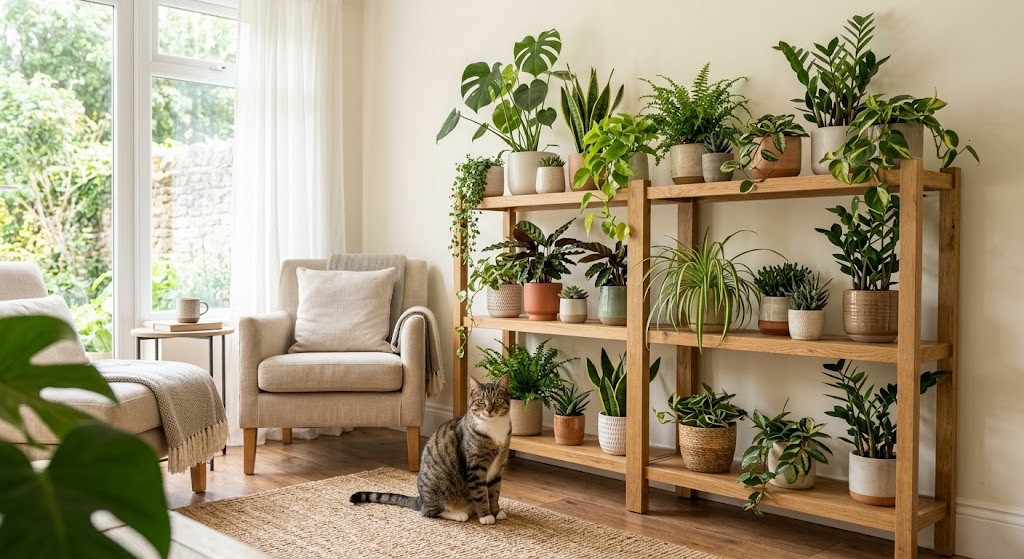
If your pet has chewed or eaten any plant, call now: your veterinarian, the nearest 24-hour emergency animal hospital, the ASPCA Animal Poison Control Center (888-426-4435) or the Pet Poison Helpline (855-764-7661). Both lines answer 24 hours a day, and a fee may apply. Do not make your pet vomit and do not attempt any home treatment unless a veterinarian or a poison-control specialist tells you to for that specific plant. The word "toxic" covers two completely different things: plants that hurt the mouth for a day, and plants that attack an organ. You cannot tell which one you are holding, and this page will not let you decide alone.
Why "Toxic" Is the Least Useful Word on a Plant List
Search any houseplant and you get a yes or no. Toxic, not toxic, next plant. That binary is the single biggest failure in plant safety writing, because it files a pothos cutting and a sago palm seed under the same heading at the same volume.
The result is predictable in both directions. An owner who reads that pothos is toxic panics over a plant whose named clinical signs resolve, and an owner who has been told "all plants are a bit toxic, she'll be fine" shrugs at a plant that can cause liver failure. One of those mistakes costs an evening. The other costs an animal.
So the useful question is not whether a plant is on a toxic list. It is what kind of harm the named sources attribute to it, and whether that harm is local or systemic. That is what the rest of this page sorts out. Our page on a cat that chewed an unidentified houseplant covers the case where you do not even know the plant's name yet.
How Toxic Is This Plant to My Pet? Three Things the Word Can Mean
Here is the framework in one table. Every entry below is drawn from the named sources listed at the end of this page.
| What the plant actually does | How the sources describe it | Examples named by the sources |
|---|---|---|
| Hurts on contact, in the mouth and throat | "Oral irritation, intense burning and irritation of mouth, tongue and lips, excessive drooling, vomiting, difficulty swallowing" (ASPCA) | Golden pothos, philodendron species, and others in the Araceae family |
| Hurts on contact and can swell the airway | "In rare instances severe throat swelling resulting in breathing difficulty can occur" (Pet Poison Helpline) | Philodendron, named by that source |
| Damages an organ after absorption | Liver failure from sago palm; "acute kidney failure" in cats from true lilies (Pet Poison Helpline) | Sago palm, true lilies and daylilies in cats |
Those three rows are not three levels of the same thing. They are different events with different timelines, and only the third one is the kind of poisoning most owners picture when they hear the word.
Tier One: Plants That Hurt Where They Touch
This is the largest group of household plant calls, and the mechanism explains almost everything about it.
The ASPCA lists golden pothos, scientific name Epipremnum aureum, in the family Araceae, with "insoluble calcium oxalates" as the toxic principle and these clinical signs: "Oral irritation, intense burning and irritation of mouth, tongue and lips, excessive drooling, vomiting, difficulty swallowing." Its entry for variegated philodendron, Scindapsus and Philodendron species, names "calcium oxalate crystals" and the same list of signs.
The Pet Poison Helpline describes the physical process behind that. "Philodendron contains microscopic crystals within the plant structure," it says, and "when pets chew the Philodendron plant, it releases the crystals causing irritation and pain to the pet's lips, oral cavity, and throat." The signs it names are "drooling, gagging, and vomiting."
Read that carefully and you can see why these cases usually look alarming but behave differently from a systemic poisoning. The injury is mechanical and local. The crystals hurt the tissue they touch. The word "insoluble" in the ASPCA's phrasing is doing real work: these are not substances that dissolve and travel.
The Exception Inside Tier One, and It Is the Reason You Still Call
The Pet Poison Helpline's philodendron page does not stop at drooling. It adds: "in rare instances severe throat swelling resulting in breathing difficulty can occur."
That single clause is why no page on this site will ever tell you a calcium oxalate plant is a wait-and-see event. A swollen airway is not a milder version of a sore mouth. It is a separate emergency that develops in the same animal from the same bite, it is not predictable from the amount chewed, and it is not something an owner can assess by looking.
There is a second reason the call still happens. An animal in genuine oral pain often stops eating and drinking, and a pet who will not drink has a new problem on top of the first one. Reporting it is how that gets caught.
And do not try to flush the mouth out or trigger vomiting on your own initiative. Vomiting brings the same crystals back through the same tissue, and for other substances it is actively dangerous, which is the subject of our page on whether to make a dog throw up.
Tier Three: Plants That Go After an Organ
This is the group the binary lists bury, and it is the group that justifies the whole framework.
Sago palm. The Pet Poison Helpline describes ingestion of "any part of the plant, especially the seed (or nut)" and names "severe gastrointestinal distress (e.g., vomiting, diarrhea, bloody vomitus)," "nervous system disturbance (e.g., stumbling gait, weakness, seizure)" and "organ failure (e.g., liver)." The page states that ingestion "may result in…death." The toxin it names is cycasin. Nothing about that profile resembles a sore mouth.
True lilies and daylilies, in cats. The Pet Poison Helpline states that "All parts of lilies from the Lilium genus are toxic for cats," and that this "includes any amount of leaf, stem, flower, pollen, vase water, or rhizome (root)." The outcome it names is "vomiting, abdominal pain, dehydration and acute kidney failure," and its guidance on timing is that "Early treatment is vital for cats following any exposure to these lilies."
The FDA puts numbers on that timeline. Early signs "start 0 to 12 hours after ingestion," kidney damage signs "about 12 to 24 hours after ingestion," and "Kidney failure occurs within 24 to 72 hours, leading to death if the cat isn't treated." Its conclusion: "if treatment is delayed by 18 hours or more after ingestion, the cat will generally have irreversible kidney failure."
Notice what makes this tier different. The harm is invisible at the start, the window closes while the animal still looks well, and the amount involved is small. Our page on which lilies are deadly to cats and which are not separates the names that matter from the ones that only sound alike.
The Same Name Can Sit in Two Different Tiers
This is where owners get caught, and it is worth stating on its own.
The ASPCA's guidance on lilies illustrates it exactly. True lilies, it says, are plants where "all parts of the plant are toxic and small amounts can cause severe injury to the kidneys," and daylilies "can cause severe kidney injury." But a peace lily, which shares the word and nothing else, causes "oral pain, drooling, vomiting or diarrhea" through insoluble calcium oxalate crystals and is not expected to cause organ damage.
So "lily" alone tells you nothing. Nor does "palm," nor "ivy," nor "philodendron" as a shop label. Common names are not a classification system, and the tier depends on the actual species.
What This Framework Does Not Do
It does not give you permission to stay home, and here is the honest list of why.
You usually do not know the species with certainty. You almost never know how much was chewed or swallowed. Species matters: true lilies devastate cats and are not described the same way for dogs. The individual animal matters too, because age, size and existing illness change how an exposure plays out, and none of the sources above asks an owner to weigh that.
And no source we read publishes a safe amount for any of these plants. Neither will we. This site does not print doses, thresholds or quantities for any substance, in any unit, because a wrong number here kills animals.
What It Does Change
Three things, all of them useful on the phone.
First, it changes what you say. "She chewed a philodendron leaf and is drooling" and "he bit a sago palm seed" are different reports, and the second one should be said first and loudly.
Second, it changes what you bring. Take the plant, a cutting, the nursery tag, or a clear photo of the leaf and stem. Our checklist of what to take to the emergency vet after a suspected poisoning covers the rest.
Third, it changes how you read the silence. For a tier one plant, the signs appear fast and visibly. For an organ-targeting plant, quiet is not evidence. That asymmetry is the single most important thing on this page.
Sources Checked
On October 3, 2026 we read the ASPCA Animal Poison Control Center entries for golden pothos and variegated philodendron, the ASPCA article Which Lilies Are Toxic to Pets, the Pet Poison Helpline pages on philodendron, sago palm and lilies, and the FDA Center for Veterinary Medicine page Lovely Lilies and Curious Cats: A Dangerous Combination. This article publishes no dose, threshold, lethal amount or safe quantity for any plant.
Frequently Asked Questions
Is a plant that only causes mouth irritation still worth a call?
Yes. The Pet Poison Helpline notes that philodendron can, in rare instances, cause "severe throat swelling resulting in breathing difficulty," and an animal in oral pain may also stop eating and drinking. The tier tells you what to report, not whether to report.
Which houseplants are in the organ-failure group?
Of the plants covered on this page, sago palm is named by the Pet Poison Helpline for organ failure including the liver, and true lilies and daylilies are named for acute kidney failure in cats. Any plant you cannot identify belongs in the phone call rather than in a tier.
How much of a plant does it take to be a problem?
We do not publish amounts, and for true lilies the question does not work the way owners expect: the Pet Poison Helpline says any amount of leaf, stem, flower, pollen, vase water or root is involved for cats.
My dog ate a leaf and is drooling. Does that mean it is only mouth irritation?
It is consistent with the calcium oxalate signs the ASPCA lists, and it is not proof of anything. Drooling appears in several different plant exposures, so describe it to a vet rather than using it to classify the plant yourself.
What if I threw the plant away before I thought to identify it?
Say so and describe it: leaf shape, size, whether it climbed or trailed, where you bought it, what the pot looked like. Poison-control staff work from descriptions and photographs regularly.
This article is general information and does not replace veterinary care. If your pet has chewed or eaten any plant, contact your veterinarian, the ASPCA Animal Poison Control Center at 888-426-4435, or the Pet Poison Helpline at 855-764-7661 now. Only a veterinarian who examines your animal can assess it.