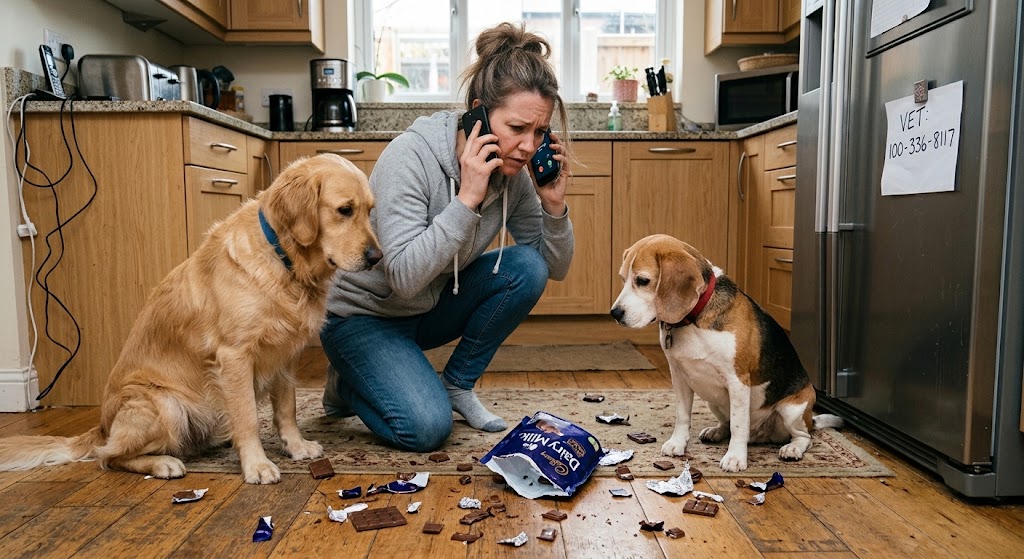
Call now, and separate the dogs while you dial. Phone your own veterinarian, your nearest 24-hour emergency animal hospital, the ASPCA Animal Poison Control Center at (888) 426-4435, or the Pet Poison Helpline at (855) 764-7661. Both hotlines are US-based and staffed around the clock, and a consultation fee may apply. Tell them how many animals were in the room and give each one's weight, because the risk is assessed per animal. Do not make any dog vomit and do not give any home remedy unless a veterinarian or a poison-control specialist tells you to, for that dog, right now. Our pet poison emergency page keeps the numbers in one place.
The short answer to "which one ate it": you almost certainly cannot know, and the safe working assumption is that each dog ate all of it. An unknown split between animals is not something anyone can allocate from the outside, so the calculation is done per dog at worst case, which usually makes the smallest dog in the room the most urgent one to talk about.
This page is general information gathered from published veterinary sources. It is not veterinary advice, it cannot examine your dogs, and it cannot tell you whether they are safe. Please read our veterinary disclaimer.
Do this in the first two minutes
- Separate the dogs, into different rooms or crates. Not as punishment. Three practical reasons follow below.
- Secure whatever is left of the substance and the packaging, out of reach of all of them.
- Photograph the scene before you clean it, then bag the debris.
- Weigh, or estimate, every dog who had access. Write the numbers down.
- Call, and say at the top of the call that more than one animal was involved.
Why separating them is the highest-value thing you do
This is the part that no general poisoning article covers, because general poisoning articles assume one dog.
First, it stops a second exposure. If one dog vomits, another may well eat it. That is not a hypothetical in a multi-dog household, it is normal dog behavior, and it converts a single-animal problem into a two-animal one in a matter of seconds.
Second, it preserves individual evidence. Once dogs are separated, vomit, diarrhea and any residue belong to a known animal. In a shared room, a puddle tells the veterinary team nothing about who produced it, and that is often the single most informative thing available.
Third, it makes monitoring possible. You cannot report who is drinking more, who has not eaten, who is restless or who is unusually quiet if they are all in the same room and you are frightened. Separate rooms turn "one of them seems off" into "the terrier has vomited twice and the retriever is normal," which is a usable sentence on a phone call.
The information gain: how risk is actually allocated across several dogs
Owners want to identify the culprit, so they look for evidence: powder on a muzzle, a guilty face, who was closest to the packet. That instinct is understandable and it is the wrong shape for the decision in front of you.
Here is the reasoning to bring to the call instead.
Nobody can divide an unknown amount between animals. If a packet is missing and two dogs had access, there is no method, veterinary or otherwise, that assigns three quarters to one and a quarter to the other. So the assessment is done per dog, at worst case, for each dog independently.
The same amount is a different exposure for each dog. Body weight is the obvious variable, which is why a small dog and a large dog in the same room are two different conversations. Age, existing kidney or heart or liver conditions, pregnancy, and current medications all matter too. The oldest and the smallest are worth naming first.
A guilty face is not evidence. Dogs read your tone and posture, and the anxious one is often the one who is best at reading you. Veterinary teams do not triage on demeanor and neither should you.
Soft evidence is worth reporting, not acting on. Residue on a muzzle or paws, a smell on the breath, staining around the mouth, wrappers found in one dog's bed: say all of it. Then let the professional weigh it. What you should not do is decide on that basis that the other dog is in the clear and skip mentioning her.
The answer may be that all of them need attention. Owners find that hard, sometimes for practical and financial reasons, and it is a fair thing to raise directly on the call. Ask what the plan is for each animal, ask whether any of them can reasonably be monitored at home instead, and ask what specifically would change that. A good clinic will talk it through rather than presenting one option.
What to have ready before you dial
Cornell's Riney Canine Health Center lists what a veterinarian needs for a suspected poisoning: the brand name and ingredient list of the substance, the amount, the time of ingestion, and the dog's approximate weight. In a multi-dog household, gather that once for the substance and once per animal.
A simple way to hold it:
| For each dog | What to have |
|---|---|
| Name | So the conversation stays straight |
| Weight | Today's weight, or your best estimate |
| Age | And whether they are a senior |
| Health conditions | Kidney, liver, heart, seizures, pregnancy |
| Medications and supplements | All of them, including flea and worm products |
| What you are seeing right now | Including nothing at all |
| Access likelihood | Was this dog definitely in the room, or possibly |
If a cat had access to the same spill, say so. Several substances behave differently and more dangerously in cats, and a cat is easy to forget when two dogs are the loud problem in the room.
If you do not know what the substance was either
That is a common combination, and it is two unknowns stacked: what it was, and who got it. The call is still worth making immediately, and the reconstruction method still works. Photograph before cleaning, take the inventory of what is within reach in that room, work out what is missing or chewed, and narrow by category if you cannot narrow by name. We set out the whole process in what to do when you do not know what your dog ate.
What not to do while you wait
Do not make any dog vomit. Not one of them, and not on your own judgment. The MSD Veterinary Manual lists the situations in which inducing vomiting should be avoided: if the substance could damage the stomach or esophagus on the way up, if more than a few hours have passed, if the swallowing reflex is absent, if the animal is convulsing, or if there is a risk of aspiration pneumonia. Cornell's guidance is the same in substance, that emesis is sometimes contraindicated and owners should consult a professional for each specific instance. In a multi-dog scenario there is an extra hazard on top: a dog vomiting in a shared space can dose a housemate. This site publishes no method for it at all, deliberately.
Do not treat only the obvious suspect. The dog who looks guilty and the dog who ate the most are not reliably the same animal.
Do not clean up before you photograph. In a multi-dog case the debris field also tells you something about how many animals were involved and where.
Do not leave them together to "keep each other calm." Calm is worth less than clean evidence and a second exposure avoided.
Getting several dogs to a clinic
Worth thinking about before you are told to come in, because it is the part that goes wrong at two in the morning.
Call someone. Two dogs, one frightened driver and a car at night is a bad combination, and one adult per animal is the version that works. Take carriers or secure crates if you have them. Take the packaging, the debris and any vomit, bagged and labeled by which dog produced it, which is a small detail that clinics appreciate more than owners expect. The full list is in what to take with you to the emergency vet.
Tell the clinic when you call how many animals are arriving. It changes how they staff the arrival, and it means nobody is waiting in a corridor holding two leads.
Frequently asked questions
How do I tell which dog ate the poison?
In most cases you cannot, and trying to is the wrong use of the first ten minutes. Report the soft evidence you do have, such as residue on a muzzle, a smell, staining, or wrappers found in one dog's bed, then let a professional weigh it. Because an unknown amount cannot be divided between animals, the working assumption for assessment is that each dog with access ate all of it.
Do all the dogs need to go to the vet?
That is a decision for the veterinarian or poison-control specialist, and it depends on the substance, the amount, and each dog's weight, age and health. It is entirely reasonable to ask directly whether every animal needs to be seen, whether any can be monitored at home, and what would change that answer. Ask rather than assume in either direction.
One dog is showing signs and the other looks fine. What does that mean?
Less than it seems. It may mean one dog ate more, or it may reflect differences in size, age or health, or it may simply mean one dog is further along than the other. A dog who looks fine after a shared exposure has not been ruled out. Report both pictures accurately and let the clinic interpret them.
Should I keep the dogs apart afterwards?
Ask for specific instructions on this, because it depends on the substance. There are two general reasons separation helps during the risk period: it prevents one dog eating another's vomit, and it lets you monitor each animal individually so you can report accurately who is eating, drinking, urinating and behaving normally.
What if I have a cat in the house too?
Mention the cat immediately, even if you are certain the cat was not involved. Several substances that are moderately concerning in dogs are considerably more dangerous to cats, and cats also groom contamination off their coats. Certainty about where a cat was during a chaotic ten minutes is worth less than most owners think.
Safe for Paws is written by Md Astafar Hossain, a dog parent and researcher, not a veterinarian. This is general information gathered from published veterinary sources including Cornell University's Riney Canine Health Center, the Merck Veterinary Manual, the ASPCA Animal Poison Control Center and the Pet Poison Helpline. It is not veterinary advice, it is not a set of instructions, and it cannot diagnose or treat your pet. Please read our full veterinary disclaimer. If anything here conflicts with your own veterinarian, listen to your veterinarian. In an emergency, call your vet, the ASPCA Animal Poison Control Center at (888) 426-4435, or the Pet Poison Helpline at (855) 764-7661.