
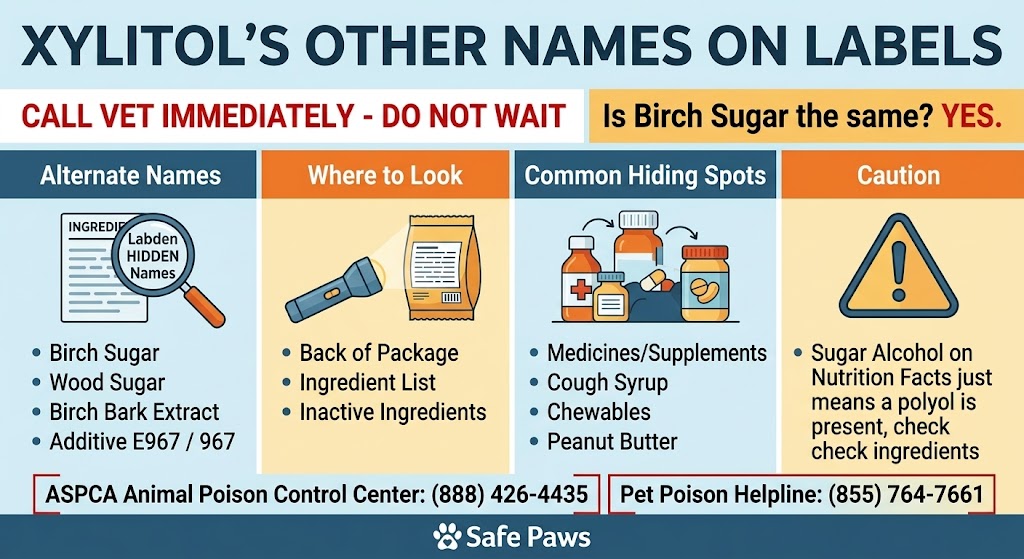
If your dog has already eaten it, call now. Do not spend this time reading.
- Your own vet, or the nearest emergency veterinary hospital out of hours.
- ASPCA Animal Poison Control Center: (888) 426-4435, 24 hours. A consultation fee applies.
- Pet Poison Helpline: (855) 764-7661, 24 hours. A consultation fee applies.
Do not make your dog vomit unless a veterinary professional tells you to. Take the packaging with you.
Pet poison emergency page, numbers only.
The short answer: yes, birch sugar is xylitol. So are wood sugar and birch bark extract, and on many labels it appears only as the additive number 967 or E967. All of these are the same compound, and all of them carry the same danger to dogs. A front-of-pack "sugar-free" claim tells you nothing about which sweetener was used, so the ingredient list is the only place to check. On medicines and supplements, look under inactive ingredients, which is where sweeteners usually sit and where almost nobody looks.
Naming conventions checked 11 August 2026. Additive naming and product formulations change, so re-read the panel on each new purchase.
Every name xylitol appears under
| What you may see on a panel | What it is |
|---|---|
| Xylitol | The plain name |
| Birch sugar | The same compound, named for a traditional source material |
| Wood sugar | The same compound |
| Birch bark extract | The same compound, in extract wording |
| E967 or 967 | The additive number for xylitol |
| Xylit, Xylitolo, Xilitol | Language variants on imported packaging |
| "Sugar alcohol" on a Nutrition Facts panel | A category, not a name. It tells you a polyol is present. It does not tell you which one. |
Anything marketed as sugar-free, no added sugar, keto, low-carb, diabetic-friendly or tooth-friendly is a candidate for a sugar alcohol of some kind, which is a reason to read the panel rather than a conclusion.
Why the alias problem exists at all
Xylitol was named as a canine hazard by the FDA and by veterinary poison control services long before "birch sugar" appeared on shelves in any volume. Owners learned one word, and they screened labels for that word.
Then some manufacturers began listing the same ingredient under a more natural-sounding name. Colorado State University's Veterinary Teaching Hospital and other veterinary sources have publicly warned that birch sugar and xylitol are the same thing, precisely because owners were scanning for "xylitol," not finding it, and concluding that a product was fine.
That is the mechanism worth understanding. The danger did not change. The word on the package did. Anyone whose safety habit is "search for one word" is exposed the next time the naming convention shifts, which is why this page is about how to read a panel rather than which word to fear.
The three places on a package to look
Most people check one of these and think they have checked. They are three different things and they tell you three different amounts of information.
1. The front of the pack: marketing, not data
"Sugar-free," "naturally sweetened," "no nasties," "tooth-friendly." None of these identifies a sweetener. Treat the front of the pack as a prompt to turn the package over, never as an answer.
2. The ingredient list: the actual answer
This is where the compound is named, under whichever of the names in the table above the manufacturer uses. Read the whole list. Sweeteners are not always near the top, especially in a product where they are a minor component like a toothpaste, a syrup or a chew.
3. The section almost nobody reads: inactive ingredients
On medicines and supplements, the sweetener is usually not in the main ingredient panel at all. Products intended to be swallowed list their active ingredients in one place and their inactive ingredients in another, and sweeteners, flavors and binders live in the second one.
This is the single most common blind spot in the whole topic, because it covers exactly the products dogs get into most often: liquid cough syrup, children's allergy medicine, chewable tablets, gummy supplements, dry-mouth lozenges and melatonin gummies. If you are checking a medicine or a supplement, find the inactive ingredients section and read that.
A fourth thing, worth knowing about
On US foods, the Nutrition Facts panel may carry a "Sugar Alcohol" line beneath Total Carbohydrate. If it is there, a polyol of some kind is in the product. It does not say which one. Treat it as a signal to go and read the ingredient list, not as an identification.
Not every sugar alcohol is xylitol
This nuance is worth getting right, because getting it wrong in either direction causes problems.
Xylitol is the sugar alcohol veterinary sources single out for dogs. The severe reaction described by the FDA and VCA Hospitals, a rapid insulin release and a sharp fall in blood sugar, with liver injury documented as a separate consequence, is specific to xylitol in dogs. That is why it gets its own warnings.
Erythritol, sorbitol, maltitol, isomalt and mannitol are different compounds. They are not xylitol, and they do not have xylitol's documented canine insulin effect. Many "stevia" and "monk fruit" blends are mostly erythritol.
Now the important qualification: this page is not calling any of them safe for dogs, and it never will. Sugar alcohols in general are known for digestive effects, some products contain more than one sweetener, and no page can tell you what a specific quantity of a specific product will do to your specific dog. If your dog eats a sugar-free product of any kind, the correct response is still to call, with the ingredient list in your hand.
The reason for spelling out the difference is practical. Owners who believe every sugar alcohol is lethal find the whole category unreadable, and people who feel a task is impossible stop doing it. Being able to look at a panel, see "erythritol," and know that it is not the compound with the canine insulin warning is what keeps a person reading panels at all. That habit is what catches the jar that does contain xylitol.
Imported and multi-language packaging
On products made for several markets, the ingredient list may be printed in a language you do not read, and the additive number may be the only token you recognize. 967 and E967 are xylitol. If you see either, treat the product as containing xylitol.
Some imported packaging also carries a separate sticker with a translated ingredient list applied over the original. Both are worth reading, because they are not always identical, and where they disagree you should assume the more cautious reading and ask the vet.
What a label cannot tell you
Three honest limits.
It cannot tell you how much matters. This site publishes no quantity, threshold or per-serving figure for xylitol or anything else. That assessment is made by a veterinary toxicologist against your dog's real weight and the real product, and both hotlines at the top of this page do it around the clock.
It cannot promise the next batch. A recipe you checked six months ago may have changed. The panel is current for the package in your hand, and only for that package.
It cannot cover what has no label. Loose gum in a coat pocket, a decanted supplement, a chew from a bulk bin, something a guest handed over. If you cannot identify the product, say so on the phone. "I do not know what it was" is a normal and workable starting point for a poison control call, and our guide to a dog who ate something unidentified covers the first hour of exactly that situation.
The two-second habit
Turn the package over. Read the ingredient list, and on anything medicinal read the inactive ingredients too. Look for xylitol, birch sugar, wood sugar, birch bark extract, 967 or E967. Do it on each new purchase rather than each new brand, because recipes change within brands.
Two places to do this today, while nothing is happening: the peanut butter jar you use for food toys or for hiding tablets, and the toothpaste in your bathroom. Those are the two products most often involved when a dog receives xylitol from a person rather than stealing it.
If you have already given your dog something
- Call now, before you finish investigating the label. Waiting for a symptom is not a plan, and our guide on the dog who "seems fine" explains why.
- Photograph the ingredient panel, or take the package with you. The full list matters more than the product name.
- Do not induce vomiting. The ASPCA's position is that induction belongs under veterinary direction only. Hydrogen peroxide, the method that circulates most widely online, is an irritant that veterinary sources associate with inflammation and ulceration of the stomach and esophagus, and vomiting carries an aspiration risk. See why you must never make a dog vomit on your own judgment.
- Do not give sugar, honey or food to counteract it unless a professional on the phone instructs you to.
- Bring what they will need. Our list: what to take to the emergency vet.
And if it turns out the product did not contain xylitol at all, you will have made one phone call. That is the correct outcome of a good habit, not a wasted evening.
Frequently asked questions
Is birch sugar the same as xylitol?
Yes. Birch sugar, wood sugar and birch bark extract are all names for xylitol, and veterinary sources including Colorado State University's Veterinary Teaching Hospital have warned owners specifically because people screening labels for the word "xylitol" were missing it under the birch sugar name.
What is E967 on an ingredient list?
E967, sometimes printed as just 967, is the additive number for xylitol. It appears most often on imported or multi-market packaging where the ingredient list may be in another language.
Where do I look for xylitol on a medicine or supplement?
Under inactive ingredients, not the main active ingredient panel. Sweeteners, flavors and binders are listed there, and it is the section most owners never read. This applies to cough syrup, liquid allergy medicine, chewable tablets and gummy supplements.
Does "sugar alcohol" on the nutrition panel mean xylitol?
No. It means a sugar alcohol of some kind is present. It could be erythritol, sorbitol, maltitol, isomalt, mannitol or xylitol. Use it as a prompt to read the ingredient list, which names the specific compound.
Are other sugar alcohols dangerous to dogs too?
They are different compounds and they do not carry xylitol's documented canine insulin response, but this page does not describe any of them as safe for dogs. If your dog eats a sugar-free product of any kind, call your vet or a poison control hotline with the ingredient list in front of you.
Safe Paws publishes veterinary-sourced pet safety information. We are not veterinarians and this page is not veterinary advice, a diagnosis, or a substitute for examining your dog. See our veterinary disclaimer. Sources named on this page: the US Food and Drug Administration, Colorado State University Veterinary Teaching Hospital, VCA Hospitals, ASPCA Animal Poison Control Center, Pet Poison Helpline. Naming conventions checked 11 August 2026.