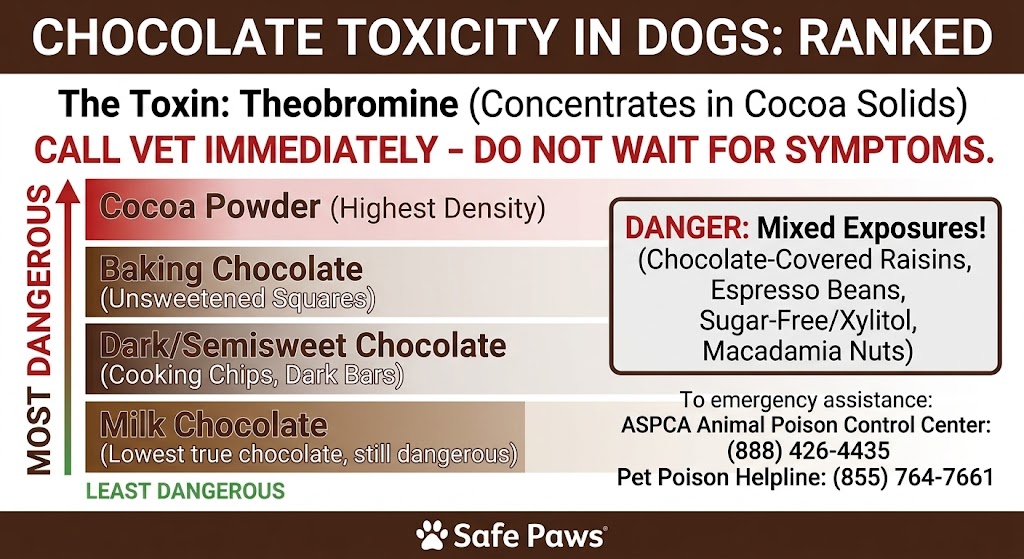
If your dog has already eaten chocolate, call now.
- Your own vet, or the nearest emergency veterinary hospital out of hours.
- ASPCA Animal Poison Control Center: (888) 426-4435, 24 hours. A consultation fee applies.
- Pet Poison Helpline: (855) 764-7661, 24 hours. A consultation fee applies.
Do not make your dog vomit unless a veterinary professional tells you to. Keep the wrapper.
Pet poison emergency page, numbers only.
The short answer: cocoa powder is the most dangerous form, followed by unsweetened baking chocolate, then semisweet and dark chocolate, then milk chocolate. That order comes from the Merck Veterinary Manual and reflects how much theobromine each form contains. Theobromine is the compound that harms dogs, and it concentrates as the cocoa solids concentrate. This is why the type matters more than the size of what was eaten: a small quantity of baking chocolate or cocoa powder can represent a larger exposure than a much larger quantity of milk chocolate. It is also why "dark is worse" is not a myth.
What the ranking cannot do is tell you whether your dog is in trouble, and the rest of this page explains why not.
What theobromine is, and why it concentrates
Chocolate comes from cocoa beans, and cocoa beans contain methylxanthines: mainly theobromine, with some caffeine. People clear theobromine quickly. Dogs clear it much more slowly, which is the whole reason a substance that is unremarkable in a human snack is a veterinary emergency in a dog. Veterinary sources including Cornell University's Riney Canine Health Center and Washington State University's Veterinary Teaching Hospital describe this slow clearance as the central fact of chocolate toxicity.
Theobromine lives in the cocoa solids, not in the sugar, the milk or the cocoa butter. So the more a product is made of cocoa solids, the more theobromine sits in the same weight of food. Cocoa powder is close to pure cocoa solids. Milk chocolate is mostly sugar and milk with cocoa solids as a minority ingredient. Same bean, very different density.
Signs described by veterinary sources include restlessness and hyperactivity, vomiting and diarrhea, excessive thirst and urination, panting, a racing or irregular heart rate, muscle tremors and seizures. These are reasons to call, not a scale for you to grade. Because dogs clear the compound slowly, effects can persist well beyond the point at which an owner expects them to settle.
The ranking, from most concentrated to least
Per the Merck Veterinary Manual, in descending order of concern:
| Form | Why it sits where it does |
|---|---|
| Cocoa powder | Effectively concentrated cocoa solids. The most theobromine-dense form in a normal kitchen. |
| Unsweetened baking chocolate | Sold in blocks and squares for baking. Very high cocoa solids, no dilution by sugar or milk. |
| Semisweet and dark chocolate | Chips, cooking chocolate, dark bars. Well above milk chocolate, with wide variation between products. |
| Milk chocolate | The lowest of the true chocolates, and still a reason to call. Also the form most often eaten in quantity, because it is what sits in candy bowls. |
| Cocoa bean hulls (cocoa mulch) | A garden material rather than a food, and named by veterinary sources as an ingestion hazard because dogs are attracted to the smell. |
White chocolate contains very little theobromine because it contains little or no cocoa solids. That does not make it a food to give a dog, and it does not settle the question, because a white chocolate product is usually full of fat and sugar and is frequently filled, coated or combined with something else.
Why the ranking cannot be self-applied
Here is the part almost every article on this topic leaves out. The ranking assumes your dog ate a labeled square of one type of chocolate. Dogs rarely do.
What a dog actually eats is a composite, and the other half of the composite is often the more serious problem:
| What was really eaten | The second exposure hiding inside it |
|---|---|
| Chocolate-covered raisins | A grape-family exposure. The ASPCA identified tartaric acid as the toxic principle in grapes and raisins, and there is no reliable threshold for it. This is frequently the more serious half of the incident, and it is the case people underestimate most. |
| Chocolate-covered espresso beans | Caffeine on top of theobromine, both methylxanthines, plus the bean itself. |
| Trail mix or a bar with chocolate and nuts | Macadamia nuts, which have their own distinct effect on dogs. |
| Sugar-free or "keto" chocolate | Xylitol, which acts far faster than theobromine and is dangerous in small amounts. |
| Brownies, cookies and cake | Cocoa powder rather than milk chocolate, so a higher-density form than the finished item looks like. Baked goods may also contain raisins, nuts or coffee. |
| A chocolate wrapper, foil or box | A foreign body question alongside the toxicity one. |
| Cocoa mulch from a garden | The ingestion hazard named above. |
Chocolate-covered raisins deserve their own line. A handful of them is a modest chocolate exposure and a real raisin exposure at the same time, and the raisin half has no dose figure anyone can give you. We cover that half in detail in my dog ate one grape and raisins baked into something.
So when you call, do not say "he ate chocolate." Say what the product was, in full, and read the ingredient list aloud if you still have it.
Why you may not know what type you have
The second reason the ranking cannot be self-applied is that the input is uncertain.
"Dark chocolate" is not a fixed density. It covers an enormous range of products, and two bars both labeled dark can differ substantially in cocoa solids.
A cocoa percentage on the front of a bar is not a theobromine measurement. It is a statement about total cocoa-derived content, including cocoa butter, which is not where theobromine lives. It correlates. It does not convert.
Filled, flavored and imported products vary more, and artisan and seasonal products more still. A truffle, a chocolate orange, a hot chocolate sachet, a chocolate protein bar and a bag of baking chips are five different questions.
And most people are estimating. How much was in the box before. How much the dog got. Whether the other dog helped. Which of those two bars it was. Every one of those is an estimate, and estimates stack.
None of this is a reason to panic. It is a reason to hand the assessment to someone who can ask the right questions about the actual product, which is exactly what a poison control specialist does.
The table this page does not print
Search this topic and the top results include per-ounce theobromine figures, dose calculators and, in one case, a promise of an exact lethal dose by breed and weight.
We publish none of it, on purpose, and it is worth saying why in plain terms.
A number on a page like this does not stay a number. It becomes a permission slip. "He's 30 pounds, it was milk chocolate, the calculator says he's under the line, we'll watch him." That calculation is being run at midnight by a frightened person using a guessed body weight, a guessed quantity, and a chocolate type they cannot verify. Three uncertain inputs produce a confident-looking output, and the output is a decision not to call.
There is a second problem. A threshold describes a population, not your dog. Age, size, existing heart disease and other medication all change what a given exposure means, and none of that is in a table.
The people who can do this properly are veterinary toxicologists working from your dog's real weight and the real product. They are on both numbers at the top of this page, at any hour. That is where the arithmetic belongs.
What the vet or the hotline will ask
Have this ready:
- What the product was, by name, with the ingredient list if you have it
- What type of chocolate, if the packaging says
- How much was in the packet or box to start with, not how much you think was eaten
- When it happened, or the window it happened inside
- Your dog's weight, or your best estimate
- Any medical history or current medication
- Anything you have already given or done
Keep the wrapper and the box. Take them with you.
If your dog ate chocolate
- Call. Your vet, an emergency hospital, or one of the hotlines above. Do this before you finish reading anything.
- Do not induce vomiting. The ASPCA's position is that induction belongs under veterinary direction only. Hydrogen peroxide, the method that circulates most widely online, is an irritant that veterinary sources associate with inflammation and ulceration of the stomach and esophagus, and vomiting itself carries an aspiration risk. This site publishes no method, no substance and no amount. The full reasoning is in why you must never make a dog vomit on your own judgment.
- Do not give milk, bread, oil or activated charcoal on your own initiative.
- Do not wait for symptoms. Early decontamination is the intervention with the most to offer, and its window narrows.
- Follow the plan you are given, including if that plan is to monitor at home. Ask what specifically to watch for and when to call back.
Step by step for the first hour: what to do in the first 60 minutes.
Frequently asked questions
Which chocolate is most dangerous for dogs?
Cocoa powder, followed by unsweetened baking chocolate, then semisweet and dark chocolate, then milk chocolate. The Merck Veterinary Manual gives that order, and it reflects how much theobromine each form contains. Cocoa bean hulls, used as garden mulch, are also named as an ingestion hazard.
Is dark chocolate really worse than milk chocolate for dogs?
Yes. It is not a myth. Dark chocolate contains more cocoa solids, and theobromine is in the cocoa solids. That is why a small amount of a dark or baking product can matter more than a larger amount of milk chocolate.
Is white chocolate safe for dogs?
White chocolate contains very little theobromine because it contains little or no cocoa solids, but it is not a food to give a dog, and white chocolate products are often filled or coated with something else. If your dog has eaten any of it, describe the actual product to a vet rather than assuming the category answers the question.
My dog ate chocolate-covered raisins. Which part matters more?
Tell the vet about both, and do not let the chocolate distract from the raisins. The ASPCA identified tartaric acid as the toxic principle in grapes and raisins, and no reliable safe threshold exists for it. This is often the more serious half of the exposure.
How much chocolate is too much for a dog?
This site publishes no dose, threshold or calculator for any substance, because a number in an owner's hands at midnight turns into a reason not to call. The assessment depends on the exact product, your dog's real weight, and their health, and veterinary toxicologists do it around the clock on both numbers at the top of this page.
Safe Paws publishes veterinary-sourced pet safety information. We are not veterinarians and this page is not veterinary advice, a diagnosis, or a substitute for examining your dog. See our veterinary disclaimer. Sources named on this page: Merck Veterinary Manual, Washington State University Veterinary Teaching Hospital, Cornell University College of Veterinary Medicine (Riney Canine Health Center), VCA Hospitals, ASPCA Animal Poison Control Center, Pet Poison Helpline.