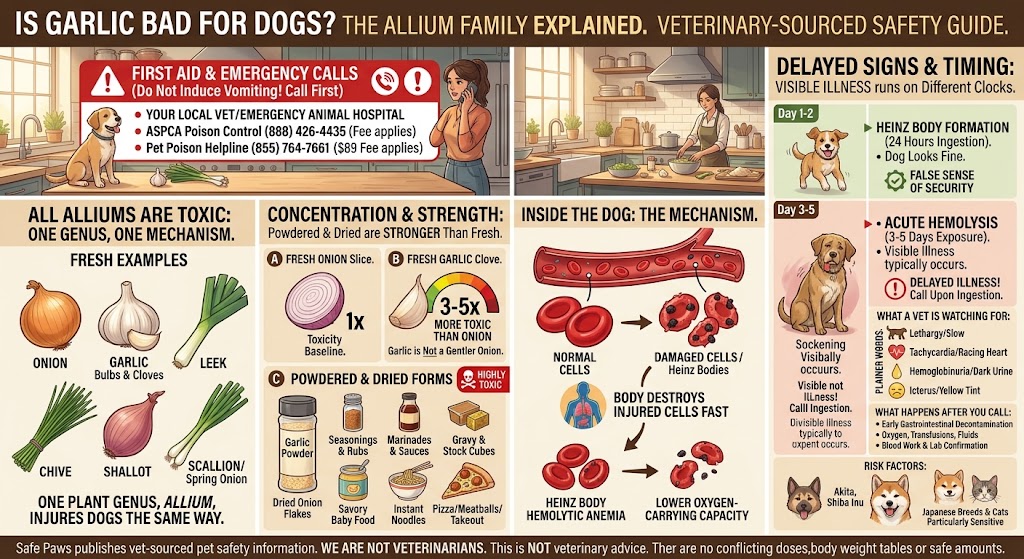
Yes. Garlic is toxic to dogs, and so is every other member of the allium family. If your dog has just eaten garlic, onion, leek, chive, shallot or scallion in any form, make the call before you read the rest of this page:
- Your own veterinarian, or your nearest 24-hour emergency animal hospital.
- ASPCA Animal Poison Control Center: (888) 426-4435. Their page states the center is available 24/7, 365 days a year, and that a one-time consultation fee applies.
- Pet Poison Helpline: (855) 764-7661. Their page states the service is available 24/7 and that an $89 incident fee applies.
Do not make your dog vomit. That decision belongs to a veterinarian or a poison-control specialist who knows your dog's weight, age and health, and who knows what was actually swallowed. Vomiting is the wrong move for some swallowed things, and it is a decision made with the animal's history in front of you, not from a web page.
Safe Paws publishes veterinary-sourced pet safety information. We are not veterinarians. This page is information to help you make a faster, better call to a professional. It is not veterinary advice, not a diagnosis, and not a substitute for having your dog examined. Our veterinary disclaimer sets out the limits of everything published here.
Why onion, garlic, leek and chive are one answer, not five
Most pages treat these as separate foods with separate verdicts. They are not separate problems. They are one plant genus, Allium, and they injure dogs by one mechanism.
The Merck Veterinary Manual's entry on Allium toxicosis names garlic, onions, chives and leeks together, and states that garlic and onions are the two most commonly associated with poisoning. On the mechanism it is direct: sulfur-containing oxidants in Allium species are thought to be responsible for the hemolysis that occurs after ingestion.
In plain language: compounds in these plants damage red blood cells. The damaged cells carry clumps of injured hemoglobin that veterinarians call Heinz bodies, the body destroys those cells faster than it can replace them, and the animal can end up short of the red blood cells that move oxygen around. Merck describes the diagnosis as clinicopathological confirmation of Heinz body hemolytic anemia. Every allium does the same thing, which is why there is one answer for the whole family.
Shallots, scallions and spring onions sit in the same genus. Merck does not list them by name, and there is no veterinary reason to file them separately from the ones it does list.
Garlic is not a gentler onion
This is the correction that matters most, because owners routinely reason that a clove is smaller than a slice, so it must be safer.
The Merck Veterinary Manual states that garlic is 3 to 5 times more toxic than onion.
Read that as a statement about concentration, not a permission slip. The same weight of garlic is not the same exposure as the same weight of onion, so measuring an incident by how much food was involved will underestimate it every time garlic is the allium in question. A teaspoon of minced garlic in a marinade is not a rounding error just because it looks like nothing next to the meat it was rubbed on.
It also means the reassurance you may find on supplement pages does not transfer. "Dogs have eaten small amounts of onion for years" and "garlic is basically an onion" are two different claims, and the second one is wrong by a factor Merck puts at three to five.
Powdered and dried are stronger than fresh, which is why real cases are usually seasoning
The mental image of allium poisoning is a dog eating a raw clove off the floor. That is not the common case.
Merck notes that toxicosis is most commonly associated with ingesting concentrated forms of Allium, such as dehydrated flakes, powders, or dry onion soup mixes. Drying removes water, and what is left is the part that does the damage, packed into a much smaller volume.
Recent laboratory work points the same way. A 2025 in vitro study in the journal Animals, by Klaudia Beleć, Justyna Barć and Olga Lasek at the University of Agriculture in Krakow, compared fresh, dried and granulated garlic against canine red blood cells in the lab. Granulated garlic extract produced the strongest effect, with roughly 15 percent of red blood cells showing Heinz bodies, compared with roughly 5 percent after fresh garlic extract. The authors are careful about what that does and does not show: the work used blood from five donor dogs in a dish, and they state plainly that direct extrapolation to living animals is not possible. Treat it as support for a direction, not as a number about your dog.
The practical consequence is a shopping list of things owners do not think of as onion or garlic at all:
- Gravy, pan sauces and stock cubes
- Seasoning blends, rubs, marinades and instant noodle sachets
- Savory baby food, which frequently carries onion or garlic powder
- Pizza, garlic bread, meatballs, meatloaf, burgers and stuffing
- Takeout dishes built on an onion and garlic base
- Salsa, guacamole and dips
If your dog got into leftovers or "a bit of what we were having", assume an allium was in it and say so on the phone. Our companion page on what to do when a dog eats onion walks through that same call in more detail, and this page is the family-level explanation sitting above it.
The damage is delayed, and that is when owners decide not to call
Here is the timing fact that changes behavior, and the reason this page keeps sending you to the phone.
Merck states that Heinz body formation begins within 24 hours of ingestion, and that hemolysis typically occurs 3 to 5 days after exposure. The injury and the visible illness run on different clocks.
So a dog that ate garlic butter at lunch and is bouncing around at bedtime has not demonstrated anything. Nothing has been ruled out. That evening is precisely the moment an owner talks themselves out of the call, because the dog looks fine, and the dog does look fine. If your dog is already some hours past the incident, that is not a reason to skip the call: see what changes when hours have passed since your dog ate something toxic.
What a vet is watching for
These are the signs the Merck Veterinary Manual lists for Allium toxicosis, in plainer words. They are a reason to get help, not a checklist for working out at home what your dog has. Only a veterinarian can confirm what is happening, and blood work is how they do it.
| What Merck lists | What it can look like at home |
|---|---|
| Lethargy, weakness, exercise intolerance | Flat, slow, unwilling to move or play |
| Anorexia | Turning down food |
| Tachypnea, tachycardia | Fast breathing, racing heart |
| Icterus | Yellow tint to the gums, eyes or skin |
| Hemoglobinuria | Red, brown or very dark urine |
| Collapse | Fainting, going down |
Merck lists death among the possible outcomes. That is why the honest version of this page does not contain a reassurance paragraph. The broader picture of what poisoning looks like in dogs covers the signs that cut across substances.
The same amount is not the same risk for every dog
Pet Poison Helpline's garlic page notes that cats and Japanese breeds of dogs, naming the Akita and the Shiba Inu, are particularly sensitive to garlic and other alliums.
That is one named example of a general truth: the amount eaten is not the whole story. Body weight, age, and whatever else is going on with a particular animal all sit inside the answer, which is exactly why the answer comes from someone who can ask about your dog. If more than one animal was in the room when the food went down, the picture changes again for each of them, and each dog needs its own assessment.
Why this page will not give you a number
You can find toxic-dose figures for allium in a few seconds. Some of them come from real veterinary sources. We do not publish them here, and the reason is not squeamishness.
A threshold gets read backwards. It is written to show how little it takes, and it gets used to work out how much is allowed, usually by someone doing arithmetic on a phone at 11pm with a dog that has already eaten. The things that decide the real answer, the true amount swallowed, the form it was in, the dog's weight and age, whether this was one incident or a habit of table scraps, are the things a number on a web page cannot know.
The honest position is the one the researchers themselves take. The Krakow team's stated conclusion is that controlled trials are still needed to establish safe intake levels for dogs. That is a scientist's way of saying the safe amount is not established.
So this page concedes what the supplement sellers will not. We are not claiming that every dog that has ever eaten garlic became ill. Garlic supplements for dogs are sold, legally, and people feed them. What we are saying is narrower and firmer: there is no established safe intake level, garlic is the most concentrated common member of the family, processing concentrates it further, and the harm is invisible for days. That combination is a bad one to guess at. Your veterinarian can make the judgment for your specific dog. A page cannot, and a brand selling the product has a reason not to.
If your dog got into something and you genuinely do not know what it was, that is its own situation and the approach differs: see what to do when you cannot identify what your dog ate.
What happens after you call
Knowing the shape of it makes the call easier to make.
Merck describes treatment for Allium toxicosis in two parts: early gastrointestinal decontamination, and management of acute hemolytic anemia, which it describes as including oxygen, transfusions and intravenous fluids in the appropriate cases. Diagnosis, per Merck, rests on the history of exposure, the clinical signs, and lab confirmation of Heinz body hemolytic anemia.
Decontamination is a clinical decision made by a professional with your dog in front of them. It is not a home procedure and it is not always the right move. Our page on what the vet actually does for dog poisoning goes through the visit step by step.
When you call, have ready: your dog's weight, roughly when it happened, what the food was, and if it came out of a packet, the label. That last one matters more than people expect, because it is often the only way to find out there was onion or garlic powder in the thing at all.
Frequently asked questions
Is a small amount of garlic safe for dogs?
There is no established safe intake level for dogs. The authors of the 2025 Animals study on garlic and canine red blood cells state that controlled trials are still needed to establish one. Because the amount that matters depends on your specific dog and on the form the garlic was in, the answer to "was this amount okay" comes from your veterinarian or a poison-control line, not from a page.
Is garlic powder worse than fresh garlic?
Concentrated forms are the ones veterinary sources single out. The Merck Veterinary Manual notes that Allium toxicosis is most commonly associated with concentrated forms such as dehydrated flakes, powders and dry soup mixes, and the 2025 Animals in vitro study found granulated garlic caused more Heinz body formation in canine red blood cells than fresh garlic did. Judge the exposure by concentration, not by how much food you saw.
My dog ate garlic bread. Is that an emergency?
Call and describe it. Garlic bread combines a concentrated allium with butter and often garlic powder, and the amount of actual garlic is not something you can read off the slice. Your vet, or Pet Poison Helpline at (855) 764-7661, can assess it against your dog's weight and the timing. Do not induce vomiting unless they tell you to.
My dog ate garlic yesterday and seems completely fine. Is he in the clear?
Not on the strength of looking fine. The Merck Veterinary Manual states that Heinz body formation begins within 24 hours of ingestion and that hemolysis typically occurs 3 to 5 days after exposure, so the visible illness runs days behind the injury. Call your veterinarian, tell them when it happened, and follow the monitoring plan they give you.
Are onion, leek, chive and shallot as much of a problem as garlic?
They belong to the same genus and injure red blood cells the same way, so they are one category. They are not equal in strength: the Merck Veterinary Manual states that garlic is 3 to 5 times more toxic than onion. Any of them is a reason to call.
Sources read and cited on this page: Merck Veterinary Manual, "Garlic and Onion (Allium spp) Toxicosis in Animals"; Pet Poison Helpline, garlic poison page; ASPCA Animal Poison Control Center; Beleć K, Barć J, Lasek O, "The Effect of the Type and Concentration of Garlic (Allium sativum) on Heinz Body Concentrations in Canine Erythrocytes: An In Vitro Study", Animals (Basel), 2025. Retrieved and checked 2026-08-26. This page deliberately publishes no toxic dose, no threshold by body weight and no safe amount, because no such figure is a safe substitute for a call about your dog. If anything here ever conflicts with what your own veterinarian tells you, listen to your veterinarian.