
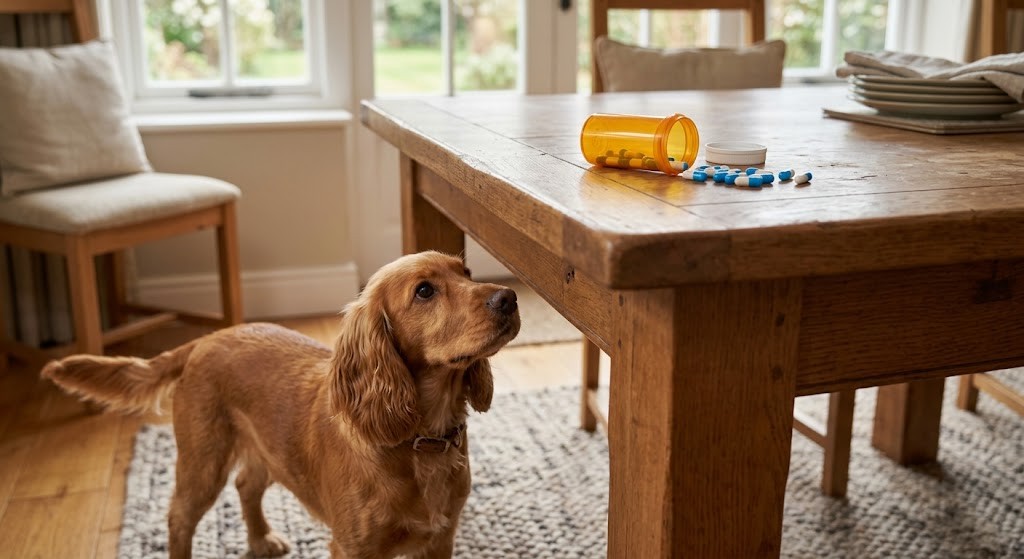
If your dog ate antidepressant tablets, ADHD medication or sleeping pills, treat it as an emergency and call now: your veterinarian, the nearest 24-hour emergency animal hospital, the ASPCA Animal Poison Control Center (888-426-4435) or the Pet Poison Helpline (855-764-7661). Both lines answer 24 hours a day, and a consultation fee may apply. The Pet Poison Helpline says of ADHD medications that "Even minimal ingestions" can be life-threatening. Do not make your dog vomit or give anything at home unless a vet or poison specialist tells you to. What the line needs from you is facts, not an apology.
If Your Dog Ate Antidepressant Pills: What to Do Right Now
- Call first, even if your dog looks normal. Phone your vet, an emergency animal hospital, the ASPCA Animal Poison Control Center at 888-426-4435 or the Pet Poison Helpline at 855-764-7661.
- Do not induce vomiting and do not give food, milk or any medicine unless a veterinarian or poison-control specialist tells you to for this drug, at this moment. Our guide on whether you should make your dog throw up explains why the vet makes that call.
- Go straight to an emergency vet if your dog is trembling, seizing, very agitated, pacing, stumbling, very sleepy or breathing with difficulty.
- Gather every packet, blister strip and bottle that could have been reached, and move them away from all pets.
- Keep other pets away from the area and from any dropped tablets while you make the call.
Toxicity varies with your dog's size, age and health and with the drug and amount. Only a veterinarian can judge that. This article is general information, not a diagnosis, and it gives no dose, threshold or safe amount.
"He Got the Whole Blister Pack." What the Poison Line Needs
When a dog chews through a blister pack, the most useful thing you can do is work out, as closely as you can, how many tablets are gone. You do not need to be exact. You need to be clear about what you know and what you are guessing.
- Count the empty pockets. A pocket that is torn open may mean a swallowed tablet. A pocket that is crushed but still sealed may still hold its tablet, so check it.
- Look on the floor and in the dog's bed for tablets or pieces. Every one you find helps the count, but do not delay the call to search.
- Read the strip itself. The foil or the box carries the drug name and strength. Keep both.
- Check for other strips. If more than one person in the home takes medication, there may be more than one drug involved.
- Note the time, or the last time you are sure the pack was intact.
Our checklist of what to bring to the emergency vet for poisoning covers the rest, from your dog's weight to any medicines your dog already takes.
Dog Ate Antidepressant Tablets: What the Sources Say
The Pet Poison Helpline's page on antidepressants says: "Antidepressant ingestions are one of the top accidental poisonings reported in pet animals," and that "Overdoses result in mild to severe gastrointestinal, cardiovascular, and neurological signs dependent upon the dosage ingested and the patients' health status." It adds: "Immediate veterinary intervention is often needed following intoxication with antidepressants by dogs and cats."
The Merck Veterinary Manual chapter on toxicoses from human antidepressants, anxiolytics and sleep aids (by Cristine Hayes, DVM, of the ASPCA Animal Poison Control Center, last updated May 2025) separates the main groups. The drug examples below are the ones Merck's pet owner chapter on human prescription drugs names.
- SSRIs, such as sertraline, fluoxetine, paroxetine and fluvoxamine. Merck lists signs including "GI signs, lethargy, ataxia, agitation, shaking, seizures," and notes that nystagmus, a flicking movement of the eyes, can occur.
- Tricyclic antidepressants, such as amitriptyline, clomipramine and nortriptyline. Merck describes early signs that include "cardiac arrhythmias, hypertension," muscle jerks and urinary retention, followed by lethargy, wobbliness, low body temperature, depressed breathing, low blood pressure and coma. Those heart rhythm effects are one reason the vet will want to know if it was a tricyclic.
If you do not know which group your medicine belongs to, that is fine. Read the name from the packet and the poison line will know.
Serotonin syndrome, and why other medicines in the house matter
Merck's owner chapter describes serotonin syndrome, with signs that "include altered mental status, agitation, sudden muscular contractions, overactive reflexes, tremors." It says the syndrome "is often seen after overdose of substances that result in increased free levels of serotonin, such as antidepressants or profound stimulants (for example, amphetamines, cocaine, pseudoephedrine, and ephedra)."
That sentence matters in a household where someone takes an antidepressant and someone else takes an ADHD stimulant, or where a decongestant sits in the same drawer. If there is any chance your dog got into more than one kind of medicine, tell the poison line every one, not just the one you noticed first.
ADHD Medication: Why Small Amounts Worry Vets
The Pet Poison Helpline's list of the top human medications poisonous to pets says: "Even minimal ingestions of these medications by pets can cause life-threatening tremors, seizures, elevated body temperatures and heart problems."
The Merck Veterinary Manual chapter on amphetamines and ADHD drugs (by Lynn Rolland Hovda, RPh, DVM, last updated February 2026) names amphetamine, dextroamphetamine, lisdexamfetamine, methylphenidate, dexmethylphenidate and atomoxetine. It lists signs in dogs including "restlessness, agitation, hyperactivity, aggression, mydriasis, circling, head bobbing, vocalization, ataxia, seizures, and death," along with vomiting, drooling and diarrhea. Mydriasis means widely dilated pupils.
Merck also describes how dogs get to these drugs, from "ingesting a dropped pill to finding and swallowing a discarded patch in the garbage to chewing up an entire container." According to Merck, these drugs also come as long-acting tablets, chewable tablets, oral solutions and skin patches, so tell the poison line the exact product form, and check the trash if a patch is missing.
Sleeping Tablets and Anxiety Medication: The Opposite of What You Expect
Owners often assume a sleeping tablet will just make a dog sleepy. The sources say it may do the reverse.
- The Pet Poison Helpline says: "About half of dogs who ingest sleep aids become agitated instead of sedate."
- Merck's chapter on antidepressants, anxiolytics and sleep aids says of sleep aids such as zolpidem: "Although expected sedation occurs, paradoxical excitement also occurs."
- Merck's owner chapter describes benzodiazepines, such as diazepam, alprazolam, clonazepam and lorazepam, as causing "central nervous system depression, depressed breathing, lack of coordination, weakness," and notes these drugs "have been associated with the contradictory state of excitement."
So a pacing, restless or vocal dog after a sleeping tablet is not a sign that the drug "didn't work." It is a reason to go to the emergency vet now.
"But My Dog Takes Fluoxetine Too"
Some of these drugs are prescribed for dogs. Merck says: "Many SSRIs are used therapeutically to treat behavioral disorders in dogs and cats." That does not make your tablet safe for your dog. Your prescription was made at your strength, for you, and only the poison line or your vet can work out what it means on top of whatever your dog already takes. Tell them about your dog's own prescription as well as the pill it ate.
Signs to Report, Not to Diagnose
These are the signs named in the sources above, grouped so you can describe what you see. They are not a checklist for deciding at home whether your dog is affected.
| What you might see | Drug groups the sources link it to |
|---|---|
| Agitation, restlessness, pacing, vocalizing | ADHD stimulants, SSRIs, sleep aids |
| Trembling, muscle jerks, seizures | SSRIs, tricyclics, ADHD stimulants |
| Sleepiness, wobbliness, weakness | Tricyclics, benzodiazepines, SSRIs |
| Wide pupils, flicking eye movements | ADHD stimulants, SSRIs |
| Fever or high body temperature, heart rhythm changes | Antidepressants, ADHD stimulants |
| Vomiting, drooling, diarrhea | SSRIs, ADHD stimulants |
Any of these means go to an emergency vet now. A dog with no signs still needs the call, and if time has already passed, our guide on a dog that ate something toxic hours ago explains why a late call is still worth making. The sources we read do not give owners a safe waiting period for these drugs, and we do not invent one.
If It Was Your Cat
Call your vet or a poison line now. Merck's owner chapter says of benzodiazepines that "Cats may be more sensitive to adverse effects." The ASPCA Animal Poison Control Center (888-426-4435) and the Pet Poison Helpline (855-764-7661) both take calls about cats.
Sources Checked
On September 28, 2026 we read the Merck Veterinary Manual chapter on toxicoses in animals from human antidepressants, anxiolytics and sleep aids, the Pet Poison Helpline's list of the top 10 human medications poisonous to pets, the Pet Poison Helpline's page on antidepressants, the Merck chapter on amphetamines and ADHD drugs in animals, and the Merck pet owner chapter on poisonings from human prescription drugs. This article publishes no dose, toxic threshold or safe amount; those are for your vet or a poison line to assess.
Frequently Asked Questions
My dog ate one antidepressant pill. Is that dangerous?
It can be. The Pet Poison Helpline lists antidepressant ingestions among the top accidental poisonings in pets and says immediate veterinary care is often needed. Whether one tablet matters depends on the drug, its strength and your dog, so call your vet or a poison line now.
What are the signs of antidepressant poisoning in dogs?
The Merck Veterinary Manual lists stomach upset, lethargy, wobbliness, agitation, shaking and seizures for SSRIs, and heart rhythm problems, high then low blood pressure, low body temperature and depressed breathing for tricyclics.
My dog ate a sleeping pill and is hyper. Is that normal?
It is described in the sources, but it is not a reason to wait. The Pet Poison Helpline says about half of dogs that eat sleep aids become agitated instead of sedated. Go to an emergency vet now.
Is ADHD medication dangerous to dogs?
Yes. The Pet Poison Helpline says even minimal ingestions can cause life-threatening tremors, seizures, high body temperature and heart problems.
Should I make my dog throw up after eating antidepressants?
Not unless a veterinarian or poison-control specialist tells you to for that drug at that moment. Call first.
This article is general information and does not replace veterinary care. If you think your dog has eaten any antidepressant, ADHD medication, sleeping tablet or other human medicine, contact your veterinarian, the ASPCA Animal Poison Control Center at 888-426-4435, or the Pet Poison Helpline at 855-764-7661 now. Toxicity varies with your dog's size and health, and only a veterinarian can assess your individual dog.