
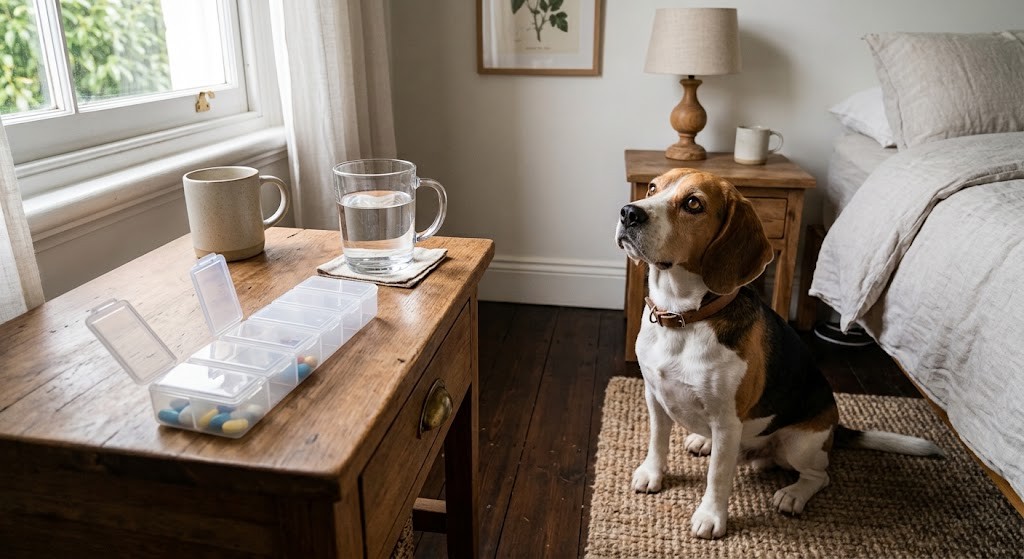
Dog ate my medication: if that is what just happened, treat it as an emergency and call now: your veterinarian, the nearest 24-hour emergency animal hospital, the ASPCA Animal Poison Control Center (888-426-4435) or the Pet Poison Helpline (855-764-7661). Both poison lines answer 24 hours a day, and a consultation fee may apply. Have the packet or pharmacy bottle in your hand when you call. Do not make your dog vomit and do not give any home treatment unless a vet or poison specialist tells you to. Whether one pill matters depends on the drug, its strength and your dog, and only a vet can judge that.
If Your Dog Ate Your Medication: The First Five Minutes
- Call first. Phone your vet, an emergency animal hospital, the ASPCA Animal Poison Control Center at 888-426-4435 or the Pet Poison Helpline at 855-764-7661. Do this even if your dog seems completely normal.
- Do not induce vomiting and do not give food, milk, oil or any medicine unless a veterinarian or poison-control specialist tells you to for this drug, at this moment. Our guide on whether you should make your dog throw up explains why that decision belongs to the vet.
- Go straight to an emergency vet if your dog is collapsing, seizing, trembling, very weak, unusually agitated or breathing with difficulty.
- Pick up every remaining pill, including any that rolled under furniture, and keep other pets away from the area.
- Keep the packaging. The name, the strength and the pharmacy label are the most useful things you can give the person on the phone.
Toxicity varies with your dog's size, age and health, and with how much was eaten. This article is general information, not a diagnosis, and it deliberately gives no dose, threshold or safe amount.
"It's My Blood Pressure Pill. Is That Even Relevant to a Dog?"
Yes. This is the question owners ask most often, and it comes from a reasonable place: the drug was made for a person, for a person's condition, so it feels like it should not do much to a dog. The sources say otherwise.
The Merck Veterinary Manual's pet owner chapter on poisonings from human prescription drugs, written by Safdar A. Khan, DVM, of the ASPCA Animal Poison Control Center, opens with the plain observation that "Pets commonly ingest prescription medications from countertops, pill minders, mail-order packages, or other sources." The same chapter lists low blood pressure among the most common signs when a pet eats several kinds of human heart and blood pressure drugs, so the pill is very much relevant.
There is a second, less obvious point. Merck notes that "Several ACE inhibitors (for example, enalapril, captopril, lisinopril) are used to treat congestive heart failure in dogs and cats," and that some heart drugs "are used to treat heart diseases in animals, but all can be toxic if a pet accidentally eats a large number of pills." So "vets prescribe this for dogs" is not the same as "my tablet is fine for my dog." Your tablet was made at a strength for your body, and your dog was never prescribed it. Only the poison line or your vet can work out what it means for your dog.
Dog Ate My Medication: Which Drug Types Worry Vets Most
The honest answer is that it depends on the drug class. The sources we read sort common human prescriptions very differently, which is exactly why the call needs the label.
Heart and blood pressure medicines
The Pet Poison Helpline's list of the top human medications poisonous to pets separates two groups. On ACE inhibitors it says: "This category of medication is typically a low risk for poisoning. All heart medications should be kept out of reach of pets." On beta-blockers it says: "Small ingestions of these drugs may cause serious poisoning in pets. Overdoses can cause life-threatening decreases in blood pressure and a very slow heart rate."
A "typically low risk" group is still not something to judge at home. You may not know which class your pill belongs to, and many people take more than one heart medicine.
The ASPCA's medication spotlight on heart and blood pressure medications (February 2019) names the classes it sees: calcium channel blockers such as amlodipine, diltiazem and verapamil; ACE inhibitors and angiotensin II antagonists such as lisinopril, benazepril, enalapril and olmesartan; diuretics such as furosemide and hydrochlorothiazide; aspirin; and statins. It says calcium channel blockers can cause "hypotension, increase or decrease in heart rate, fluid in the lungs, damage to the kidneys and even death."
Mood, attention and sleep medicines
These are a separate group with their own risks. In brief, the Pet Poison Helpline says antidepressant overdoses "can lead to serious neurological problems such as sedation, incoordination, tremors and seizures," and that with ADD and ADHD medications, "Even minimal ingestions of these medications by pets can cause life-threatening tremors, seizures, elevated body temperatures and heart problems."
Pain relievers
Human NSAIDs and acetaminophen head the Pet Poison Helpline's list. Merck's owner chapter notes that "Accidental ingestion by animals of NSAIDs intended for human use is common." If the pill was a painkiller, say so on the call and read out the full name from the packet.
Signs the Sources Link to Common Prescription Drugs
These are listed so you can describe what you see accurately to the vet or poison line, not so you can decide at home whether your dog is affected. A dog with no signs yet still needs the call. For a fuller explanation of why looking normal is not reassurance, see our guide on a dog that ate something toxic but seems fine.
| Drug group | Signs named in the Merck Veterinary Manual owner chapter |
|---|---|
| Beta blockers | "slow heart rate and low blood pressure"; depressed breathing, coma, seizures, high blood potassium and low blood sugar may develop |
| Calcium channel blockers | "low blood pressure, slow heart rate, gastrointestinal upset, and irregular heart rhythms" |
| ACE inhibitors | "abnormally low blood pressure with secondary kidney damage" |
| Antidepressants | agitation, confusion, fever, abnormal heart rhythms, high blood pressure, sudden muscular contractions |
| Sleep aids and benzodiazepines | central nervous system depression, depressed breathing, lack of coordination, weakness; Merck notes these drugs have also "been associated with the contradictory state of excitement" |
Weakness, collapse, a very slow or racing heartbeat, trembling, seizures or trouble breathing mean go to an emergency vet now, not wait for a callback.
What to Have Ready When You Call
The call goes faster, and the advice is more precise, when you have these answers in front of you. Our checklist of what to bring to the emergency vet for poisoning covers the same ground for the visit itself.
- The exact drug name, as printed on the box or pharmacy label, not just what you call it.
- The strength, usually printed per tablet or capsule.
- Any letters after the name, such as XL, SR, ER or CR. They are part of the product name, so read them out.
- How many could be missing. Count what is left against the label or the blister strip. An estimate is fine if you say it is an estimate.
- Whether it came from a pill organizer. If so, list every medicine that was in that compartment, because your dog may have eaten more than one drug.
- When it happened, or the last time you saw the pills intact.
- Your dog: age, weight, breed, health conditions and any medicines your dog already takes.
- What you have seen since, including "nothing yet."
Why Pill Organizers and Dropped Pills Matter
The Merck line about countertops and "pill minders" matches what the Pet Poison Helpline tells owners about storage. Its advice includes: "If you place your medication in a weekly pill container, make sure to store the container in a cabinet out of reach." A pill organizer mixes several drugs in one compartment, and a dog that chews it open can swallow a combination nobody would plan for. That is the main reason to tell the poison line exactly what was in each compartment.
A dropped pill is the other common route. People often take medication standing in the kitchen or bathroom, and a tablet that bounces off the counter can be gone before anyone looks down. If you are not sure whether the dog ate it or it rolled away, search carefully, but make the call while you search rather than after.
What the Vet May Do
What happens next depends on the drug, the amount, the time and your dog. The vet may decide to decontaminate, monitor heart rate, blood pressure and blood work, give fluids, or keep your dog in for observation. None of that can be done safely at home. Our guide on what the vet does for dog poisoning walks through a typical visit so you know what to expect.
If It Was Your Cat
The same rules apply, and cats can be more vulnerable. Merck's owner chapter notes, in its section on benzodiazepines, that "Cats may be more sensitive to adverse effects." Call your vet, the ASPCA Animal Poison Control Center at 888-426-4435 or the Pet Poison Helpline at 855-764-7661 now, and tell them it was a cat.
Sources Checked
On September 28, 2026 we read the Merck Veterinary Manual's pet owner chapter on poisonings from human prescription drugs (reviewed October 2020, last updated May 2026) and the Pet Poison Helpline's list of the top 10 human medications poisonous to pets. On the same day we read the ASPCA's February 2019 medication spotlight on heart and blood pressure medications. This article publishes no dose, toxic threshold or safe amount; those are for your vet or a poison line to assess for your dog.
Frequently Asked Questions
My dog ate one of my pills. Is one pill dangerous?
It can be. The Pet Poison Helpline says of beta-blockers that "Small ingestions of these drugs may cause serious poisoning in pets," and of ADHD medications that "Even minimal ingestions" can be life-threatening. Whether one pill matters depends on the drug, its strength and your dog, so call your vet or a poison line now.
Can blood pressure medication hurt a dog?
Yes. The Merck Veterinary Manual lists low blood pressure and a slow heart rate among the most common signs of overdose with beta blockers and calcium channel blockers, and low blood pressure with kidney damage as the main concern with ACE inhibitors.
My vet prescribes the same drug for my dog. Does that make my pill safe?
No. Merck notes that some heart drugs are used in animals but that "all can be toxic if a pet accidentally eats a large number of pills." Your tablet was made for you, at your strength. Tell the poison line the drug and strength, and mention that your dog is on a related prescription.
Should I make my dog throw up after eating my medication?
Not unless a veterinarian or poison-control specialist tells you to for that drug at that moment. Call first and follow the instructions you are given.
What if my dog seems fine after eating my medication?
Call anyway. The poison line assesses the risk from the drug, the strength and your dog, not from how your dog looks right now. The call is about the exposure, not the symptoms.
This article is general information and does not replace veterinary care. If you think your dog has eaten any human medication, contact your veterinarian, the ASPCA Animal Poison Control Center at 888-426-4435, or the Pet Poison Helpline at 855-764-7661 now. Toxicity varies with your dog's size and health, and only a vet can assess your individual dog.