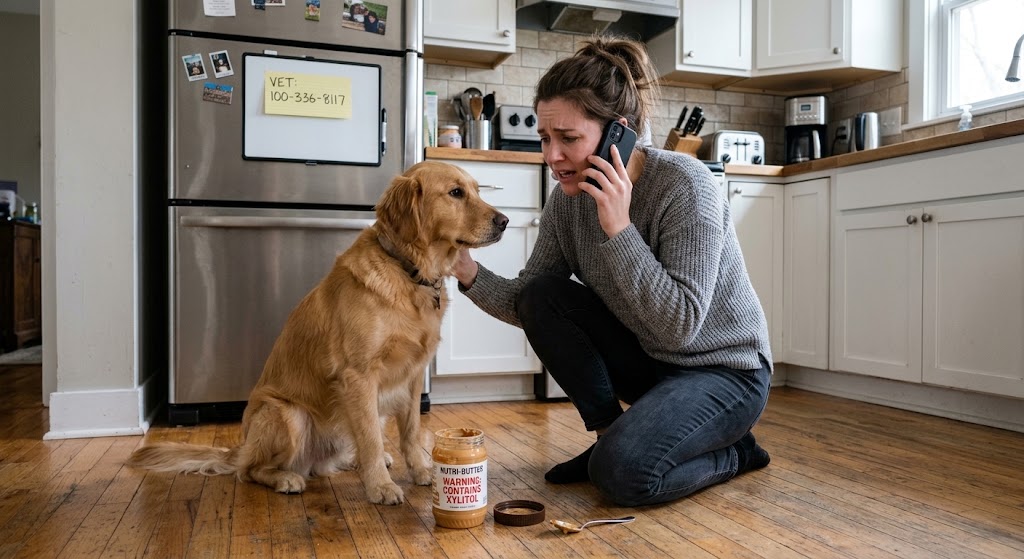
Call for help now, before you finish reading. Phone your own veterinarian, your nearest 24-hour emergency animal hospital, the ASPCA Animal Poison Control Center at (888) 426-4435, or the Pet Poison Helpline at (855) 764-7661. Both hotlines are US-based and staffed around the clock, and a consultation fee may apply. Do not make your dog vomit and do not give any home remedy, food or drink unless a veterinarian or a poison-control specialist tells you to, for this exact product, right now. Our pet poison emergency page has the same call order in one place.
While the phone rings, do one thing: put the jar somewhere you will not lose it. Not the spoon, not the lid. The jar, with the ingredient panel on it.
This page is general information gathered from published veterinary sources. It is not veterinary advice, it cannot examine your dog, and it cannot tell you whether your dog is safe. Please read our veterinary disclaimer.
Why the jar matters more than anything else you can do
Xylitol exposure is one of the few situations where an ordinary household object is genuinely diagnostic. The ingredient panel tells a veterinary team what compound they are dealing with and roughly how far up the list it sits, and that is information nobody can reconstruct later from a description.
If the jar is already in the bin, take it back out. If it is gone entirely, a photograph of the same product from the manufacturer's website is a distant second best, and you should say clearly on the call that it is a substitute rather than the actual jar. Being uncertain out loud is more useful to a specialist than sounding confident.
The number this page does not give you
Most of the results for this search will eventually tell you how much xylitol is a problem, usually worked out against your dog's weight.
This site publishes no dose, no threshold and no weight-based calculation for any substance, and that is deliberate rather than an oversight. There is no number on this page you can measure your dog against. The arithmetic those pages invite needs three values you do not have: exactly which product it was, exactly how much your dog ate, and how much xylitol that particular formulation contains, which is not printed on the label. Three guesses in, the calculation produces a confident answer that is not about your dog.
There is a second number this page withholds on purpose. Published veterinary sources describe how quickly signs can begin, and those figures get quoted everywhere. They are the wrong tool for an owner, because the only thing an owner can do with a stopwatch is talk themselves out of a phone call once it has run out. Signs can come on fast. Speed of onset is not something you can use to make this decision.
Read the label, not a brand list
Nearly every page ranking for this search publishes a list of peanut butter brands that contain xylitol. The NC State College of Veterinary Medicine names several. Those lists are real and they were accurate when they were written, and they are also the most perishable sentence on any of those pages.
Manufacturers reformulate. A brand can run several product lines and sweeten only one of them. A jar bought last year is not the jar someone reviewed for an article. A list can only ever tell you what was true somewhere else, at some earlier time, and it is read as an all-clear at exactly the moment an all-clear does the most damage.
The ingredient panel on the jar in your kitchen is the only current, product-specific truth available to you. Read it now, out loud, to whoever answers the phone. If the jar is gone, say so, and say which product you believe it was.
The names xylitol hides under
This is the paragraph most worth your thirty seconds, because a careful reader scanning for the word "xylitol" can read a panel correctly and still miss it.
The ASPCA's guidance, reproduced by NC State, is to look for anything containing "xyl". The names that appear on real packaging include:
- Birch sugar and birch bark extract
- Xylite
- D-xylitol
- Anhydroxylitol and 1,4-anhydro-d-xylitol
- Xylitylglucoside
Birch sugar is the one that catches people. It reads like a wholesome ingredient, it appears on products that market themselves as natural, and it is the same compound. If any of these is on the panel, treat it as xylitol and say the exact word you found to the person on the phone.
Xylitol is not confined to peanut butter. The Pet Poison Helpline lists it in chewing gum, mints, candies, puddings and gelatin snacks, sauces, syrups and jams, oral rinses and toothpaste, over-the-counter supplements, nasal sprays, and even cosmetics. If it was in your peanut butter, it is worth knowing what else in the same cupboard it might be in.
Why this happens to careful people
It is worth saying plainly, once, because you are probably not saying anything kind to yourself right now.
Peanut butter is the standard way owners give a dog a tablet. It is the thing that goes in the puzzle feeder and the lick mat. It is also a product category that has been reformulated hard for human diets, so sugar-free, keto, protein and "no added sugar" lines exist alongside the ordinary version on the same shelf, in near-identical packaging. The exposure route here is not carelessness. It is a product change that happened underneath a routine, and it lands most often on the owners who use peanut butter most, which is the ones medicating a dog.
None of that changes what you do next, which is call. It does mean the useful question is what is in the jar, not what you should have done.
What the vet or the hotline will ask you
Expect these, roughly in this order. "I do not know" is a useful answer and they hear it constantly.
- What was the product, exactly? Read the front of the jar and then the ingredient list, including where in the list the sweetener appears.
- How much, at worst case? Round up, not down. What is left in the jar is evidence of what was not eaten, which is not the same thing.
- How long ago? A best estimate is fine. If you found it rather than watched it, give the window.
- How much does your dog weigh? Their real weight. If you do not know, say approximately, and say the breed.
- How old is your dog, and is there anything else going on? Existing conditions, and every medication or supplement they are on.
- What are you seeing right now? Including nothing at all. "He is behaving completely normally" is information, not an admission that you are wasting their time.
Write down what you are told, including any case number the hotline gives you. That number lets a clinic talk to the same specialist about the same case instead of starting again.
Why "he seems completely fine" is not the all-clear
The Pet Poison Helpline describes xylitol as affecting dogs in more than one way: it can trigger a dangerous drop in blood sugar, and it is associated with acute liver failure. NC State describes the blood-sugar effect as an insulin release, producing weakness, disorientation, tremors and, in serious cases, seizures.
Two things follow from that, and neither is reassuring.
A dog can look completely normal and be in the early part of this, because a normal-looking dog in the first stretch is behaving exactly the way an affected dog behaves in the first stretch. And because more than one system can be involved, a dog who looks like they got through the first part is not automatically finished with it. Whether your dog needs monitoring, and for how long, is a decision that belongs to someone who can see them.
We wrote a whole page on this reflex, because it is the most common reason a treatable ingestion becomes a hospital case: why a dog that seems fine can still be in trouble.
What you must not do while you wait
Do not make your dog vomit. Not with hydrogen peroxide, not with salt, not with anything, and not because a search result gave you a method. Whether bringing material back up helps or harms depends on the substance, the timing and the state the dog is in, and for several common household products it causes a second injury on the way. This site publishes no method for it at all, and that is the point of the page.
Do not give food, sugar, syrup or anything else in an attempt to correct blood sugar. You will find that suggestion online. It is an intervention aimed at a specific clinical picture, it can be the wrong thing for a dog who is not fully alert, and it is not a decision to make from a kitchen. If a veterinarian or a poison-control specialist instructs you to do something specific while you travel, do that, and only that.
Do not wait to see what happens. If you are told to come in, take these things with you, and take the jar.
Related emergency guides
- What to do in the first 60 minutes after your dog eats something toxic
- Why a dog that seems fine can still be in trouble
- Why you must never make a dog vomit on your own judgment
- What to take with you to the emergency vet
- When the ingredient is hidden inside something baked
Frequently asked questions
How much xylitol peanut butter is dangerous for a dog?
This site does not publish that figure, in any unit, for any substance. The honest reason is that the answer depends on the exact formulation, the true amount eaten and your individual dog, and the amount of xylitol in a given jar is not printed on the jar. A veterinarian or a poison-control specialist can work through it with you on the phone in minutes using values they verify rather than estimate. Call them, read the ingredient panel out, and round the amount up.
My peanut butter says "birch sugar" and not xylitol. Is that different?
No. Birch sugar is xylitol under another name, and it is the name most likely to be missed by someone scanning a label carefully. The ASPCA's guidance is to treat anything containing "xyl" as xylitol, which also covers xylite, anhydroxylitol and xylitylglucoside. Tell the hotline the exact wording you found on the panel.
Is my brand of peanut butter safe for dogs?
This page will not tell you that any product is safe, and you should be wary of any page that does. Formulations change, brands run multiple product lines, and a list published somewhere else last year cannot describe the jar in your hand. Read the ingredient panel on that jar. If you cannot read it, or it is gone, that is a reason to call rather than a reason to assume.
My dog only licked the spoon. Do I still need to call?
Call anyway. It is a short conversation and it costs you nothing but the time, and specialists tell owners that no visit is needed more often than people expect. Deciding for yourself that a small amount does not count is the one step in this that cannot be undone.
He ate it hours ago and he is completely normal. Have we got away with it?
That is genuinely encouraging and it is not proof. Xylitol can affect more than one body system, so a dog who looks past the first part is not necessarily past all of it. Call with the timing anyway and let a professional decide whether your dog needs to be seen or watched, and for how long. "Seems fine so far" is one of the facts they weigh, not the conclusion.
Safe for Paws is written by Md Astafar Hossain, a dog parent and researcher, not a veterinarian. This is general information gathered from published veterinary sources including the ASPCA Animal Poison Control Center, the Pet Poison Helpline and the NC State College of Veterinary Medicine. It is not veterinary advice, it is not a set of instructions, and it cannot diagnose or treat your pet. Please read our full veterinary disclaimer. If anything here conflicts with your own veterinarian, listen to your veterinarian. In an emergency, call your vet, the ASPCA Animal Poison Control Center at (888) 426-4435, or the Pet Poison Helpline at (855) 764-7661.