
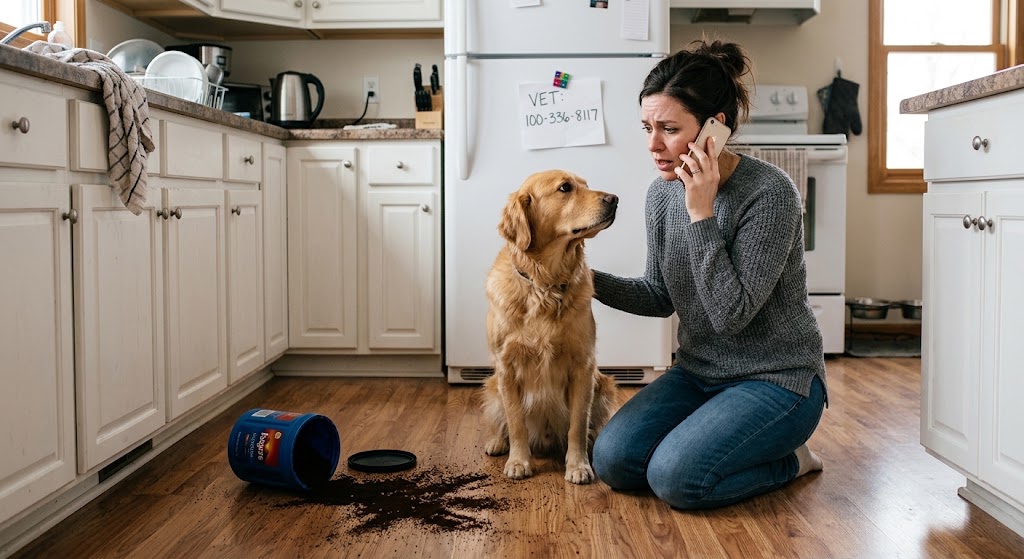
Call now, before you finish reading this page. Phone your own veterinarian, your nearest 24-hour emergency animal hospital, the ASPCA Animal Poison Control Center at (888) 426-4435, or the Pet Poison Helpline at (855) 764-7661. Both hotlines are US-based and staffed around the clock, and a consultation fee may apply. Caffeine is treated as a poisoning in dogs, and Pet Poison Helpline's own guidance is not to wait for symptoms. Do not make your dog vomit and do not give any home remedy unless a veterinarian or a poison-control specialist tells you to, for this exact substance, right now. Our pet poison emergency page keeps the same call order in one place.
While the phone is ringing, go back to the bin and look at what is actually missing. Not just the grounds.
This page is general information gathered from published veterinary sources. It is not veterinary advice, it cannot examine your dog, and it cannot tell you whether your dog is safe. Please read our veterinary disclaimer.
What a caffeine call is really about
Caffeine belongs to a family of compounds called methylxanthines, the same family as theobromine in chocolate. Veterinary sources treat ingestion in dogs as a stimulant poisoning rather than an upset stomach, which is why the advice you will get on the phone is different in tone from what you might expect for a food.
Pet Poison Helpline lists the forms that come up in real cases, and the list is wider than most owners expect: whole or ground coffee beans, brewed coffee hot or iced, espresso and espresso beans, chocolate-covered espresso beans, used coffee grounds pulled from the trash or compost, coffee pods and capsules, and coffee-flavored foods and desserts. Tea, energy drinks, pre-workout powders, diet pills and some pain medications belong on the same shelf in your head.
The signs veterinary sources describe run from restlessness, hyperactivity, vomiting, diarrhea, a raised heart rate, panting and muscle tremors at the milder end, through to seizures, collapse, abnormal heart rhythms, raised blood pressure and severe agitation. Pet Poison Helpline states that symptoms of caffeine poisoning can begin within one to two hours of ingestion.
Read that list as reasons to call, not as a test to pass. None of it has to be happening yet.
The sentence that changes the advice on this page
Almost every article on this query tells you the same reassuring thing: used grounds have already given up most of their caffeine to the hot water, so a bin raid is less serious than a bag raid. That is a real chemical fact, and it is genuinely relevant.
It is also not an all-clear, and here is the part those pages skip.
Pet Poison Helpline's own position is that you should not wait for symptoms, because caffeine poisoning can escalate quickly, and by the time visible signs appear the caffeine has already been absorbed. That single line dismantles the wait-and-see plan that "used grounds are weaker" quietly encourages. Weaker is a statement about concentration. It is not a statement about the dose your specific dog took, which nobody in your kitchen can measure, from a volume nobody watched.
So the honest version is: used grounds probably carry less caffeine than fresh ones, you do not know how much less, you do not know how much your dog swallowed, and the window in which a professional can act most usefully is the same window in which your dog still looks completely normal.
The information gain: the grounds are rarely the only thing swallowed
This is the part no ranking page covers, and it is the part that most often changes what happens next.
A dog does not eat coffee grounds off a clean plate. The grounds arrive wrapped in something, and the wrapper goes down too.
- A paper filter. A soggy cone of filter paper, swallowed whole, is a second and completely separate problem from the caffeine. It is a foreign body.
- A pod or capsule. Plastic or aluminum, often crushed into sharp-edged pieces, and containing grounds that were never brewed at all. A chewed pod can be the worst version of this scenario wearing the costume of the mildest one.
- The foil lid, which tears into thin metal strips.
- A tea bag, with its staple, tag and string. Owners call about the caffeine. The string is what a veterinarian will want to hear about, because linear foreign material behaves differently in an intestine than a lump does.
- Everything else in the bin. Bones, onion skins, fat trimmings, packaging, a discarded chocolate wrapper. A dog that raided a compost caddy also met whatever mold is growing in it.
When you call, describe the container as well as the contents. Say "used grounds, and I think the paper filter is gone too," or "a coffee pod, and I cannot find the foil lid." The specialist is triaging two risks at once, and the second one is the one owners forget to mention.
If you truly cannot tell what was taken, work from the frame in what to do when you do not know what your dog ate rather than guessing.
What the vet or the hotline will ask you
Expect roughly these, in roughly this order. "I do not know" is a normal answer and they hear it all day.
- What was it exactly? Fresh grounds, used grounds, a pod, a tea bag, an energy drink, a supplement. Read the label if there is one.
- What else was in it or around it? Filter, foil, string, chocolate coating, anything else in the bin.
- How much, at worst case? Round up. The amount left in the bag is evidence of what was not eaten, not of what was.
- How long ago? A window is fine. If you found the mess rather than saw it happen, say so.
- How much does your dog weigh? Today's weight.
- Age, health conditions, and every medication or supplement your dog takes. Heart conditions matter here in particular.
- What are you seeing right now? Including nothing.
Write down what you are told, including any case number the hotline gives you. If you end up driving in, that number lets the clinic talk to the same specialist about the same case, and these are the things to take with you.
Energy drinks and tea are not milder versions of coffee
They are different problems that happen to share an ingredient.
Energy drinks are a mixed exposure by design. Alongside caffeine they can carry other stimulants, large amounts of sugar, and in sugar-free versions an artificial sweetener that may be its own emergency. Read the full ingredient list on the can to whoever answers the phone rather than saying "an energy drink." The name of the drink tells them less than the panel on the back does.
Tea bags bring the string-and-staple problem described above, and some herbal blends contain plant material that is a separate question in its own right.
Chocolate-covered espresso beans are two methylxanthines at once, which is the one combination worth naming out loud on the call.
The number this page does not give you
This site publishes no dose, no toxic threshold and no weight-based calculation for any substance, deliberately. You will find figures for caffeine elsewhere, sometimes contradicting each other, usually attached to a calculator.
We leave them out because the inputs are unknowable in the moment that matters. You do not know how much caffeine survived brewing in that particular batch. You do not know how much of the pile was eaten versus scattered across the floor. And a number that makes an owner decide not to call is doing harm in exactly the scenario where Pet Poison Helpline says the absence of symptoms proves nothing.
The people on the hotline can run that arithmetic with you, with the real product in front of you, and they will not be wrong about which figure applies.
What not to do while you wait
Do not make your dog vomit. Not with hydrogen peroxide, not with salt, not with mustard, not because a forum said so. Whether bringing material back up helps or harms depends on the substance, on the timing, and on the state the animal is in, and a dog that is already tremoring or agitated is a dog for whom that decision is made in a clinic. This site publishes no method for it at all, on purpose.
Do not give coffee, food, milk or a "settling" remedy to dilute it. Ask first.
Do not decide to wait and watch on your own judgment. A monitoring plan given to you by someone who knows what was eaten is a real plan with a defined length. A self-imposed wait is not, and the reasoning is set out in why a dog that seems fine can still be in trouble.
Do not clean up the evidence. Keep the pod, the bag, the can, the wrapper and even the vomit. It all helps.
Frequently asked questions
Are used coffee grounds safe for dogs?
Safer than fresh is not the same as safe. Most of the caffeine in used grounds has been extracted during brewing, which is why the risk is generally described as lower, but Pet Poison Helpline lists used grounds pulled from the trash or compost among the exposures it takes calls about. Nobody in the kitchen can measure what was left in them or how much was eaten, so the call is still the right move.
How long after eating coffee grounds will a dog show symptoms?
Pet Poison Helpline states that signs of caffeine poisoning can begin within one to two hours of ingestion. It also states plainly that owners should not wait for symptoms, because by the time visible signs appear the caffeine has already been absorbed. A normal-looking dog in the first hour has not told you much.
My dog ate a whole tea bag. Is that a caffeine problem or a blockage problem?
Potentially both, and that is exactly how to describe it on the phone. The tea itself is a caffeine question. The bag, staple, tag and string are a foreign-body question, and string-shaped material in an intestine is treated as its own concern. Mention both rather than picking one.
My dog licked up some spilled coffee. Does that count?
It counts as a reason to make the call. Brewed coffee, hot or iced, is on Pet Poison Helpline's own list of caffeine exposures in dogs. A small lick from a large dog and a spilled mug drained by a small one are different situations, and the person on the phone is equipped to tell them apart. This page is not.
It happened last night and I only just found it. Is it too late to bother calling?
No. Call anyway. Treatment options change with time, but the decision about what is still worth doing belongs to a professional who knows the substance and the timeline. We cover how that conversation goes in what to do when the ingestion happened hours ago.
Safe for Paws is written by Md Astafar Hossain, a dog parent and researcher, not a veterinarian. This is general information gathered from published veterinary sources including the ASPCA Animal Poison Control Center, the Pet Poison Helpline and the Merck Veterinary Manual. It is not veterinary advice, it is not a set of instructions, and it cannot diagnose or treat your pet. Please read our full veterinary disclaimer. If anything here conflicts with your own veterinarian, listen to your veterinarian. In an emergency, call your vet, the ASPCA Animal Poison Control Center at (888) 426-4435, or the Pet Poison Helpline at (855) 764-7661.